Sunday, November 8, 2026
You arrive with 64 more of these than you'll take to college
By Corey Lewis · Editorial standards
Trivia of the Day
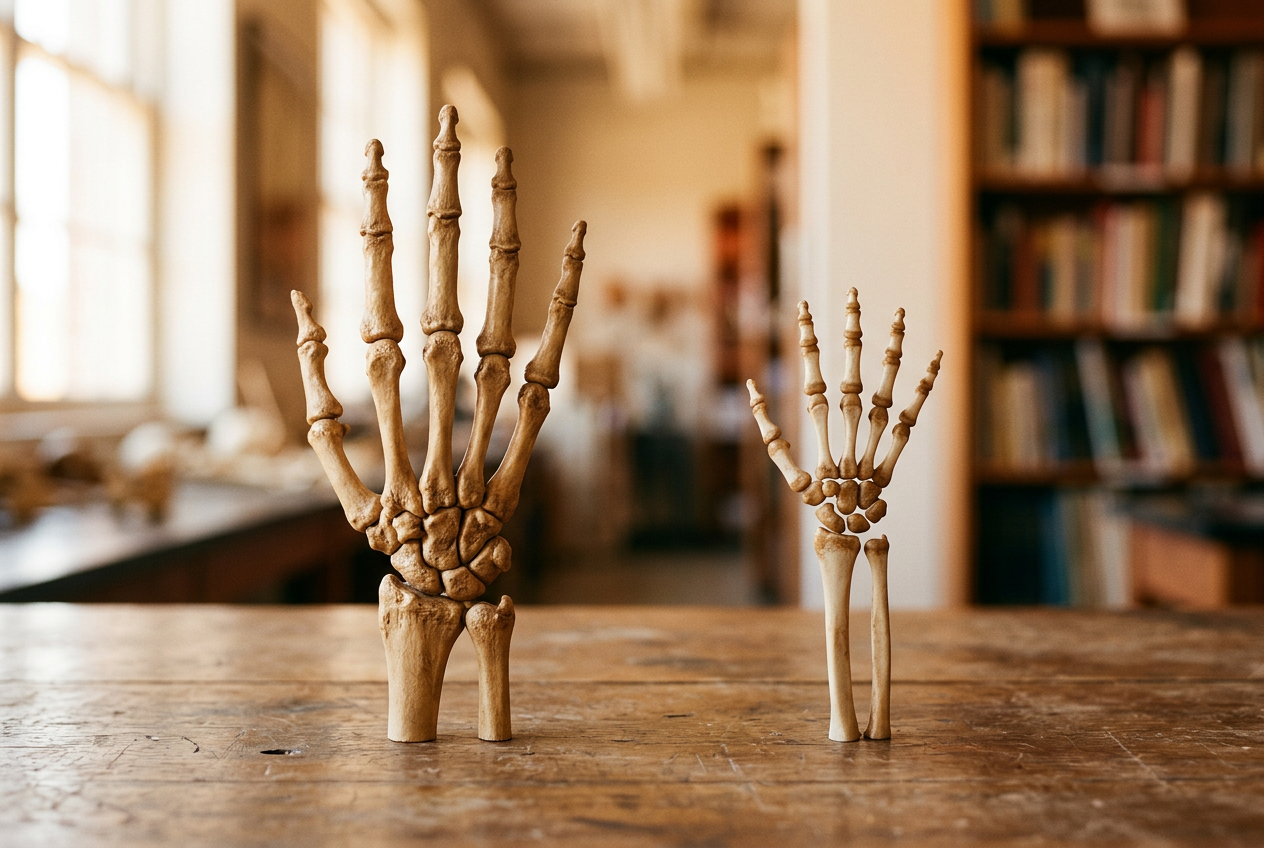
What body part do humans have approximately 270 of at birth but only 206 of as adults?
- Bones
- Teeth
- Muscle groups
- Nerve bundles
Answer: Bones — A newborn's skeleton is mostly cartilage, and many bones are still in pieces—your kneecap, for instance, doesn't fully harden until you're three or four. The skull alone starts as 45 separate plates that slide over each other during birth, then knit together over the first two years. By the time you're in your twenties, dozens of those childhood bones have fused into single, weight-bearing structures, leaving you with the 206 bones you'll carry for the rest of your life—and explaining why toddlers bounce back from falls that would sideline an adult.
A Skeleton Built in Stages
When a baby is born, its skeleton is less a finished framework than a work in progress. Roughly 270 bones—or bone-like structures—are present, but many are still cartilage, the rubbery tissue that will harden into bone over months or years. The skull is the most dramatic example: 45 separate plates allow the head to compress as it squeezes through the birth canal, then slowly fuse into the 22 bones of the adult skull. The fontanelles, or soft spots, remain open for 12 to 18 months to accommodate the brain's explosive early growth.
The spine tells a similar story. Newborns have 33 separate vertebrae, but by adulthood the five sacral vertebrae merge into the sacrum and the four coccygeal vertebrae become the coccyx, leaving 26 distinct bones. The pelvis begins as three separate bones on each side—the ilium, ischium, and pubis—that fuse completely around age 25. Even the kneecap doesn't fully ossify until a child reaches three to five years old, existing initially as pure cartilage.
The Chemistry of Ossification
The transformation from 270 infant bones to 206 adult bones happens through ossification, a process discovered in detail by French surgeon Henri-Louis Duhamel du Monceau in 1742 using madder root dye to track bone growth in chickens. Osteoblasts, specialized cells discovered by German anatomist Franz von Leydig in 1857, deposit calcium phosphate and collagen into the cartilage matrix at rates varying by bone and individual. The process follows predictable timelines that forensic anthropologists use to estimate age at death in juvenile remains.
Hormones orchestrate the timing. Growth hormone from the pituitary gland drives cartilage expansion at growth plates, while thyroid hormones regulate the pace of ossification itself. Sex hormones—estrogen and testosterone—eventually trigger the final fusion of growth plates, typically between ages 14 and 18 in girls and 16 and 21 in boys. This is why childhood malnutrition or hormonal disorders can permanently affect adult height, as damaged growth plates may close prematurely or remain open too long.
When Fusion Goes Wrong
Craniosynostosis, the premature fusion of skull bones, affects one in 2,500 births and requires surgical intervention to prevent brain damage and vision problems. The condition was first successfully treated by American neurosurgeon Harvey Cushing in 1918, though modern techniques using endoscopic tools have reduced surgery time from eight hours to under two hours. Left untreated, the fused plates create distinctive head shapes—scaphocephaly from sagittal suture fusion, trigonocephaly from metopic fusion—that 19th-century physicians mistakenly attributed to moral deficiency.
Conversely, delayed ossification presents its own challenges. Cleidocranial dysplasia, caused by CBFA1 gene mutations identified in 1997, prevents collarbone formation and delays skull fusion, sometimes leaving fontanelles open into adulthood. Olympic gymnast Simone Biles has hypermobile joints partly due to slower skeletal maturation, demonstrating how variation in fusion timing creates both athletic advantages and injury risks. Vitamin D deficiency rickets, once endemic in industrial cities with coal smoke blocking sunlight, still affects 250 million children globally, bowing leg bones that should have hardened by age two.
Modern Medicine's Bone Count Debates
Today's 206-bone standard, established by Belgian anatomist Andreas Vesalius in 1543 and refined in Gray's Anatomy (1858), remains surprisingly controversial. Some anatomists count 208 bones by separating the sternum's xiphoid process and manubrium as distinct structures. Others argue for 212 by counting all sesamoid bones—small bones embedded in tendons—though only the patella appears universally. The hyoid bone in the throat stands alone, unconnected to any other bone, a fact that makes it crucial in forensic investigations of strangulation.
Bone biology now drives regenerative medicine. In 2023, researchers at UC San Diego grew replacement jaw bones using a patient's own stem cells and a 3D-printed scaffold that mimicked fetal cartilage templates. Space agencies study astronaut bone loss—1 to 2 percent of mass monthly in zero gravity—to design countermeasures for Mars missions, where weakened skeletons could snap under the return to gravity. The newborn's 270 bones, once merely a curiosity, now offer a blueprint for healing adult fractures by reactivating the ossification processes that built our skeletons in the first place.
What most people get wrong
Most people assume the difference is simply that children have smaller bones. In fact, infants have *more* bones, not fewer; the reduction to 206 happens because dozens of separate childhood bones fuse together as cartilage hardens into solid bone.
Sources & further reading
Word of the Day
contiguous adjective · kuhn-TIG-yoo-us
Sharing a common border; touching along a boundary. From the Latin *contingere* (to touch), the word originally described physical contact between territories or objects, though it now extends to any unbroken sequence in space or time.
“The 48 contiguous states stretch from the Atlantic to the Pacific, while Alaska and Hawaii remain geographically separate. In a different sense, her memories of that summer were not contiguous—whole weeks had vanished, leaving only scattered images.”
Joke of the Day
Why did the newborn refuse to play Jenga with the pediatrician?
It had too many pieces to keep track of already.
This Day in History
1923 — On November 8, 1923, Adolf Hitler and the Nazi Party launched the Beer Hall Putsch in Munich, attempting to overthrow the Weimar government by force. Hitler stormed a crowded beer hall with 600 storm troopers, declared a national revolution, and briefly took local officials hostage. The coup collapsed the next day when police opened fire on a Nazi march through the city, killing 16 and forcing Hitler to flee. He was arrested two days later, convicted of treason, and sentenced to five years in Landsberg Prison—where he spent nine months writing *Mein Kampf*, the manifesto that would define the ideology of the Third Reich. The failed putsch transformed Hitler from a regional agitator into a national figure, and the lenient sentence allowed him to regroup and pursue power through elections instead of insurrection.
Enjoyed this issue?
Get the next one free, every morning.
More from Words IQ