Monday, November 9, 2026
A Spanish coin circulated as American currency—which symbol?
By Corey Lewis · Editorial standards
Trivia of the Day
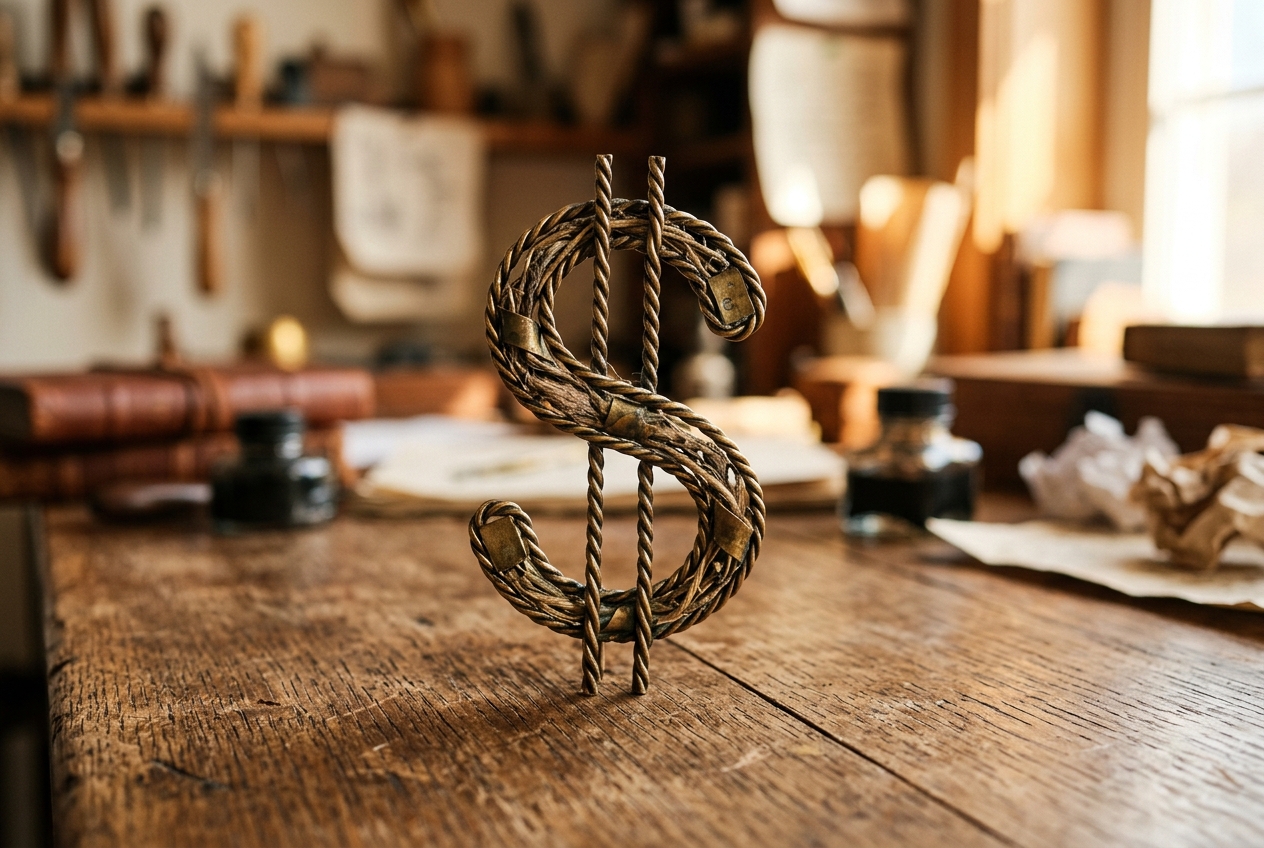
Which currency symbol may have originated from Spanish pieces of eight?
- the pound sterling sign
- the dollar sign
- the cent sign
- the florin symbol
Answer: the dollar sign — The dollar sign ($) likely evolved from the Spanish peso symbol 'P' superimposed with 'S', representing pieces of eight that circulated widely in early America. Spanish silver pesos were legal tender in the United States until 1857, decades after independence, and the typographic shorthand for this ubiquitous coin became the foundation of modern commerce. Today that symbol marks more than thirty currencies worldwide, from the Canadian dollar to the Singapore dollar, all traced back to Spanish colonial trade.
The Silver Standard of the New World
Spanish pieces of eight—formally reales de a ocho, or eight-real coins—dominated Atlantic commerce from the 1500s through the early 1800s. Minted in vast quantities at colonial facilities in Mexico City, Lima, and Potosí, these silver coins became the de facto currency of the Americas, circulating freely in British, French, and Dutch territories where official coinage was scarce. Each piece of eight could be physically cut into eight wedges, or bits, to make change; two bits equaled a quarter of a dollar, a term that survives in American slang today. The coin's reliability and uniform weight made it more trusted than many European issues, and merchants from Boston to Buenos Aires priced goods in Spanish dollars long before any nation called itself the United States. By the time the Continental Congress began discussing a national currency in the 1780s, the Spanish dollar was already the measuring stick of value across the hemisphere, and the fledgling republic had no practical alternative but to adopt its weight and decimal structure. The Coinage Act of 1792 explicitly defined the new U.S. dollar as equivalent in weight to the Spanish milled dollar, cementing a monetary link that would shape global finance for centuries.
From Peso to Glyph
The evolution of the dollar sign remains contested, but the most credible theory traces it to colonial bookkeepers' shorthand for pesos. Eighteenth-century merchants wrote 'P' with a superscript 'S' to denote pesos, and as quill strokes blurred in haste, the letters merged into a single glyph. Some ledgers from the 1770s show a 'P' with two vertical lines through the loop, others a simple 'S' with one or two bars, but all descend from the same Spanish abbreviation. An alternative hypothesis points to the Pillars of Hercules on the Spanish coat of arms, depicted as two columns wrapped in a banner bearing the motto Plus Ultra; the columns and ribbon supposedly inspired the '$' form. Yet this explanation lacks documentary support, and no Spanish documents of the era use such a symbol. What is certain is that by the 1790s, American account books routinely employed a mark resembling the modern dollar sign, and early printed bills from the Bank of the United States feature it prominently. The glyph's simplicity and distinctiveness made it ideal for typesetting, and as the U.S. dollar gained international standing in the nineteenth century, the symbol followed, embedding itself in typewriter keyboards, printing presses, and eventually computer character sets worldwide.
The Coin That Wouldn't Die
Spanish dollars remained legal tender in the United States until the Act of February 21, 1857, a full seventy years after the Constitution was ratified. The reason was pragmatic: the U.S. Mint could not produce enough coins to meet demand, and Spanish silver was abundant, trusted, and universally accepted. During the Revolutionary War, the Continental Army paid soldiers in Spanish dollars; the Continental currency collapsed into worthlessness, but the foreign coins held their value. Even after the Philadelphia Mint began operations in 1792, its output was modest, and Spanish pieces of eight continued to dominate daily transactions. In some states, particularly in the South and West, Spanish dollars circulated well into the 1850s, and it was not uncommon for a merchant in New Orleans or San Francisco to accept a Mexican or Peruvian piece of eight as readily as a U.S.-minted coin. The 1857 ban forced Americans to exchange their foreign coins for domestic currency, but by then the dollar sign had so thoroughly colonized the national imagination that its Spanish origins were already fading into obscurity. The symbol had become American property, and its ancestry was a curiosity rather than a controversy.
The Global Inheritance
Today more than thirty countries use currencies named 'dollar,' from Australia to Zimbabwe, and nearly all employ the '$' symbol inherited from Spanish colonial trade. The peso itself survives in eight Latin American nations, still marked by the same glyph that crossed the Atlantic in the sixteenth century. When Hong Kong adopted its dollar in 1863, it borrowed both the name and the symbol from the Spanish-Mexican coins that had circulated in Canton for generations; the same pattern repeated in Malaya, Sarawak, and British North Borneo. The dollar sign even appears in non-dollar contexts: the cifrão, a double-barred variant, marks the former Portuguese escudo and the current Brazilian real. ASCII encoded the symbol at position 36 in 1963, ensuring its place in every computer system built since, and Unicode preserves multiple variants, including the single-stroke and double-stroke forms. The Spanish Empire dissolved, its coinage melted down or locked in museums, but the typographic ghost of the piece of eight endures on every price tag, every invoice, every stock ticker. It is a monument to the power of commerce to outlast conquest, and to the strange durability of symbols born from expedience rather than design.
What most people get wrong
Many believe the dollar sign was invented by the United States Mint or derived from the initials 'U.S.' In fact, the symbol predates American independence and comes from Spanish colonial currency that circulated for decades as legal U.S. tender.
Word of the Day
grandiloquent adjective · gran-DIL-uh-kwent
Pompous or extravagant in language, style, or manner, especially in a way that is intended to impress. From Latin grandiloquus, literally 'grand-speaking,' combining grandis (grand) with loqui (to speak), the word entered English in the late sixteenth century to describe speech that aimed for majesty but often landed in bombast.
“The senator's grandiloquent speech, full of classical allusions and three-syllable synonyms, left the town hall audience more confused than inspired. His opponent simply said, 'I'll fix the roads,' and won by twenty points.”
Joke of the Day
Why did the Spanish peso refuse to retire after 1857?
It had too much change left in it.
This Day in History
1989 — The Berlin Wall fell on November 9, 1989, as East German officials announced that citizens could cross the border freely. Confused border guards, overwhelmed by crowds and lacking clear orders, opened the checkpoints at Bornholmer Strasse shortly before midnight, and jubilant Berliners from both sides swarmed through, many climbing atop the concrete barrier to celebrate. The structure had divided the city since August 1961, a stark Cold War symbol that claimed at least 140 lives among those who tried to escape. Within weeks, sledgehammers and cranes dismantled whole sections, and by October 1990 Germany was reunified under a single government. The event marked the symbolic end of Soviet dominance in Eastern Europe and accelerated the collapse of communist regimes across the continent.
Enjoyed this issue?
Get the next one free, every morning.
More from Words IQ