Tuesday, November 10, 2026
It consumes a fifth of every breath you take—what is it?
By Corey Lewis · Editorial standards
Trivia of the Day
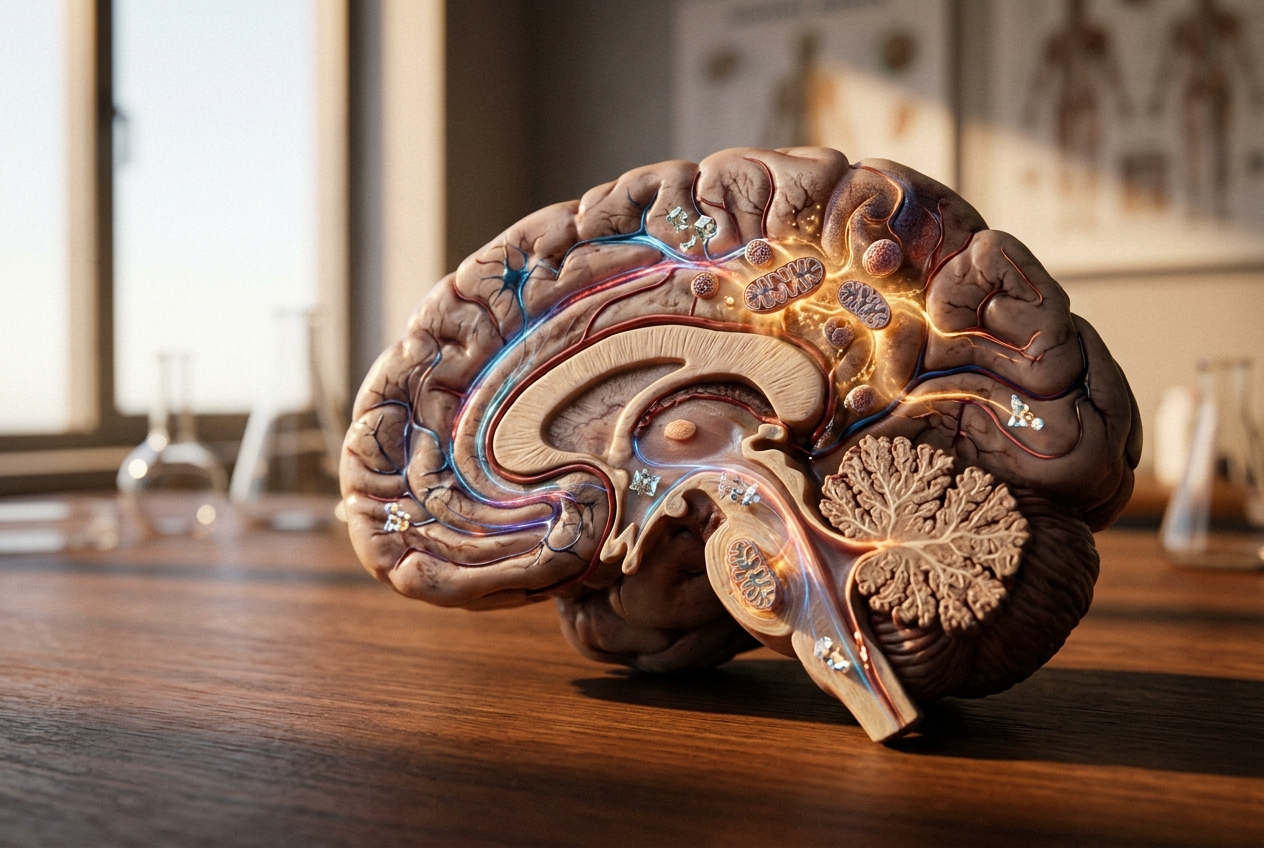
What uses 20% of your body's energy but accounts for only 2% of its weight?
- the human heart
- the human liver
- the human brain
- the human kidneys
Answer: the human brain — The human brain burns through roughly 320 calories daily just to keep itself running—more than a Big Mac's worth of energy spent on thinking, remembering, and keeping you alive, even though it weighs only about three pounds. That metabolic cost is why evolution kept our brains relatively small: a larger brain would demand so much fuel that early humans couldn't forage enough food to support it. The brain's energy budget explains why deep thinking feels exhausting and why glucose drops during intense mental work—your neurons are literally burning sugar as fast as your muscles do during a jog.
The Most Expensive Organ You Own
The human brain weighs roughly 1.4 kilograms in adults—about 2% of total body mass—yet it commands 20% of the body's resting energy expenditure, a proportion unmatched by any other organ. That energy, delivered as glucose and oxygen through a dense network of blood vessels, fuels roughly 86 billion neurons and an even greater number of glial support cells. Each neuron maintains an electrical charge across its membrane, ready to fire signals at a moment's notice, and that readiness costs energy even when the cell isn't actively transmitting. The brain consumes about 0.1 calories per minute at rest, adding up to 320 to 450 calories over a full day depending on body size and metabolic rate. During cognitively demanding tasks—solving a math problem, learning a new language, or navigating an unfamiliar city—glucose uptake in active brain regions can spike by 50%, though the whole-brain increase remains modest because only a fraction of neurons participate in any given task. The cost is so high that human infants devote more than 60% of their resting metabolism to brain function, a figure that drops to the adult ratio only around age ten as body mass catches up.
Evolution shaped the brain's energy appetite through a relentless trade-off: bigger brains confer survival advantages—better problem-solving, social cooperation, tool use—but they also require more calories, which early humans had to extract from an unpredictable environment. Anthropologists call this the expensive-tissue hypothesis, first articulated by Leslie Aiello and Peter Wheeler in 1995. The hypothesis notes that humans have relatively small guts for a primate of our size, a concession that freed up metabolic budget for a larger brain; cooking food, which began at least 800,000 years ago, made nutrients more bioavailable and further reduced digestive costs. Comparisons across species bear this out: the human brain accounts for 20% of resting metabolism, while a chimpanzee brain uses only 8% and a mouse brain about 8% as well, despite wide variation in absolute brain size. The constraint is so tight that in human populations facing chronic malnutrition, children's brain growth takes priority over body growth, sometimes at the cost of stunted height. The brain's metabolic demand also explains why it is exquisitely sensitive to drops in blood glucose: a fall of just 20% can impair attention and memory, and prolonged hypoglycemia causes unconsciousness within minutes.
How the Brain Spends Its Budget
The largest single expense in the brain's energy ledger is not conscious thought but the maintenance of the resting potential in neurons—the voltage difference across the cell membrane that keeps each neuron primed to fire. Sodium and potassium ions constantly leak through the membrane, and pumps powered by ATP actively shuttle them back to maintain the gradient. This housekeeping consumes an estimated 20 to 50% of the brain's total energy, even during sleep. Another major cost is synaptic transmission: when a neuron fires, neurotransmitters are released, receptors are activated, and the postsynaptic cell must reset its ion balance, all of which require ATP. Glial cells, especially astrocytes, also burn significant glucose as they recycle neurotransmitters, regulate blood flow, and support the myelin sheaths that insulate axons. Myelin itself is metabolically expensive to produce but reduces the energy cost of long-distance signaling by allowing action potentials to jump between nodes rather than propagate continuously.
Measurements using positron emission tomography and functional MRI show that the brain's energy consumption is remarkably uniform across different mental states. A person solving calculus problems uses only about 5% more glucose in the prefrontal cortex than someone daydreaming, because the baseline energy cost—keeping neurons ready and synapses maintained—is so high that incremental activity barely registers. This is why
What most people get wrong
Most people believe that the brain uses significantly more energy when you're thinking hard or learning something new, assuming mental exertion burns calories the way physical exercise does. In reality, cognitively demanding tasks increase the brain's energy consumption by only about 5% above its already-high baseline, because the vast majority of its energy goes toward maintaining resting potentials in neurons and recycling neurotransmitters—work that continues around the clock whether you're solving equations or staring into space.
Sources & further reading
Word of the Day
protean adjective · PROH-tee-uhn
Displaying great diversity or variety; capable of assuming many forms, like the shape-shifting sea god Proteus in Greek mythology who could transform himself into any creature or element to evade capture. The word entered English in the late sixteenth century directly from Proteus, the prophetic old man of the sea who tended Poseidon's seals and would answer questions only if held fast through all his transformations.
“The actor's protean talent allowed him to vanish into roles as varied as a stuttering monarch, a wisecracking detective, and a tormented physicist, each performance unrecognizable from the last.”
Joke of the Day
Why did the neuroscientist refuse to argue about whether thinking burns extra calories?
Because the brain uses 20% of your energy no matter what, so technically every argument costs the same.
This Day in History
1975 — The bulk carrier SS Edmund Fitzgerald sank in a Lake Superior storm on November 10, 1975, taking all 29 crew members with her in one of the most famous maritime disasters in Great Lakes history. The 729-foot ore carrier, carrying 26,116 tons of taconite pellets from Superior, Wisconsin to Detroit, went down in waves exceeding 25 feet and winds over 60 miles per hour, breaking in two and plunging 530 feet to the lake bed. No distress call was ever received; the ship simply vanished from radar seventeen miles from the entrance to Whitefish Bay. The loss inspired Gordon Lightfoot's ballad "The Wreck of the Edmund Fitzgerald" in 1976 and prompted changes to Great Lakes shipping regulations, including requirements for better survival suits and updated load-line regulations limiting how deep a vessel could sit in the water during storm season.
Enjoyed this issue?
Get the next one free, every morning.
More from Words IQ