Thursday, November 5, 2026
Minutes after Eagle touched down, one crew member did this
By Corey Lewis · Editorial standards
Trivia of the Day
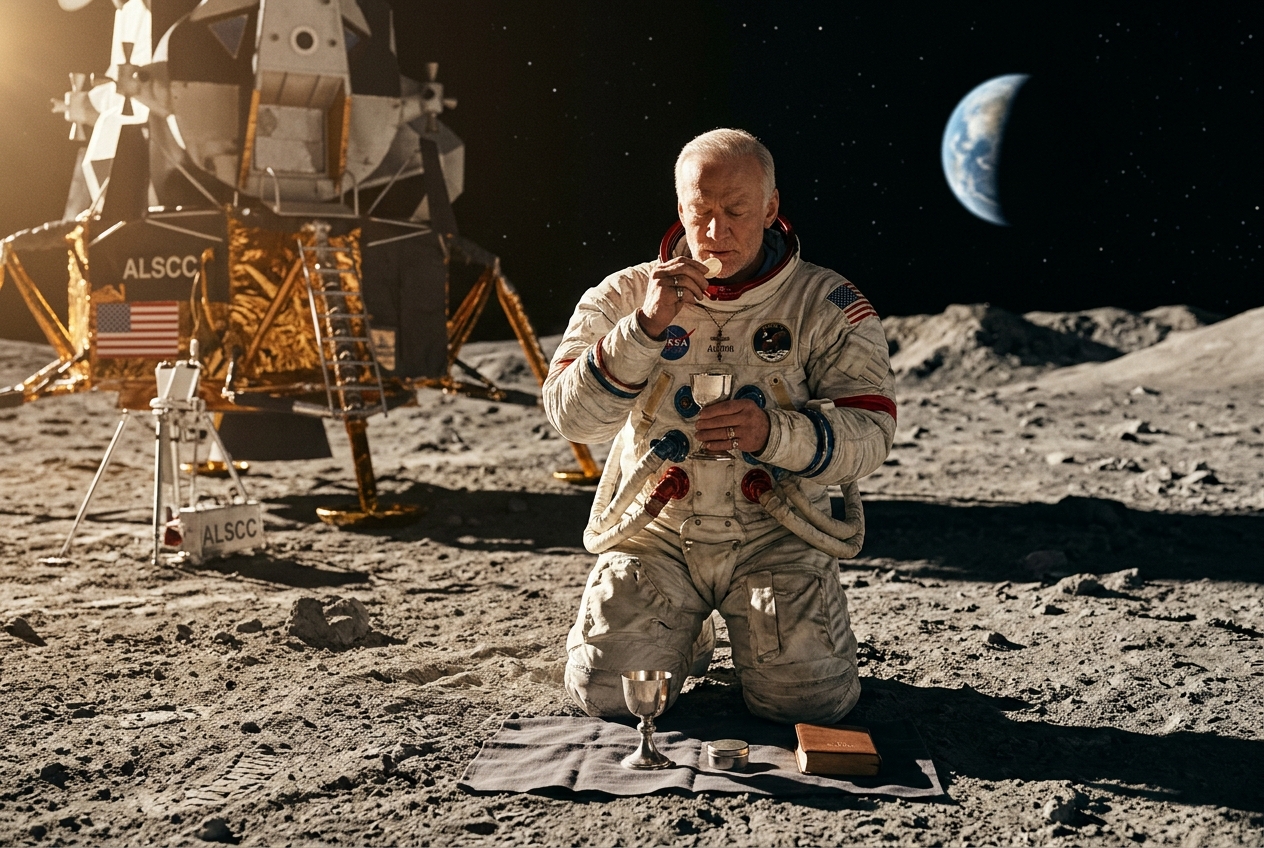
Which religious ritual did Buzz Aldrin perform on the lunar surface shortly after the Eagle landed, making it the first such ceremony on another world?
- A silent Buddhist meditation
- Astronaut Buzz Aldrin's communion on the Moon
- A Jewish Kiddush blessing
- A Muslim call to prayer
Answer: Astronaut Buzz Aldrin's communion on the Moon — Buzz Aldrin took communion on the Moon in July 1969, using a chalice and wine provided by his Presbyterian church in Houston. He waited until after Neil Armstrong's first words to Earth, then privately consumed the bread and wine in the lunar module while Armstrong watched in respectful silence. NASA had asked him not to broadcast the ceremony after a lawsuit over the Apollo 8 crew reading Genesis in orbit, so the moment remained largely unknown to the public for decades. It matters because it captures the collision of the spiritual and technological at humanity's highest achievement—a Texas elder's silver chalice sitting on a metal table 238,900 miles from Earth.
The chalice that flew to Tranquility Base
Buzz Aldrin packed a tiny communion kit in his personal preference kit before Apollo 11 launched on July 16, 1969. Webster Presbyterian Church in Webster, Texas, near the Johnson Space Center, had given him a silver chalice barely larger than a shot glass, a small vial of wine, and a wafer sealed in plastic. Aldrin was an elder at Webster Presbyterian and had received permission from Dean Woodruff, the pastor, to carry the elements into space. The entire kit weighed less than an ounce. NASA approved it as a morale item, the same category that let Armstrong bring a piece of wood from the Wright brothers' 1903 Flyer. Aldrin did not tell the press or mission control what he planned to do with it.
On July 20, 1969, the Eagle lunar module touched down at 4:17 p.m. Eastern time in the Sea of Tranquility. Armstrong radioed "The Eagle has landed," and mission control told the crew to stay put for a scheduled rest period before the moonwalk. Aldrin asked for a few moments of silence. He pulled out the communion kit, poured the wine into the chalice, and read from the Gospel of John: "I am the vine, you are the branches. Whoever remains in me, and I in him, will bear much fruit." He ate the wafer and drank the wine while Armstrong, not religious, watched without participating. In the Moon's one-sixth gravity, the wine curled slowly up the side of the chalice in a thick arc instead of splashing. Aldrin later said he wondered if he was committing sacrilege by performing communion in a place God had not explicitly blessed, then decided that the whole universe was God's creation.
Why NASA kept it quiet
Aldrin had wanted to broadcast the ceremony live to Earth, but NASA's public affairs office told him no. Six months earlier, the Apollo 8 crew had read the first ten verses of Genesis while orbiting the Moon on Christmas Eve 1968, and atheist activist Madalyn Murray O'Hair sued NASA for violating the First Amendment's establishment clause. Her lawsuit was eventually dismissed, but NASA's lawyers were nervous. They told Aldrin he could take communion if he wanted, but not on the air. So Aldrin performed the ceremony during a scheduled radio blackout while Armstrong and the flight controllers stayed silent. Aldrin did not mention it in his initial post-flight debriefings. He wrote about it briefly in a 1970 article for Guideposts magazine, but the story did not become widely known until he published his memoir "Magnificent Desolation" in 2009. Webster Presbyterian still uses the same chalice for communion services every July 20.
The theological argument Aldrin didn't expect
Some Christians objected once the story became public. They argued that communion requires a congregation, not a solitary communicant, and that Aldrin lacked the authority to consecrate the elements without an ordained minister present. Others pointed out that the Moon had no atmosphere, no water, and no living things, so it was not part of the "very good" creation described in Genesis—maybe it was spiritually neutral ground, outside the covenant. Aldrin was surprised by the criticism. He had assumed the act would be universally welcomed as a sign of faith. Dean Woodruff, his pastor, defended him, saying that an elder in the Presbyterian tradition could lead communion in extraordinary circumstances, and landing on the Moon qualified. The Vatican's newspaper, L'Osservatore Romano, praised the gesture as a reminder that human achievement depended on divine grace, though it did not weigh in on the validity question.
Why it still matters half a century later
Webster Presbyterian Church has loaned the chalice to the Museum of the Bible in Washington, D.C., where it sits in a case next to a replica of the Apollo 11 command module. The congregation celebrates "Lunar Communion Sunday" every year on the Sunday closest to July 20, using the same chalice Aldrin used. NASA's current policies allow astronauts to practice their religion in space but discourage public religious ceremonies that might alienate international partners or non-religious crew members. The International Space Station has hosted a Jewish Passover Seder, Muslim Ramadan observances, and Christian Christmas services, all conducted privately. Aldrin's communion remains the only religious ritual known to have been performed on another celestial body. It matters because it reminds us that the astronauts who walked on the Moon were not just engineers and test pilots—they were human beings trying to make sense of an experience no one had ever had, and some of them reached for the oldest tools they knew.
What most people get wrong
Many people assume Aldrin's communion was a NASA-sponsored event or a public broadcast, but it was a private act that NASA specifically asked him not to mention on the radio because of legal concerns over the separation of church and state.
Sources & further reading
Word of the Day
exiguous adjective · ig-ZIG-yoo-us
Extremely scanty or meager; barely sufficient. From Latin *exiguus* meaning 'small, petty, short,' derived from *exigere* 'to drive out, demand, measure'—the same root that gives us 'exact.' It originally meant 'weighed out precisely' before narrowing to 'weighed out stingily.'
“Aldrin's communion kit was exiguous by design: a chalice smaller than a shot glass, one wafer, one vial of wine—the minimum needed for the sacrament, calculated to survive launch and vacuum. Later, Antarctic explorers would pack exiguous rations for weight, only to find that hunger makes every gram feel like theft.”
Joke of the Day
Why did the Apollo 11 flight surgeon refuse to pack snacks for the lunar module?
He figured communion wafers didn't count as meal replacement.
This Day in History
1872 — Susan B. Anthony was arrested in Rochester, New York, for voting in the presidential election two days earlier. She had registered under a new interpretation of the Fourteenth Amendment, arguing that its citizenship clause implicitly granted women the right to vote. Federal agents detained her at her home on Madison Street, and she was later tried and fined one hundred dollars, which she refused to pay. The judge did not jail her for contempt, knowing it would let her appeal to the Supreme Court, so the case never went further—but her act became a rallying cry for suffragists and helped set the stage for the Nineteenth Amendment forty-eight years later.
Enjoyed this issue?
Get the next one free, every morning.
More from Words IQ