Thursday, October 22, 2026
3,400 miles of steel stretch across red desert—keeping what out?
By Corey Lewis · Editorial standards
Trivia of the Day
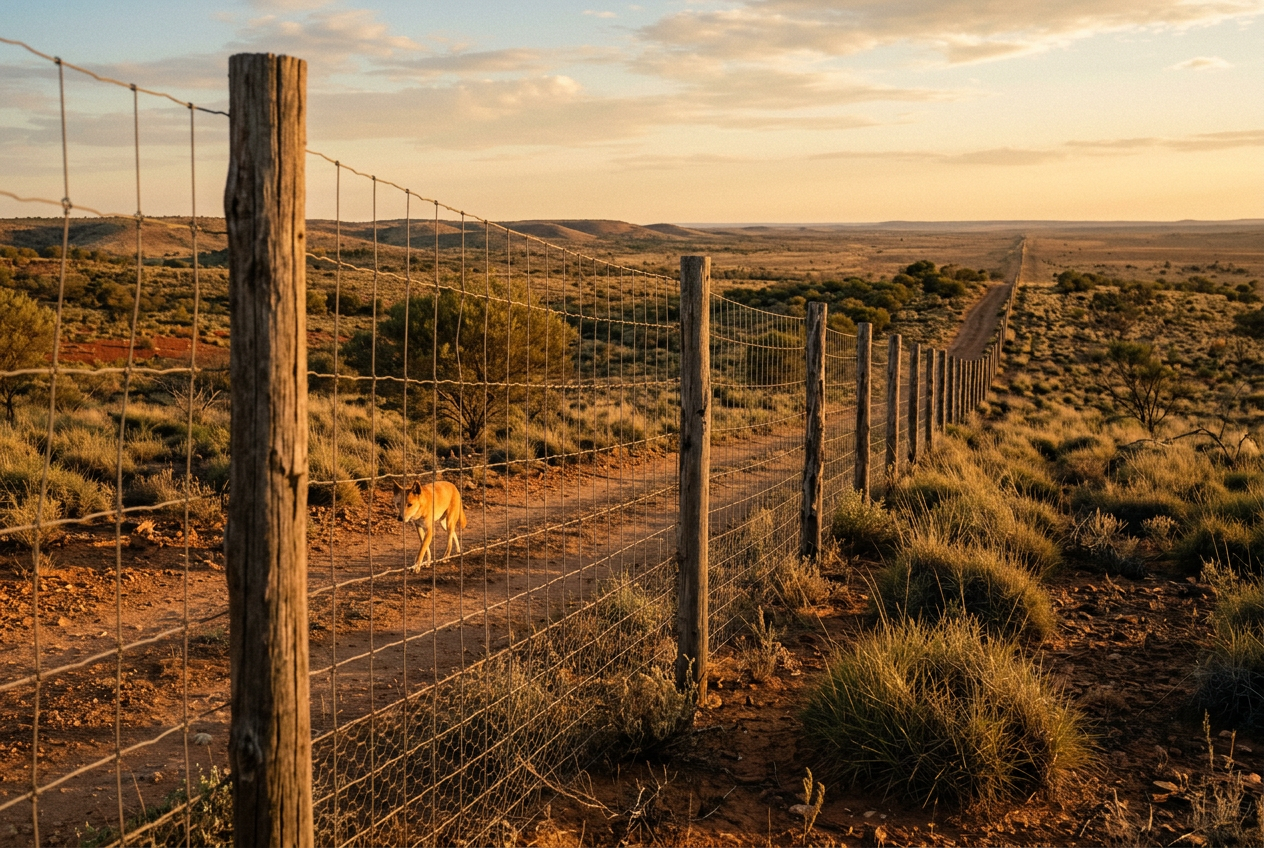
What is the longest fence in the world, stretching over 3,400 miles across Australia?
- The Great Wall of China
- Australia's dingo fence
- The US-Mexico border fence
- Norway's reindeer fence
Answer: Australia's dingo fence — The dingo fence in Australia is longer than the distance from New York to Los Angeles, built to keep dingoes away from fertile southeastern lands. At 3,488 miles, it's actually longer than the Great Wall of China's main sections combined, and it required constant patrols by boundary riders who lived in isolation stations spaced every 20 to 30 miles. The fence has created an accidental ecological experiment: sheep graze safely on one side while native wildlife populations differ dramatically on the other, making it one of the world's longest dividing lines between two ecosystems.
The Barrier That Crosses a Continent
The dingo fence—officially the Dog Fence—runs 3,488 miles across the Australian interior, slicing through Queensland, New South Wales, and South Australia. Built between 1880 and 1885, it was designed to protect the wool-producing sheep stations of southeastern Australia from wild dingoes migrating from the north and west. The fence replaced earlier barriers built by individual stations, and by the early 20th century it had been consolidated into a single continuous structure maintained by government boards. Standing six feet high and buried a foot underground to prevent digging, the fence uses wire mesh tight enough to stop a dingo but permeable to smaller animals. To put its scale in perspective, the barrier is roughly 500 miles longer than the distance between New York City and Los Angeles, and it dwarfs the continuous sections of the Great Wall of China. The fence traverses deserts, scrublands, and arid plains where summer temperatures regularly exceed 110°F, and maintaining it requires a small army of workers spread across one of the most desolate landscapes on Earth.
The Lonely Work of Boundary Riders
Patrolling the dingo fence became one of Australia's most isolated jobs. Boundary riders lived in small huts spaced 20 to 30 miles apart along the fence line, each responsible for inspecting and repairing their section on foot, horseback, or later by motorcycle. These workers checked for breaches caused by floods, fallen trees, kangaroo impacts, and burrowing animals, and they shot any dingoes found near the barrier. The job attracted loners and people fleeing city life, and some riders went weeks without seeing another human. Supply runs came by truck or camel train in the early years, and communication relied on radio sets that crackled through dust storms. One rider in the 1950s, Jack Murray, famously kept a diary documenting his encounters with feral camels, venomous snakes, and the occasional emu stampede. The work paid poorly but offered solitude and a kind of frontier independence that had vanished elsewhere in Australia. By the 1980s, motorcycles and four-wheel-drive vehicles replaced horses, and solar-powered electric fencing reduced the need for constant human patrols, but a small crew still inspects the fence regularly.
The Ecological Divide Nobody Planned
The dingo fence accidentally created one of the longest ecological experiments in the world. On the northern and western side, dingoes hunt kangaroos, rabbits, and other herbivores, keeping their populations in check. On the southeastern side, where dingoes are absent, kangaroo populations exploded, and vegetation suffered from overgrazing. Scientists comparing the two sides in the 1990s found that kangaroo density was up to 50 times higher on the dingo-free side, and the landscape showed less plant diversity and more soil erosion. The fence also trapped native species: emus and kangaroos sometimes die trying to cross, and smaller mammals like bilbies and bandicoots have declined on the dingo-free side because foxes and feral cats thrive without dingo competition. In 2016, researchers published a study showing that the fence had split two versions of the same ecosystem, each evolving differently over a century. Conservationists now debate whether sections of the fence should be removed to restore natural predator-prey balance, but sheep farmers resist, citing losses from dingo attacks that can reach thousands of dollars per station per year.
Why the Fence Still Matters
The dingo fence remains the longest continuous structure built for pest control, and it still protects Australia's $3 billion wool and sheep industry. In 2014, the Queensland government invested $3.5 million to upgrade sections with electric wiring and GPS-monitored sensors that alert rangers to breaches within hours. The fence has become a symbol of human attempts to engineer nature at continental scale, and it raises questions about the cost of such interventions. Some ecologists argue that the fence does more harm than good by disrupting wildlife migration and creating imbalanced ecosystems, while graziers insist it's essential to their survival. In recent years, tourists have begun visiting the fence, particularly the section near Coober Pedy in South Australia, where a small museum documents its history. The fence is also a reminder of Australia's harsh interior: a land so vast and unforgiving that the only way to control it was to draw a line across its heart and patrol it forever.
What most people get wrong
Many people assume the dingo fence is shorter than the Great Wall of China, but the dingo fence is actually longer than the Great Wall's main sections combined—and unlike the Great Wall, it remains a continuous working barrier maintained to this day.
Sources & further reading
Word of the Day
implacable adjective · im-PLAK-uh-buhl
Unable to be appeased, pacified, or satisfied; relentless and unyielding. From Latin *implacabilis* ('not able to be calmed'), the word entered English in the 15th century to describe enemies, forces, or emotions that refuse reconciliation or mercy.
“The dingo fence stands as an implacable barrier between predator and prey, neither side yielding after 140 years. The detective pursued the case with implacable determination, refusing to close the file even after the trail went cold for a decade.”
Joke of the Day
Why did the dingo fence refuse to work in customer service?
Because it was built to keep problems out, not resolve them.
This Day in History
1797 — The USS Constitution, the oldest commissioned warship still afloat, was launched in Boston Harbor on October 22, 1797. Designed by naval architect Joshua Humphreys, the frigate was built with live oak timber so dense it could deflect British cannonballs during the War of 1812, earning the nickname 'Old Ironsides.' The ship won 33 battles without a single defeat, and it remains a commissioned U.S. Navy vessel today, docked at the Charlestown Navy Yard in Massachusetts. Its survival into the 21st century makes it a floating monument to early American shipbuilding and naval power.
Enjoyed this issue?
Get the next one free, every morning.
More from Words IQ