Thursday, October 29, 2026
Two months after V-E Day, voters fired their wartime leader—who?
By Corey Lewis · Editorial standards
Trivia of the Day
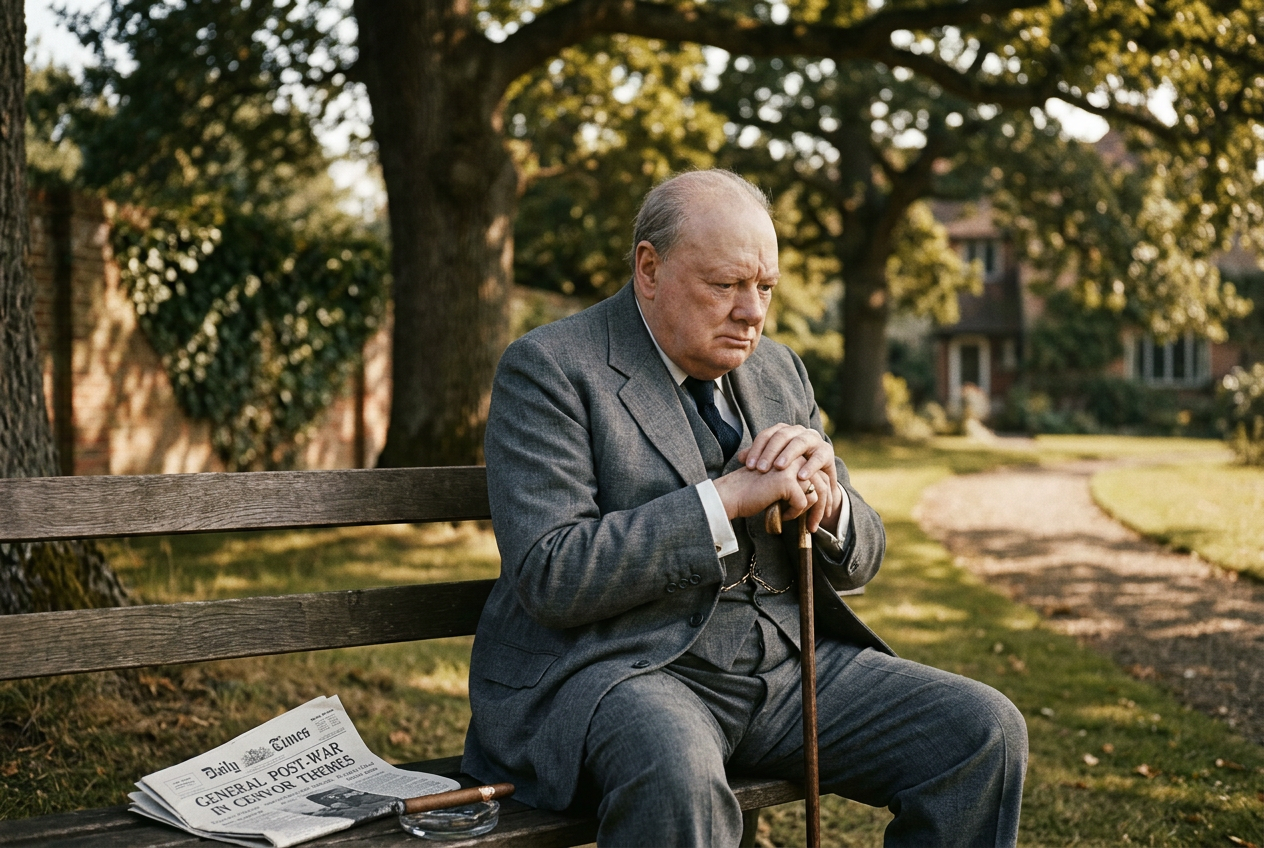
Who was voted out of office by British voters just two months after leading them to victory in World War II?
- Clement Attlee
- Winston Churchill
- Anthony Eden
- Harold Macmillan
Answer: Winston Churchill — Churchill's Conservative Party lost the July 1945 election in a landslide — Labour won 393 seats to the Conservatives' 213 — even though VE Day had been celebrated just two months earlier in May. Voters wanted domestic reform more than they wanted to honor wartime leadership, and Churchill himself called the result "an effective dismissal" after six years at the helm. The timing shocked the world: Franklin Roosevelt's successor Harry Truman, meeting Churchill at Potsdam in July, learned mid-conference that his negotiating partner had been replaced by Attlee, and Stalin reportedly asked if the election might be overturned.
The Landslide Nobody Expected
On July 26, 1945, Britain woke to news that stunned the Allied world: Winston Churchill, the man whose speeches had rallied a nation through the Blitz and whose strategy had helped topple Nazi Germany just eleven weeks earlier, had been voted out of office. The Labour Party, led by the mild-mannered Clement Attlee, won 393 seats in Parliament against the Conservatives' 213 — a margin so decisive that even Labour candidates were caught unprepared. Churchill had called the election for July 5, expecting gratitude for victory in Europe to translate into votes, but two million servicemen and women voting by mail from overseas tipped the balance. Those absentee ballots, counted three weeks after polls closed to allow time for ships to deliver them, revealed that the men and women who had fought the war wanted jobs, housing, and healthcare more than they wanted to toast their general. Churchill's wife Clementine told him the defeat might prove "a blessing in disguise," to which he replied, "At the moment it seems quite effectively disguised."
Britain in 1945 was exhausted, bombed-out, and nearly bankrupt. Six years of total war had killed 450,000 civilians and servicemen, flattened entire neighborhoods in London and Coventry, and left the Treasury so drained that the country would ration bread for the first time even after victory. Voters remembered the 1930s, when Conservative governments had presided over mass unemployment, means-tested relief, and the appeasement of Hitler at Munich in 1938. Labour's manifesto promised a National Health Service, full employment, nationalized utilities, and new council housing — a cradle-to-grave welfare state funded by progressive taxation. Churchill campaigned on his record as a war leader and warned, in a radio address that backfired spectacularly, that socialism would require "some form of Gestapo" to enforce. Attlee responded with quiet competence, and the electorate, which had expanded to include millions of women voting for the second time, chose the future over the past. Polling, still in its infancy, had missed the shift entirely; even Churchill's own seat in Woodford was contested, though he held it comfortably.
Potsdam and the Sudden Handover
The election result arrived while Churchill was in Potsdam, outside Berlin, negotiating the postwar order with Harry Truman and Joseph Stalin. Churchill had flown to Germany on July 15, settled into a villa overlooking a lake, and spent a week haggling over Poland's borders, German reparations, and the upcoming invasion of Japan. On July 25, he flew back to London for the ballot count, confident enough to bring Attlee along as an observer — Labour's leader sat in on the conference sessions as a courtesy, since a coalition government was still in place until the votes were tallied. When the results came in on July 26, Churchill tendered his resignation to King George VI that evening, and Attlee flew back to Potsdam the next day as Britain's new prime minister. Stalin, informed of the switch, reportedly asked whether the election might be annulled, unable to fathom a system in which a wartime leader could be dismissed by popular vote. Truman, who had been president for only three months himself after Roosevelt's death in April, found himself negotiating the shape of postwar Europe with a man he had barely met. The conference ended on August 2 with agreements on occupation zones, war crimes trials, and the Potsdam Declaration demanding Japan's unconditional surrender — all concluded under Attlee's signature, not Churchill's.
What the Voters Saw That Churchill Didn't
Churchill had assumed that his oratory, his bulldog tenacity, and his role in defeating Hitler would eclipse any doubts about his domestic record. He had not reckoned with the memory of Tonypandy in 1910, when as Home Secretary he sent troops to suppress striking Welsh miners, or his opposition to Indian independence, or his disastrous return to the gold standard as Chancellor in 1925, which deepened the Depression. Servicemen voting from barracks in Cairo and Hamburg had no nostalgia for prewar Britain; they wanted the egalitarianism they had experienced in the ranks extended to civilian life. Labour organizers had worked in factories, unions, and air-raid shelters throughout the war, building a grassroots network that the Conservatives, reliant on Churchill's charisma, had neglected. The Beveridge Report of 1942, a blueprint for universal social insurance written by a Liberal economist, had been endorsed by Labour and treated coolly by Churchill's coalition cabinet. Voters knew which party had blocked reform and which had championed it. Churchill's final campaign rally at Walthamstow drew 20,000 cheering supporters, but when the ballot boxes opened, two-thirds of them had voted Labour.
The Long Return and the Iron Curtain
Churchill spent six years in opposition, leading the Conservative Party from the backbenches and delivering some of the most consequential speeches of his life. In March 1946, in Fulton, Missouri, with Truman sitting behind him, he warned that an "iron curtain" had descended across Europe, a phrase that defined the Cold War before it had a name. He wrote his six-volume war memoirs, won the Nobel Prize for Literature in 1953, and painted oils at his country house in Kent, channeling his frustration into landscapes and still lifes. In 1951, with Britain still rationing meat and Labour's popularity fading, he returned to Downing Street at age 76, serving until 1955 when ill health forced his final retirement. He never quite forgave the electorate for 1945, though he admitted in private that Attlee's government had built the NHS and overseen Indian independence — outcomes Churchill opposed but which became permanent features of British life. His defeat in 1945 remains a paradox: the man who saved democracy was dismissed by it at the peak of his achievement, a reminder that voters judge leaders not only by what they have done, but by what they promise to do next.
What most people get wrong
Many believe Churchill was voted out because Britons were ungrateful for his wartime leadership, but the election turned on domestic policy — voters trusted Labour to build the welfare state they wanted, and Churchill's warnings about socialist "Gestapo" tactics backfired badly.
Sources & further reading
Word of the Day
vituperation noun · vye-TOO-per-AY-shun
Bitter, abusive criticism or censure; sustained verbal attack. From the Latin vituperare, 'to blame or find fault with,' itself from vitium (fault) and parare (to make ready) — literally, to prepare a catalog of faults. The word carries the weight of deliberate, almost ritualized condemnation.
“Churchill's campaign speech comparing Labour's platform to Gestapo tactics drew immediate vituperation from the press and likely cost him votes. In courtroom drama, the prosecutor's vituperation can alienate a jury if it veers from facts into personal assault.”
Joke of the Day
Why did the pollster refuse to attend Churchill's 1945 victory party?
The absentee ballots hadn't come in yet.
This Day in History
1929 — The New York Stock Exchange crashed on Black Tuesday, October 29, 1929, when panicked investors traded a record 16.4 million shares and the Dow Jones Industrial Average plummeted 12 percent in a single session. The crash followed a week of steep losses and wiped out billions in paper wealth, triggering bank failures, mass unemployment, and the onset of the Great Depression. Within three years, industrial production had fallen by half, one in four American workers was jobless, and shantytowns called Hoovervilles sprang up in city parks — a collapse whose effects reached every continent and set the stage for the political upheavals of the 1930s.
Enjoyed this issue?
Get the next one free, every morning.
More from Words IQ