Sunday, October 18, 2026
Rocks weighing 700 pounds slide across a California desert—leaving trails but no tracks
By Corey Lewis · Editorial standards
Trivia of the Day
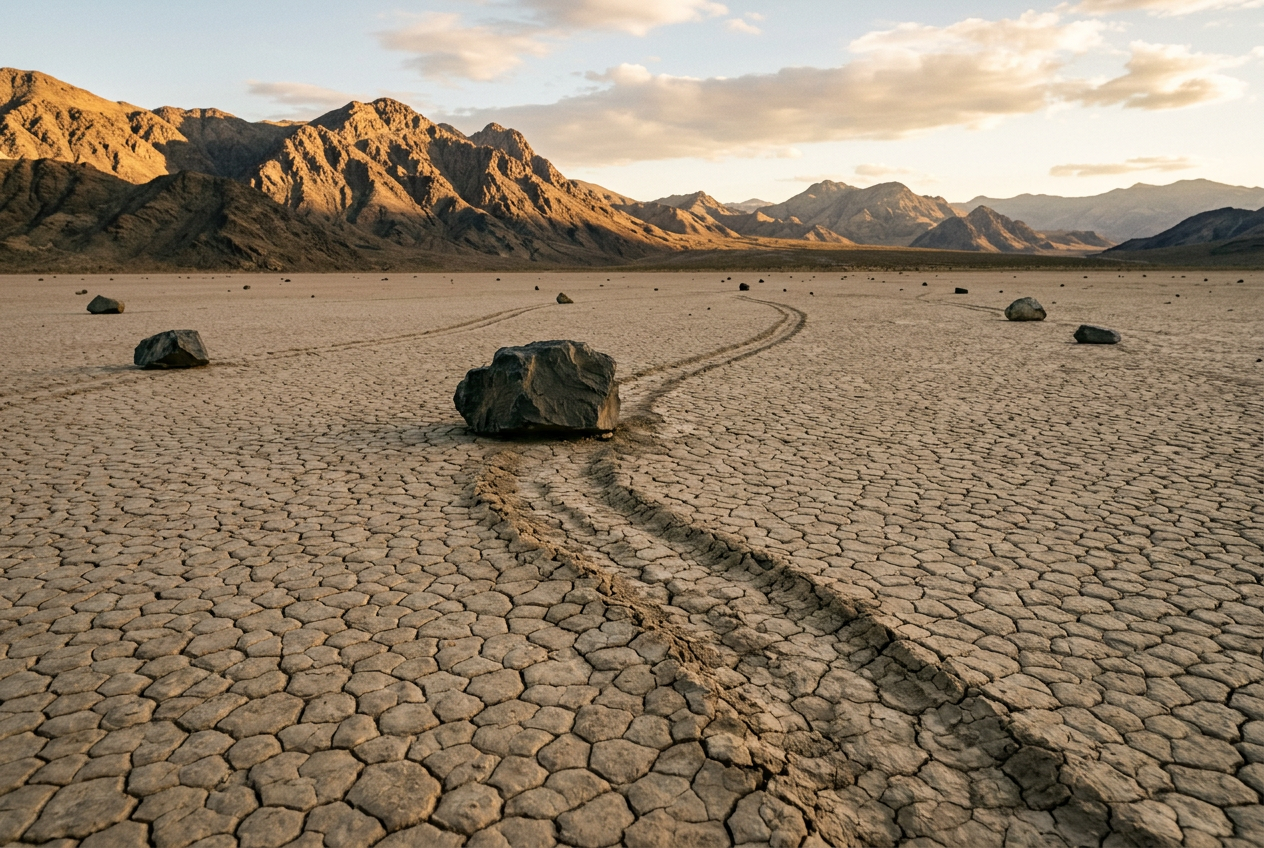
What California location features rocks that mysteriously move across the desert floor, leaving trails behind them?
- Racetrack Playa in Death Valley
- Badwater Basin in Death Valley
- Kelso Dunes in the Mojave
- Anza-Borrego Desert State Park
Answer: Racetrack Playa in Death Valley — At Racetrack Playa in Death Valley, rocks weighing up to 700 pounds glide across the desert floor on their own, leaving trails up to 1,500 feet long—a phenomenon that remained unexplained for nearly a century until scientists discovered it required a precise combination of thin winter ice, light wind, and morning sun. The rocks move only a few times per decade, and until 2014 no human had ever witnessed the movement in progress, making it one of geology's most enduring mysteries. The phenomenon matters because it demonstrates how rare environmental conditions can create effects that seem to defy physics, reminding us that some of nature's most dramatic processes happen too slowly or infrequently for humans to observe directly.
The Mystery That Stumped Geologists for a Century
Racetrack Playa sits in a remote corner of Death Valley National Park, a flat expanse of dried lakebed two miles long where rocks ranging from pebbles to 700-pound boulders leave perfectly straight trails across the cracked mud surface. The phenomenon was first documented in 1915, but for nearly a century no scientist could explain how stones moved across a flat surface with no footprints, tire tracks, or other signs of interference. The trails themselves stretched up to 1,500 feet, some in parallel lines suggesting multiple rocks moved simultaneously, others zigzagging as if the boulder had changed direction mid-journey. By the 1940s, geologists had proposed everything from magnetic fields to dust devils to pranksters with ropes, but none of the theories held up under scrutiny. The playa became a pilgrimage site for scientists and amateur sleuths alike, all trying to catch the rocks in motion. Park rangers reported finding fresh trails after winter storms, but the rocks themselves sat motionless at the end of their tracks, offering no clues about what force had pushed them there. The mystery deepened in the 1970s when researchers placed numbered stakes beside specific rocks and returned months later to find the stones had moved—but the stakes remained undisturbed, ruling out the theory that humans were dragging them as a hoax.
How Sailing Stones Actually Work
The answer finally came in 2014 when Richard Norris and James Norris, a pair of researchers from the Scripps Institution of Oceanography, installed time-lapse cameras and GPS tracking devices on 15 rocks at Racetrack Playa. On December 20, 2014, they witnessed the movement for the first time: a perfect alignment of rare conditions that occurs only a handful of times per decade. Winter rains must fill the playa with water several inches deep, then overnight temperatures must drop below freezing to form a thin sheet of ice across the lakebed. As the morning sun warms the ice, it begins to break into large floating panels, still thick enough to exert force but thin enough to move. A light wind of just 10 miles per hour pushes these ice panels across the slick mud surface, and the panels in turn shove any rocks embedded in them. The GPS data revealed rocks moved at speeds up to 15 feet per minute—glacially slow by human standards but fast enough to carve visible furrows in the soft playa surface. The process requires such specific conditions that the Norrises calculated it happens perhaps three to six times per century, explaining why no one had ever filmed it before. The rocks don't move far in a single event; the 1,500-foot trails accumulate over multiple winters, each ice-push adding another segment to the track.
The Human Detail Nobody Expects
When the Norrises finally captured video of the rocks moving in 2014, they weren't standing on the playa watching through binoculars—they were 50 miles away, checking weather data on a laptop. The GPS units they'd bolted to the rocks transmitted movement data in real time, but the researchers had deliberately stayed away to avoid disturbing the fragile surface. When the alerts came through that rocks were moving, Richard Norris drove frantically to the playa, arriving just as the ice was melting and the movement had stopped. He found himself standing in ankle-deep mud and water, surrounded by rocks that had just completed their mysterious journeys, but the spectacle itself was over. The anticlimax was profound: after a century of speculation and nine years of waiting with cameras running, the actual event was so subtle that a person standing on the playa might not even notice it happening. The rocks don't lurch or tumble; they glide almost imperceptibly, pushed by forces measured in ounces per square inch. Later analysis of the time-lapse footage showed the movement looked less like rocks sailing and more like a slow, surreal ballet played out across a frozen mud flat.
Why It Still Matters Today
The sailing stones of Racetrack Playa have become a case study in how scientists approach phenomena that happen too rarely or slowly for traditional observation methods. The solution required patience—cameras running for years—and technology that didn't exist when the mystery was first documented in 1915. The phenomenon also serves as a reminder that Earth still holds genuinely unexplained processes; it wasn't until the 21st century that humans understood something as visible and well-documented as rocks moving across open ground. Climate scientists now study the playa's ice dynamics as an analog for understanding how ice sheets interact with sediment in polar regions, processes that affect sea-level rise predictions. The site has also influenced planetary geology: similar trails have been photographed on Mars, and the Racetrack Playa mechanism offers a template for explaining them without invoking wind speeds or water depths that Mars couldn't sustain. Death Valley National Park now restricts access to the playa to preserve the fragile surface, a recognition that some natural wonders are best appreciated from a distance. The trails themselves can last for years before rain erodes them, meaning a visitor today might see tracks carved by a rock that moved during a storm in 2014—a physical record of an event witnessed by cameras but almost never by human eyes.
What most people get wrong
Most people assume the rocks move during violent windstorms or dust devils, but the phenomenon actually requires calm conditions: light breezes of just 10 mph pushing thin ice sheets, not gale-force winds acting directly on the stones.
Word of the Day
oleaginous adjective · oh-lee-AJ-in-us
Oily or greasy in texture or appearance; derived from the Latin 'oleum' meaning oil, the word has evolved to describe both literal slickness and figurative insincerity, especially when describing overly smooth or fawning behavior.
“The mechanic's hands were oleaginous after a morning spent rebuilding carburetors. In a different sense, the politician's oleaginous flattery made even his supporters uncomfortable—his praise felt less like admiration and more like calculation.”
Joke of the Day
Why did the geologist refuse to play poker at Racetrack Playa?
The rocks kept moving the chips when nobody was looking.
This Day in History
1867 — The United States formally took possession of Alaska from Russia in a ceremony at Sitka on October 18, 1867, completing the $7.2 million purchase that Secretary of State William Seward had negotiated six months earlier. Critics had mocked the acquisition as 'Seward's Folly' and 'Seward's Icebox,' dismissing the 586,000-square-mile territory as a frozen wasteland with no economic value. The discovery of gold in the Klondike in 1896 and vast oil reserves at Prudhoe Bay in 1968 would prove the skeptics spectacularly wrong, making the Alaska Purchase one of history's greatest real-estate bargains at roughly two cents per acre. The ceremony itself was notably awkward: Russian and American soldiers stood in formation as the Imperial Russian flag was lowered, but it snagged on the flagpole and had to be cut down with bayonets—an inauspicious start to American sovereignty that locals interpreted as a bad omen.
Enjoyed this issue?
Get the next one free, every morning.
More from Words IQ