Tuesday, November 3, 2026
After the British burned it, whose 6,487 books rebuilt this U.S. collection?
By Corey Lewis · Editorial standards
Trivia of the Day
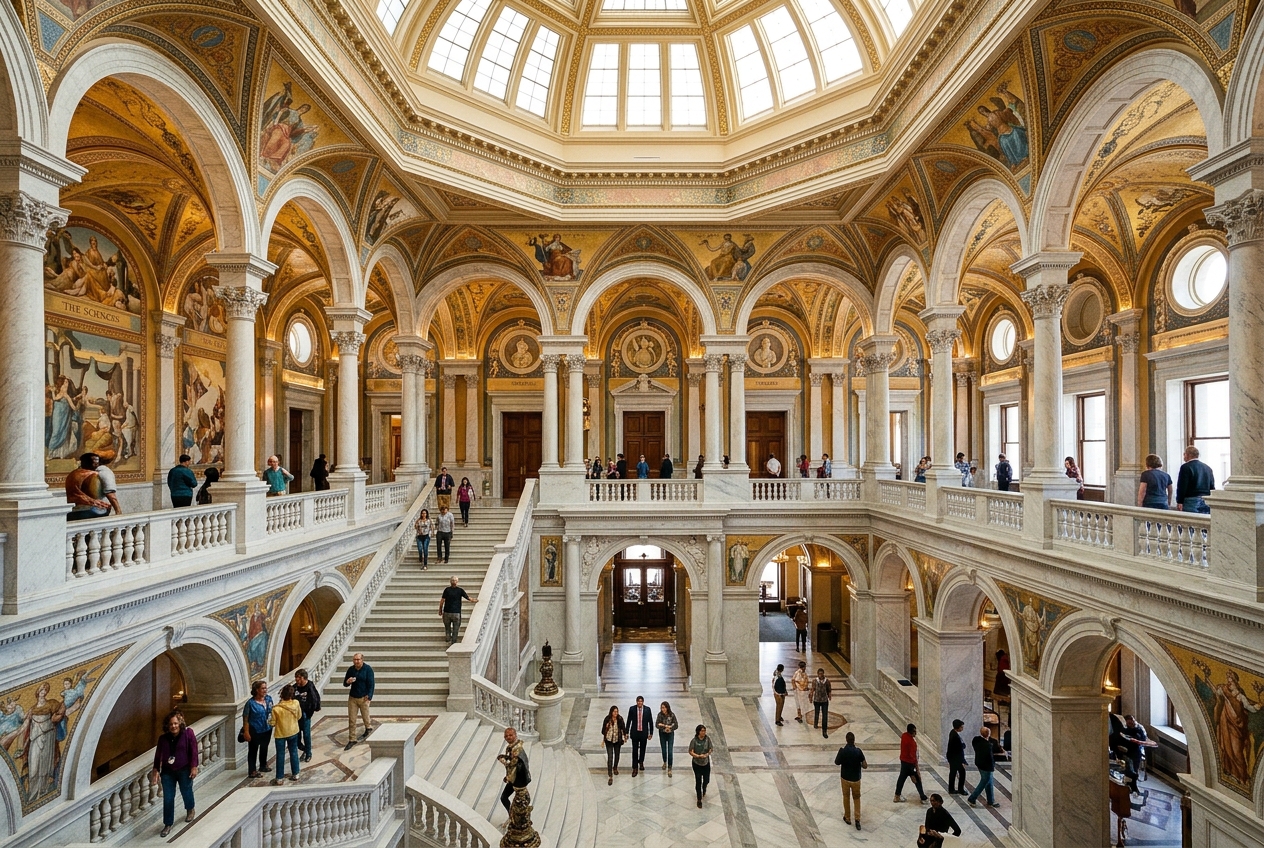
What U.S. institution was rebuilt from Thomas Jefferson's personal book collection after the British burned the original in 1814?
- the Smithsonian Institution
- the Library of Congress
- the National Archives
- the American Philosophical Society
Answer: the Library of Congress — Jefferson's library wasn't just big—it was radical. He organized his 6,487 volumes by Francis Bacon's three faculties of the mind (Memory, Reason, Imagination) rather than conventional library systems, and he insisted on including works in languages most Americans couldn't read, subjects considered scandalous, and even books arguing against Christianity. Congress paid him $23,950 for the entire collection in 1815, and that intellectual breadth—literature alongside science, philosophy next to cookbooks—set the template for what a national library should be: not a narrow reference desk, but a repository of human knowledge in all its messy, contradictory glory.
The Fire That Erased a Collection
On August 24, 1814, British forces marched into Washington and set fire to the Capitol building, destroying the 3,000-volume Library of Congress that had been assembled since 1800. The collection included legal texts, maps, and reference works gathered to serve members of Congress, but flames consumed nearly everything. Within days, Thomas Jefferson—then 71 and living at Monticello—wrote to Samuel Harrison Smith offering his personal library as a replacement. Jefferson had spent five decades assembling what was arguably the finest private collection in North America: 6,487 books covering subjects from architecture to zoology, in languages including Greek, Latin, French, Spanish, and Italian. He proposed selling the entire library to Congress for whatever price they deemed fair, and in January 1815, Congress agreed to pay $23,950—roughly half of what Jefferson had spent acquiring the books, but enough to ease his mounting debts.
The sale wasn't without controversy. Federalist congressman Cyrus King of Massachusetts objected that Jefferson's library contained too many works in foreign languages and too many books on subjects unrelated to lawmaking. Some volumes openly criticized religion; others explored radical political theories. But Jefferson's supporters argued that a national library should reflect the full range of human thought, not merely the narrow concerns of legislators. The vote passed, and in ten wagons over several months, Jefferson's books made the 120-mile journey from Monticello to Washington. They arrived in 1815 and formed the core of the rebuilt Library of Congress, transforming it from a legislative reference collection into an institution with universal ambitions.
A Revolutionary Cataloging System
Jefferson didn't simply sell Congress a pile of books—he sold them a philosophy. He had organized his library according to Francis Bacon's division of knowledge into three faculties: Memory (history), Reason (philosophy and science), and Imagination (fine arts and literature). Within each faculty, he created dozens of subdivisions, producing a classification system far more flexible than anything Congress had used before. A book on Roman history sat near one on architecture, because both illuminated how civilizations expressed themselves. Works on theology neighbored volumes on ethics, because Jefferson saw them as different approaches to the same questions. This system allowed the library to grow in any direction without bursting its framework, and when the Library of Congress eventually outgrew Jefferson's scheme in the 1890s, it developed the famous Library of Congress Classification system—still in use today—that echoed Jefferson's belief that knowledge forms a web, not a ladder.
The breadth of Jefferson's collection also set a precedent. He included Voltaire and Tom Paine alongside the Bible, cookbooks next to treatises on physics, bawdy novels beside works of political theory. Federalists who had opposed the purchase grumbled that taxpayers' money had gone toward books that would corrupt rather than educate, but Jefferson's vision prevailed. The Library of Congress became a true national library, not merely a congressional reading room, and by the mid-19th century it was acquiring books on every subject, in every language, for every kind of reader. That transformation began with Jefferson's insistence that a democracy needs access to all ideas, not just safe ones.
The Second Fire and What Survived
Irony struck on Christmas Eve, 1851, when a chimney fire destroyed roughly two-thirds of Jefferson's original collection—about 35,000 of the library's 55,000 volumes, including many of Jefferson's books. The loss was devastating, but by then the library had grown far beyond Jefferson's donation. It had absorbed countless other collections, and Congress immediately voted funds to rebuild. Still, some of Jefferson's volumes survived: today, the Library of Congress holds about 2,000 books known to have belonged to Jefferson, identified by his distinctive handwriting or bookplates. Many others may survive unidentified, shelved among the library's 170 million items. The 1851 fire accelerated a shift that had already begun—the library's mission expanded from serving Congress to serving the nation, and eventually the world.
In 1897, the library moved into its own building across from the Capitol, a Beaux-Arts palace designed to hold the growing collection. The Thomas Jefferson Building, as it's now known, features murals celebrating knowledge, reading rooms modeled on European palaces, and inscriptions quoting Jefferson himself. In 2000, Congress appropriated funds to re-acquire Jefferson's entire original library—not the surviving copies, but replacement copies of every book he sold in 1815. The Library of Congress tracked down rare editions, sometimes spending years locating an 18th-century imprint, and reassembled the collection as Jefferson would have shelved it. That reconstructed library now occupies a dedicated room, arranged by Jefferson's own system, a monument to the idea that a nation's memory depends on preserving not just its own story but the whole record of human thought.
Why It Still Shapes How We Think About Libraries
Jefferson's sale changed what Americans expect from public institutions. Before 1815, libraries were either private gentleman's collections or narrowly focused reference rooms. Jefferson's library was neither: it was personal but encyclopedic, organized by a system that treated all knowledge as connected. That model influenced the development of public libraries across the United States in the 19th century, institutions designed not to serve a single profession or class but to make the full range of human knowledge available to anyone who could read. The Library of Congress itself now holds more than 170 million items—books, maps, manuscripts, recordings, photographs—making it the largest library in the world, and its mission statement still echoes Jefferson's conviction that democracy depends on an informed citizenry with access to every kind of information.
The library also inherited Jefferson's belief that a collection should grow without ideological limits. Today, the Library of Congress acquires materials in 470 languages, adds 12,000 items to its collections every working day, and serves as the research arm of the U.S. Congress while also functioning as a de facto national library open to the public. It registers copyrights, preserves films, digitizes historical documents, and maintains the largest law library in the world. All of that traces back to the decision in 1815 to buy not just books, but a vision—Jefferson's insistence that a free society must preserve and share the full, unfiltered, contradictory record of what human beings have thought, written, and created. The British burned a legislative library in 1814; Jefferson's response built something much larger.
What most people get wrong
Many people assume the Smithsonian Institution was founded before the Library of Congress and served as the original national collection, but the Library of Congress was established in 1800—46 years before the Smithsonian opened in 1846—and Jefferson's 1815 donation long predates the Smithsonian's founding.
Sources & further reading
Word of the Day
truculent adjective · TRUCK-yuh-lent
Eager to fight or argue; aggressively defiant or scathing in manner. The word descends from Latin truculentus, from trux ('fierce, savage'), and originally described someone brutal or cruel. By the 19th century, English usage softened slightly to mean belligerent or harshly confrontational—still hostile, but more about verbal combat than physical violence.
“The senator's truculent response to the reporter's question—"I don't answer stupid queries"—made headlines and drew rebukes from colleagues. Later, facing a truculent crowd of protesters outside the hall, she chose silence over further confrontation, recognizing that one defiant outburst per day was probably enough.”
Joke of the Day
Why did the librarian refuse to organize the Library of Congress by the Dewey Decimal System?
Because Jefferson already gave them his own system, and you don't Dewey someone else's arrangement!
This Day in History
1957 — The Soviet Union launched Sputnik 2 into orbit carrying Laika, a stray dog from Moscow, making her the first animal to orbit Earth. Soviet engineers had only four weeks to design the mission after Nikita Khrushchev demanded a satellite launch to mark the anniversary of the Bolshevik Revolution, and they knew from the start that the spacecraft had no re-entry capability—Laika would not survive. She died within hours from overheating and stress, though Soviet officials claimed for years that she had lived for days. The mission proved that a living creature could survive launch and weightlessness, paving the way for human spaceflight, but it also sparked the first global debate about the ethics of animal testing in space exploration, a controversy that continues whenever researchers send living subjects beyond Earth's atmosphere.
Enjoyed this issue?
Get the next one free, every morning.
More from Words IQ