Monday, October 19, 2026
Building budget was off by 1,357%—which one finally opened?
By Corey Lewis · Editorial standards
Trivia of the Day
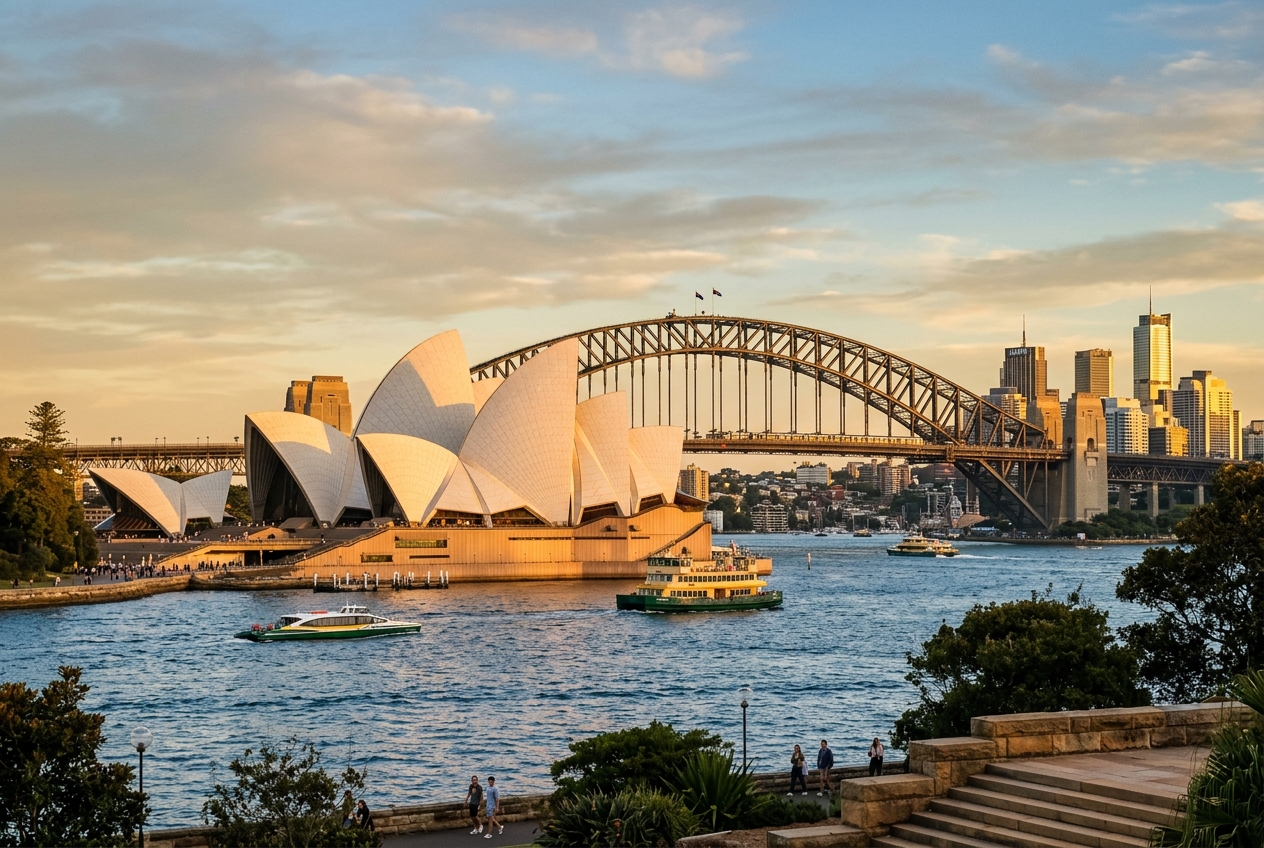
Which iconic building was originally estimated to cost $7 million and take four years to build, but actually cost $102 million and took 14 years to complete?
- The Sydney Opera House
- The Guggenheim Museum Bilbao
- The Centre Pompidou
- The Walt Disney Concert Hall
Answer: The Sydney Opera House — The Sydney Opera House stands as one of history's most spectacular budget overruns: predicted to cost 7 million Australian dollars and open in 1963, it finally premiered in 1973 at 102 million dollars—nearly fifteen times the estimate. Danish architect Jørn Utzon resigned in 1966 after bitter disputes with the government over costs and design changes, never returning to see his masterpiece completed. Today those distinctive white shells draw over 8 million visitors annually, and the building that nearly bankrupted New South Wales is worth an estimated $4.6 billion to Australia's economy each year—making it perhaps the most profitable overrun in construction history.
The Impossible Geometry
When Jørn Utzon's design won the 1957 international competition, the Danish architect was 38 years old and had never built anything larger than a house. His entry featured soaring white shells that looked like billowing sails—or perhaps peeling orange segments—but the drawings contained almost no engineering detail. New South Wales Premier Joseph Cahill announced construction would begin in 1959, cost 7 million Australian dollars, and finish by Australia Day 1963. The government had secured those numbers before anyone calculated whether Utzon's curves could actually stand up. Early engineering attempts failed: the shells couldn't be built as parabolas, ellipsoids, or any standard geometric form. For two years, Utzon's team tested hundreds of configurations using models and rudimentary computers. The breakthrough came in 1961 when Utzon realized all the shell segments could be cut from the surface of a single sphere 246 feet in radius—like slicing pieces from one enormous orange. This meant the 2,194 precast concrete ribs could be mass-produced using repeating molds, making construction theoretically possible. By then the budget had already doubled and the scheduled opening had been pushed to 1965.
The Construction That Wouldn't End
Foundation work began in March 1959 on Bennelong Point, a former tram depot jutting into Sydney Harbour. Crews immediately discovered the sandstone bedrock was far weaker than surveys indicated, requiring 700 concrete piers drilled up to 82 feet deep. The podium—the massive platform supporting the shell structures—took four years to complete instead of the planned eighteen months. Its construction alone consumed the entire original 7-million-dollar budget. Meanwhile Utzon's team was still solving the shell geometry problem. When construction of the shells finally began in 1963, each rib had to be positioned with millimeter precision; the smallest error would compound across the structure until the segments no longer met. Swedish glass manufacturer Orrefors spent three years developing a special chevron-patterned tile system after Utzon rejected conventional materials. The tiles—1,056,006 of them, in two colors—were individually placed by hand. By 1965, the project had cost 22 million dollars, employed 350 workers simultaneously, and showed no signs of finishing soon. The delays and cost overruns became a political scandal.
The Architect Who Never Came Back
In February 1966, the newly elected Liberal government of Robert Askin demanded Utzon provide detailed drawings for the interior stages and submit to oversight by a government-appointed committee. Utzon, who worked intuitively and revised designs as construction progressed, refused to hand over incomplete plans he considered works in progress. The government stopped his fees. On February 28, 1966, Jørn Utzon resigned, telling the press he had been forced out by impossible demands and political interference. He left Australia in April and never returned, not even for the opening. A panel of Australian architects—Peter Hall, David Littlemore, and Lionel Todd—took over, redesigning much of the interior. Utzon's plan had called for experimental plywood acoustic shells in the main hall; Hall's team installed a conventional proscenium stage instead, reducing the Concert Hall's capacity by 800 seats. The original vision for a flexible interior space became a fixed theater layout. The shell exteriors were complete by 1967, but interior work dragged on for six more years. Queen Elizabeth II officially opened the Sydney Opera House on October 20, 1973—ten years late, at a final cost of 102 million dollars. Utzon's name appeared nowhere in the opening ceremony program.
The Icon That Saved Itself
Within a decade, the Opera House had become Australia's most recognizable symbol, appearing on everything from tourism posters to the 2000 Sydney Olympics logo. UNESCO inscribed it as a World Heritage Site in 2007, calling it
What most people get wrong
Most people believe the Sydney Opera House was designed to resemble sails on Sydney Harbour, fitting its waterfront location. Utzon himself said the shells were inspired by peeling an orange, and the geometry is based on a sphere, not sail shapes. The comparison to sails came from observers after the design was revealed, not from the architect's intent.
Word of the Day
imbrication noun · im-brih-KAY-shun
An overlapping arrangement of edges, like roof tiles or fish scales; from the Latin 'imbricare' (to cover with rain tiles), itself from 'imbrex' (a curved roof tile that channeled water). In architecture it ensures water runs off without penetrating; in nature it appears wherever surfaces must shed liquid or resist penetration—pine cones, pangolin armor, the Sydney Opera House's chevron-patterned ceramic tiles.
“The contractor achieved perfect imbrication on the slate roof, each tile overlapping the next by exactly three inches. In her biology dissertation, she described the imbrication of reptilian scales as an evolutionary response to moisture loss, noting that desert species show tighter overlap than their rainforest cousins.”
Joke of the Day
Why did the Sydney Opera House architect refuse to play jigsaw puzzles after 1966?
He'd already spent seven years on one where the client kept changing the picture.
This Day in History
1781 — At Yorktown, Virginia, British General Charles Cornwallis surrendered 8,000 troops to George Washington's Continental Army and French forces under Comte de Rochambeau, effectively ending the American Revolutionary War. Cornwallis had fortified Yorktown expecting reinforcements by sea, but French Admiral de Grasse's fleet blocked the Chesapeake Bay while Washington's combined army of 17,000 besieged the town. After three weeks of bombardment, with supplies exhausted and no relief in sight, Cornwallis sent a drummer boy and officer with a white handkerchief on the morning of October 17. The formal surrender occurred two days later; Cornwallis claimed illness and sent a deputy to hand over his sword. Though the Treaty of Paris wouldn't be signed until 1783, Yorktown convinced the British Parliament that the war was unwinnable, leading Prime Minister Lord North to resign and his successors to open peace negotiations.
Enjoyed this issue?
Get the next one free, every morning.
More from Words IQ