Sunday, November 8, 2026
Trivia of the Day
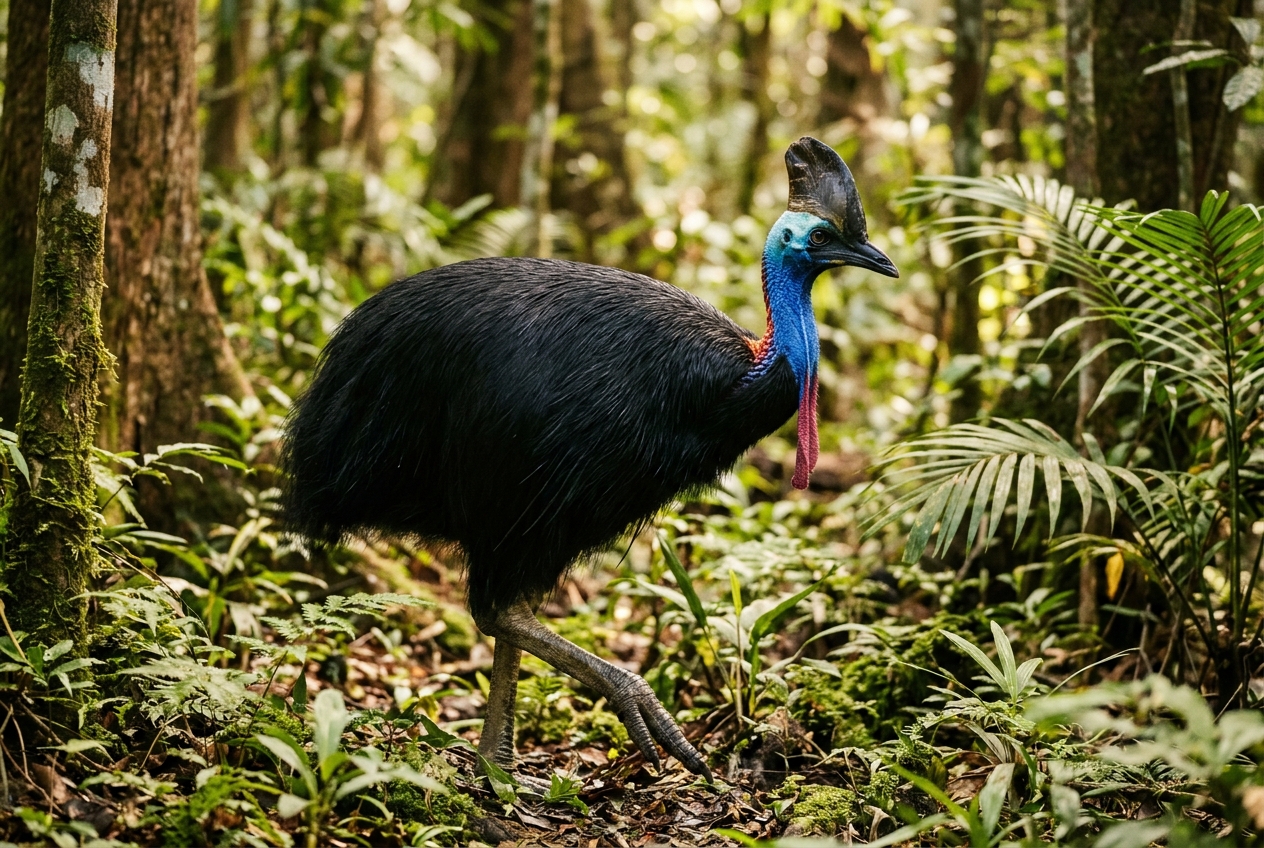
Which flightless bird is often called the world's most dangerous bird due to its dagger-like claws that can be up to 5 inches long?
- the ostrich
- the emu
- the cassowary
- the rhea
Answer: the cassowary — The cassowary's reputation is backed by documented fatalities: in 1926, Australian teenager Phillip McClean bled to death in minutes after a cassowary kicked him in the neck, severing his jugular vein. Modern emergency-room records from Queensland and New Guinea list lacerations, broken bones, and puncture wounds from birds defending territory or scraps of food—wounds that required surgery and months of recovery. The World Health Organization classifies cassowaries among animals responsible for human deaths, a list that includes crocodiles and venomous snakes.
The claw that made the headlines
The cassowary's middle toe ends in a keratinous spike up to five inches long, shaped like a curved dagger and sharp enough to pierce muscle and bone. In 2019, a Florida man named Marvin Hajos died after his pet cassowary attacked him following a fall; the medical examiner's report listed the cause as exsanguination from deep lacerations to the forearms and abdomen. That death made international news, but it was hardly the first. In 1926, Australian teenager Phillip McClean and his brother encountered a cassowary near their family farm in Mossman, Queensland. When Phillip struck the bird with a stick, it lunged, and a single kick to the neck opened his jugular vein. He bled out within minutes, and the coroner's inquest formally recorded the bird as the killer. Mission Beach Hospital in northern Queensland treats an average of two cassowary injuries per year—deep gashes, fractured ribs, and punctured abdomens—most of them inflicted when tourists or residents get too close during breeding season, which runs from June through October. The bird does not need to chase: one leap and a forward thrust of the leg is enough to deliver a wound that requires emergency vascular surgery.
Cassowaries inhabit the tropical rainforests of northeastern Australia, New Guinea, and several nearby islands, where they evolved without mammalian predators for millions of years. The three living species—southern, northern, and dwarf—all share the blade-like claw, but the southern cassowary, *Casuarius casuarius*, stands up to six feet tall and weighs as much as 130 pounds, making it the second-heaviest bird alive after the ostrich. Unlike ostriches, which inhabit open savanna and rely on speed to escape danger, cassowaries evolved in dense forest where visibility is measured in feet, not miles. When threatened, a cassowary cannot run far, so it attacks instead. The bird's body is built for combat: a bony casque on top of the skull acts as a battering ram to clear undergrowth and, during fights, to block strikes from rivals. The legs generate tremendous force—biologists estimate a kick delivers around 450 pounds per square inch, comparable to the bite of a hyena. The claws are not retractable, so the bird carries them exposed at all times, slicing through leaf litter as it walks and leaving three-toed tracks that resemble those of a small theropod dinosaur. In 2003, researchers at the University of Queensland used high-speed cameras to film cassowaries kicking padded targets and recorded strike velocities exceeding 30 miles per hour, faster than a human punch.
The bird that moves like a velociraptor
Paleontologists studying cassowary locomotion have drawn explicit comparisons to dromaeosaurid dinosaurs—the family that includes *Velociraptor* and *Deinonychus*. Both groups share a similar hunting posture: balance on one leg, swing the other forward, and drive the claw downward in a slicing motion. In 2005, Phil Senter of Fayetteville State University published a study in the *Journal of Zoology* showing that cassowaries and theropod dinosaurs use nearly identical kicking mechanics, a case of convergent evolution driven by similar selective pressures. The comparison extends beyond movement. Cassowaries are solitary, territorial, and aggressive during breeding season, when males incubate clutches of three to five bright-green eggs for about 50 days, then guard the striped chicks for up to nine months. During that period, adult males patrol a home range of up to two square miles and charge anything they perceive as a threat—dogs, wild pigs, humans, even vehicles. In 2017, a cassowary in the Daintree Rainforest attacked a rental car, kicking out the headlight and leaving three parallel gouges across the fender. Wildlife officers attribute the uptick in aggression to habitat fragmentation: as logging and development shrink the forest, cassowaries encounter humans more often, and the birds have no instinct to retreat.
Yet for all their ferocity, cassowaries are also essential to the rainforest ecosystem. They consume fallen fruit from more than 150 plant species, including massive drupes the size of tennis balls that no other animal can swallow whole. The seeds pass through the digestive tract unharmed and are deposited in new locations, often miles from the parent tree. In 2004, botanist Andrew Dennis calculated that cassowaries disperse seeds for at least 70 rainforest species that depend entirely on the bird for reproduction—without cassowaries, those plants would vanish within a generation. The bird's role as a seed disperser dates back at least 30 million years, making it one of the oldest mutualistic relationships in Australia. Some fruiting trees have evolved specifically to attract cassowaries: their fruit ripens at ground level, turns vivid blue or purple, and emits a pungent odor that the bird can detect from hundreds of feet away.
The attack that rewrote zoo policy
In 1999, two cassowaries at the San Diego Zoo attacked a zookeeper named Brian Moore during a routine feeding. Moore entered the enclosure carrying a bucket of fruit, and both birds charged simultaneously. One kicked him in the chest, cracking two ribs and puncturing his left lung; the other slashed his thigh, severing the femoral artery. Moore survived only because a colleague outside the enclosure used a fire hose to drive the birds back, then applied a tourniquet while paramedics arrived. The incident prompted the Association of Zoos and Aquariums to reclassify cassowaries as Category I animals—the same tier as big cats and venomous reptiles—and mandate that keepers never enter an enclosure alone or without a secondary barrier. Today, most zoos feed cassowaries through chutes or automated dispensers, and any direct contact requires protective padding and a second staff member armed with a deterrent. The San Diego attack was not an outlier. In 2012, a cassowary at the Singapore Zoo broke through a wire fence and attacked a visitor who had been tossing bread into the exhibit. The bird knocked the woman to the ground and delivered three kicks before handlers subdued it with a tranquilizer dart; she required 40 stitches and spent two weeks in the hospital.
Why it still matters
The cassowary's danger to humans is inseparable from its ecological importance, and both are under threat. Deforestation in Queensland has reduced cassowary habitat by 60 percent since 1980, and the Australian government now lists the southern cassowary as endangered, with fewer than 4,500 individuals remaining in the wild. Cyclone Yasi in 2011 destroyed an estimated 70 percent of cassowary food sources in the Wet Tropics region, forcing the birds into residential areas to forage, which led to a spike in vehicle strikes and dog attacks. In 2021, the Queensland Department of Environment recorded 25 cassowary deaths from cars, the highest annual toll on record. Conservation groups have installed underpasses and wildlife corridors, but development continues to fragment the forest. The bird's reputation as a killer complicates conservation efforts: public fear translates into political indifference, and funding for cassowary protection lags behind that for charismatic species like koalas and sea turtles. Yet the cassowary is a keystone species—its disappearance would trigger a cascade of extinctions among the plants that depend on it for seed dispersal, reshaping the rainforest into something unrecognizable. The bird that kills humans is also the bird that keeps the forest alive.
What most people get wrong
Many assume the cassowary's casque—the bony helmet atop its head—is used as a weapon in attacks, but studies show it functions primarily for display, thermoregulation, and pushing through dense vegetation; the real danger is always the claw.
Word of the Day
puissant adjective · PWEE-sunt or PYOO-ih-sunt
Having great power, influence, or force; mighty. From Old French, derived from Latin *posse* ('to be able'), the same root that gave English 'potent' and 'possible.' It entered English in the 15th century as a term for military and political might, though today it often carries a literary or archaic tone.
“The senator's puissant allies in the banking industry ensured the bill never reached a vote. In medieval romance, a puissant knight could defeat a dozen foes single-handedly, though historians note real combat was rarely so one-sided.”
Joke of the Day
Why did the cassowary refuse to join the witness protection program?
It already had a record.
This Day in History
1923 — German hyperinflation reached its peak on November 8, 1923, when the exchange rate hit 4.2 trillion marks to one U.S. dollar—a loaf of bread cost 200 billion marks, and workers demanded payment twice daily so they could spend their wages before the currency lost more value. The Weimar government, unable to meet reparations payments after World War I, had printed money at an unprecedented rate, destroying savings and destabilizing the economy. Within weeks, the government introduced the Rentenmark, pegged to land value rather than gold, which ended the hyperinflation almost overnight and became a textbook case in monetary policy.
Enjoyed this issue?
Get the next one free, every morning.
More from Words IQ