Tuesday, October 20, 2026
260 storm days per year make one body of water Earth's lightning capital
By Corey Lewis · Editorial standards
Trivia of the Day
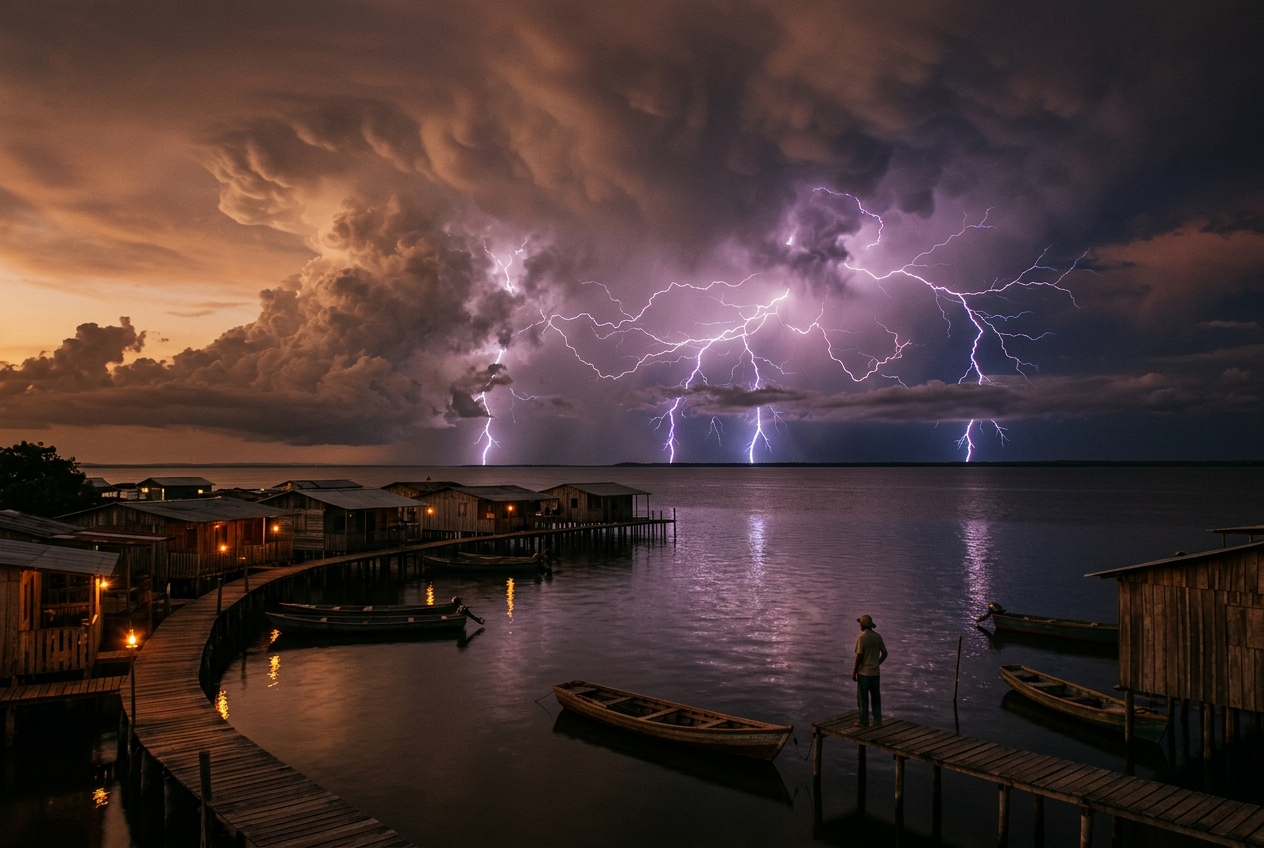
Which body of water holds the world record for the most lightning strikes per year, averaging 260 storm days annually?
- Lake Maracaibo in Venezuela
- Lake Victoria in East Africa
- The Congo Basin in Central Africa
- The Gulf of Mexico
Answer: Lake Maracaibo in Venezuela — Lake Maracaibo experiences lightning an average of 260 nights per year, making it the lightning capital of the world with the Catatumbo lightning phenomenon. The storm's consistency is so reliable that sailors used it as a natural lighthouse for centuries, and it produces more ozone than any other atmospheric phenomenon on Earth. Scientists estimate the Catatumbo lightning generates up to 1.2 million flashes annually, accounting for roughly 10% of the planet's total atmospheric ozone production and creating an electrical spectacle visible from 250 miles away.
The Geometry of a Perfect Storm
Lake Maracaibo sits in northwestern Venezuela at the end of a 99-mile channel connecting it to the Gulf of Venezuela and the Caribbean Sea beyond. The lake itself covers 5,130 square miles, making it South America's largest body of water, though its brackish mixture of fresh and salt water defies easy classification. At its southern end, where the Catatumbo River empties into the lake near the town of Congo Mirador, warm trade winds from the Caribbean collide with cold air descending from the Andes Mountains that ring the basin on three sides. This topographical funnel creates a meteorological crucible: the surrounding peaks reach 16,000 feet and form a natural amphitheater that traps moisture-laden air, while methane from the region's oil deposits and decomposing organic matter in the lake's swamps may enhance electrical conductivity. The result is a thunderstorm machine that operates with clockwork regularity, generating lightning nearly every night from April through November.
The Relampago del Catatumbo in Action
The phenomenon peaks between September and October when the storms can produce up to 280 flashes per hour, illuminating the night sky in a continuous strobe of forked and sheet lightning. Each storm cell typically lasts nine to ten hours, beginning around 7 PM and continuing past dawn, though the most intense activity concentrates between midnight and 2 AM when temperature differentials reach their maximum. The lightning rarely reaches the ground—most discharges remain cloud-to-cloud—and thunder is often inaudible from shore despite the visual fury overhead. Spanish conquistador Lope de Aguirre encountered the phenomenon in 1595 during his murderous expedition down the Orinoco, and his chroniclers described a sky "torn by continuous fire." In 1823, the storms inadvertently saved the Venezuelan republic when their glow revealed a Spanish naval squadron attempting a nighttime approach to Maracaibo, allowing independence forces under Admiral José Prudencio Padilla to maneuver into position and secure victory in the Battle of Lake Maracaibo on July 24.
The Silence and the Return
For six weeks in early 2010, the Catatumbo lightning stopped completely. Fishermen who had navigated by its glow for generations found themselves disoriented in unaccustomed darkness, and scientists scrambled to explain the disappearance. The leading theory pointed to a severe regional drought linked to El Niño conditions that had drained wetlands and reduced the atmospheric moisture necessary for storm formation. The Catatumbo River's flow dropped to record lows, and Lake Maracaibo's water level fell by several feet. When seasonal rains returned in April 2010, so did the storms, though environmental researchers now monitor the phenomenon as a potential climate change indicator. A second pause occurred in 2016, lasting 10 weeks and again coinciding with drought conditions. Local communities have organized to protect the watershed, declaring the lightning a natural heritage site and pushing for UNESCO recognition, aware that agricultural expansion and oil exploration in the surrounding basin threaten the delicate hydrology that feeds the storms.
Lightning Capital of the World
NASA satellite data collected between 1995 and 2013 confirmed what locals had long claimed: the Catatumbo region produces more lightning per square kilometer than anywhere else on Earth. The concentration reaches 250 flashes per square kilometer annually, with the village of Congo Mirador recording the highest density at the exact confluence of lake and river. By comparison, central Africa's thunderstorms—often called the continent's "lightning alley"—produce roughly 150 flashes per square kilometer, and Florida's lightning corridor averages about 50. The Guinness World Records officially recognized the region in 2014 after analyzing 16 years of satellite imagery. Scientists from the University of Zurich and Venezuela's Center for Scientific Research have proposed the storms as a global atmospheric regulator, noting that the ozone generated by constant electrical discharge may offset pollution degradation in the troposphere. Tourism operators now run night boat trips from the town of Catatumbo, and the phenomenon appears on Venezuela's coat of arms as a symbol of natural wealth—though visitors must navigate the region's security challenges and infrastructure decay to witness what mariners once called the "Lighthouse of Maracaibo."
What most people get wrong
Many people assume the Catatumbo lightning is a single continuous electrical discharge or a permanent storm hovering in place. In reality, the phenomenon consists of hundreds of individual thunderstorm cells that form, discharge, and dissipate throughout each night, driven by recurring atmospheric conditions rather than a perpetual weather system—the storms regenerate nightly because the underlying geography and wind patterns remain constant, not because the lightning itself never stops.
Word of the Day
coruscate verb · KOR-uh-skayt
To give off or reflect bright flashes of light; to sparkle or glitter brilliantly. From the Latin coruscatus, past participle of coruscare meaning 'to vibrate, glitter, flash,' the word entered English in the 18th century carrying the sense of sudden, brilliant intermittent light rather than steady glow—think lightning rather than lamplight.
“The Catatumbo lightning coruscates across Lake Maracaibo's surface with such regularity that sailors once navigated by its glow. Her wit coruscates in conversation, each sharp observation landing with the unexpected flash of a well-cut diamond catching sunlight.”
Joke of the Day
Why did the meteorologist refuse to propose at Lake Maracaibo?
Too much chance of a spark ruining the moment.
This Day in History
1803 — The United States Senate ratified the Louisiana Purchase treaty on October 20, 1803, transferring 828,000 square miles from France to the young republic for $15 million—roughly four cents per acre. Napoleon Bonaparte had sold the territory to fund his European wars after losing Saint-Domingue (Haiti) to revolution and concluding that France could not defend such distant possessions against British naval power. The acquisition doubled the size of the United States overnight and opened the path to westward expansion, though constitutional scholars debated whether President Thomas Jefferson had the authority to purchase foreign territory without explicit legislative approval. The ratification set the stage for the Lewis and Clark expedition and transformed the United States from an Atlantic coastal nation into a continental power.
Enjoyed this issue?
Get the next one free, every morning.
More from Words IQ