Sunday, October 18, 2026
This mission's flyby photos remain the only close-ups we have of two planets
By Corey Lewis · Editorial standards
Trivia of the Day
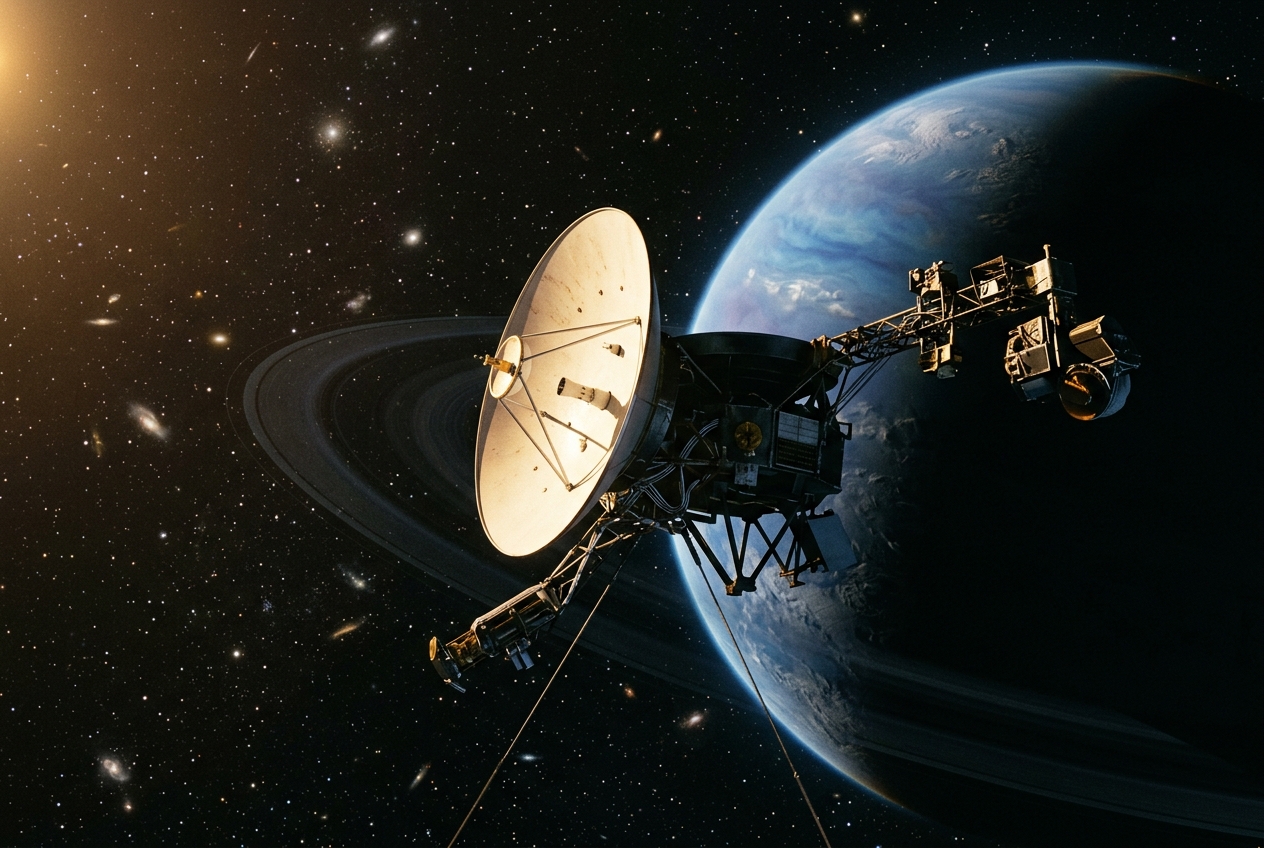
What spacecraft is the only human-made object to have visited Uranus and Neptune?
- Voyager 1 spacecraft
- Voyager 2 spacecraft
- Pioneer 11 spacecraft
- Galileo spacecraft
Answer: Voyager 2 spacecraft — Voyager 2 is the only spacecraft ever to fly past Uranus in 1986 and Neptune in 1989, and no missions to either planet are currently planned. Both encounters happened during a rare planetary alignment that occurs once every 176 years, allowing the spacecraft to use gravity assists to reach the outer solar system. The next window for a similar mission won't open until the 2150s, meaning no human alive today will see new close-up images of these worlds in their lifetime—and why it matters: the data Voyager 2 sent back remains our sole detailed portrait of two entire planets, one-quarter of our solar system's major worlds frozen in a single 1980s snapshot.
The 176-Year Window
Voyager 2 launched from Cape Canaveral on August 20, 1977, sixteen days before its twin Voyager 1, but followed a slower trajectory that would take it past all four gas giants. NASA designed the mission around a planetary alignment that hadn't occurred since Thomas Jefferson was president and wouldn't repeat until the 22nd century: Jupiter, Saturn, Uranus, and Neptune lined up in an arc that allowed a single spacecraft to visit each one using gravity assists, slingshotting from planet to planet without carrying enough fuel for the journey on its own. The alternative—a direct flight to Neptune—would have required a spacecraft the size of a building and taken thirty years. Voyager 2's route cut the travel time to twelve years and fit on a Titan IIIE rocket. Engineers at the Jet Propulsion Laboratory calculated the trajectories by hand and on early computers, plotting a path that threaded through the moons of four planets with margins measured in hundreds of kilometers across billions of kilometers of space.
Uranus in January 1986
Voyager 2 reached Uranus on January 24, 1986, flying within 81,500 kilometers of the planet's cloud tops at 9:00 a.m. Pacific time. The encounter revealed a world nothing like the other gas giants: Uranus rotates on its side, its axis tilted 98 degrees, so its poles point nearly directly at the sun during its 84-year orbit. The spacecraft discovered ten new moons, measured a magnetic field offset 60 degrees from the rotational axis, and photographed Miranda, a moon whose surface looks like it was shattered and reassembled, with cliffs ten times deeper than the Grand Canyon. Voyager 2's cameras captured images in near-total darkness—Uranus receives 1/400th the sunlight Earth does—requiring exposure times so long that engineers had to rotate the entire spacecraft during the shot to avoid blurring. The flyby lasted just five and a half hours; the spacecraft spent decades traveling to Uranus and had only a few hours to gather data before hurtling past at 15 kilometers per second, never to return.
Neptune in August 1989
Voyager 2 arrived at Neptune on August 25, 1989, the only spacecraft ever to visit the solar system's outermost major planet. Flying within 4,950 kilometers of Neptune's north pole, closer than it had approached any other planet, Voyager 2 discovered six moons, four rings, and the Great Dark Spot, a storm system the size of Earth. Winds on Neptune blow at 2,100 kilometers per hour, the fastest in the solar system, on a planet so distant it receives 1/900th Earth's sunlight. The spacecraft photographed Triton, Neptune's largest moon, revealing geysers of nitrogen erupting through surface ice at minus 235 degrees Celsius, the coldest known temperature on any solid surface. Voyager 2's final planetary encounter used Neptune's gravity to bend the spacecraft's path southward, sending it diving below the plane of the solar system at 470 million kilometers per day, leaving the planets behind forever. The mission returned 4,950 images of Neptune and Triton in under 24 hours, then fell silent on the planetary stage.
The Only Visitor
No spacecraft has returned to Uranus or Neptune since 1989, and none is currently funded or scheduled. Voyager 2's images remain the highest-resolution pictures we have of two entire planets, one-quarter of the major worlds in our solar system. A 2023 National Academies report recommended a Uranus orbiter and probe as NASA's top priority for the next decade, but the earliest launch date would be 2031, arriving in 2044—55 years after Voyager 2's flyby. Neptune would wait even longer; no serious mission proposal exists beyond preliminary concept studies. The problem is distance and money: a Uranus mission costs over four billion dollars and requires nuclear power sources, of which NASA produces only one per decade. Voyager 2 itself continues operating, now over 20 billion kilometers from Earth in interstellar space, sending data through a transmitter powered by decaying plutonium-238. The spacecraft carries a golden record with greetings in 55 languages and images of Earth, a message to no one in particular from a species that visited four worlds in twelve years and hasn't gone back.
What most people get wrong
Many people assume Voyager 1 visited more planets because it's more famous and is now farther from Earth, but Voyager 1 flew past only Jupiter and Saturn—Voyager 2 alone reached Uranus and Neptune, making it humanity's only emissary to the ice giants.
Word of the Day
gasconade noun · gas-kuh-NAYD
Extravagant boasting or boastful talk; bravado. The term comes from Gascon, a region in southwest France whose people gained a reputation in literature for swaggering braggadocio, immortalized by figures like Dumas's d'Artagnan, a Gascon musketeer whose boldness often outpaced his means.
“The candidate's gasconade about single-handedly fixing the economy convinced no one who'd read the actual budget figures. Later, trapped in a failed negotiation of his own design, his gasconade evaporated into silent finger-pointing at staffers who'd warned him all along.”
Joke of the Day
Why did Voyager 2 refuse to write a travel blog after visiting Neptune?
It had already seen four planets and didn't want to come across as a gasconade.
This Day in History
1867 — The United States formally took possession of Alaska from Russia in a ceremony at Sitka on October 18, 1867, completing the $7.2 million purchase negotiated six months earlier by Secretary of State William Seward. Russian and American soldiers gathered as the Russian flag came down and the Stars and Stripes rose over the territory, marking the end of 126 years of Russian America. Critics had mocked the acquisition as 'Seward's Folly' and 'Seward's Icebox,' calling the vast northern wilderness worthless—until gold strikes in the 1890s and oil discoveries in the 20th century proved Alaska one of the most resource-rich land deals in history. The $7.2 million purchase price, roughly two cents per acre, would be worth $140 million today, a fraction of the trillions in resources extracted since.
Enjoyed this issue?
Get the next one free, every morning.
More from Words IQ