Thursday, November 5, 2026
The Sun climbs the western sky on this solar system body
By Corey Lewis · Editorial standards
Trivia of the Day
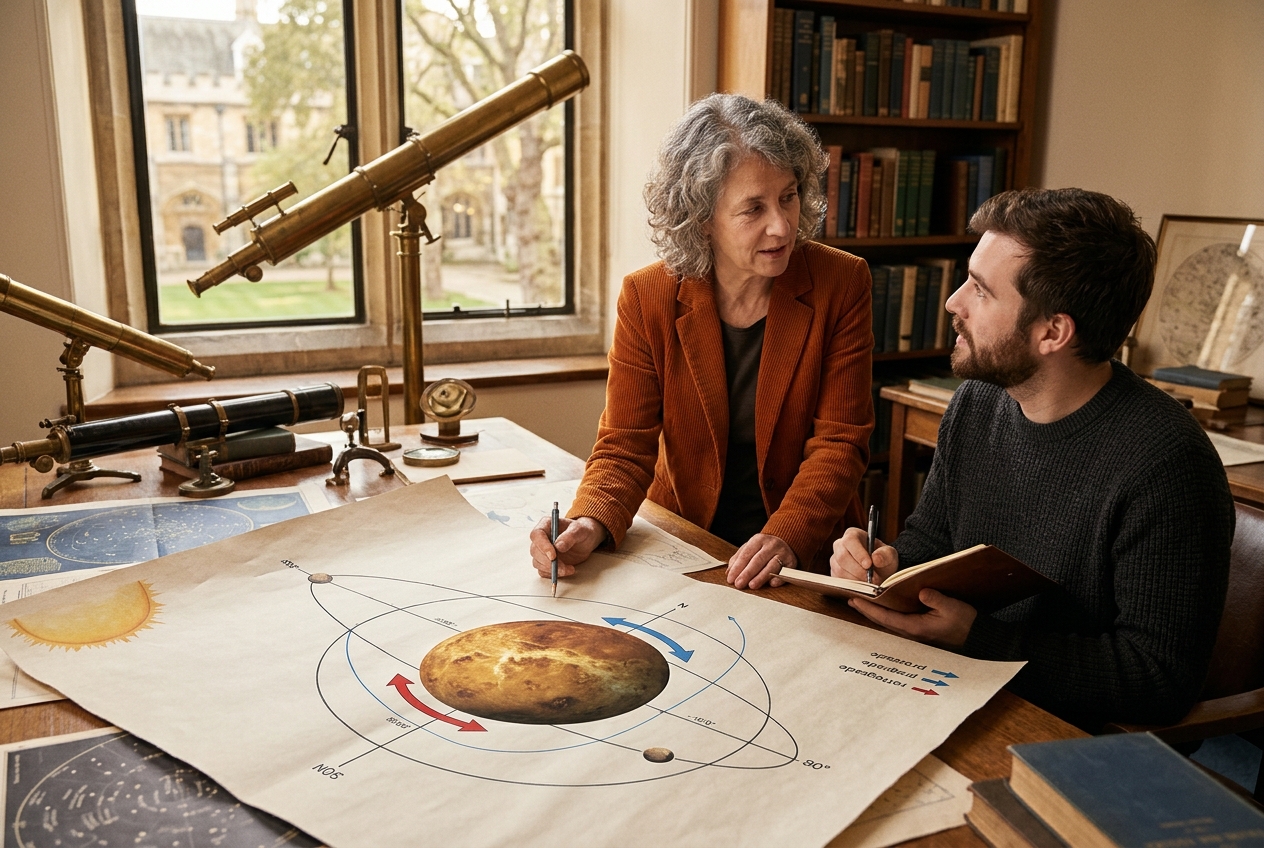
Which planet in our solar system rotates in the opposite direction from almost all the others, making the Sun rise in the west?
- Uranus tilts sideways on its axis
- Venus rotates backward compared to most planets
- Mercury has a highly elliptical orbit
- Neptune has the strongest winds in the solar system
Answer: Venus rotates backward compared to most planets — Venus rotates so slowly that one Venusian day (243 Earth days) is longer than one Venusian year (225 Earth days), and it spins clockwise when viewed from above the Sun's north pole—the opposite direction of nearly every other planet. Scientists still debate whether a massive ancient collision knocked Venus into retrograde rotation or whether tidal forces from its thick atmosphere gradually reversed its spin over billions of years. Either way, if you stood on Venus's scorching surface, you'd see the Sun rise in the west, creep across the sky for four Earth months, and set in the east—assuming the planet's sulfuric acid clouds ever parted long enough to let you see it.
The Backward Spin Nobody Expected
When Galileo turned his telescope toward Venus in 1610, he saw phases like the Moon's, proving the planet orbited the Sun, but he had no way to measure its rotation. That discovery waited until 1962, when radar astronomers at MIT and the Jet Propulsion Laboratory in California bounced radio waves off Venus's cloud-shrouded surface and timed the echoes. The data revealed something startling: Venus rotates east to west, opposite the west-to-east spin shared by Earth, Mars, Jupiter, Saturn, and the Sun itself. Only Venus and Uranus (which rolls on its side) break the pattern, but Uranus's tilt is usually explained by a glancing collision. Venus, by contrast, rotates upright and backward, taking 243 Earth days to complete one rotation—so leisurely that its year (one orbit around the Sun) finishes in just 225 Earth days. A single Venusian day outlasts a Venusian year, and the Sun rises in the west every 117 Earth days, the interval between one sunrise and the next. No other planet in the solar system combines these oddities, and no single explanation has closed the case.
How a Planet Reverses Course
Two leading theories compete to explain Venus's retrograde rotation, and both hinge on events billions of years ago. The collision hypothesis suggests that a Mars-sized protoplanet slammed into Venus early in the solar system's history, delivering enough angular momentum to flip the planet's spin axis past vertical and into reverse. Computer simulations show that such an impact could leave Venus rotating backward without ejecting enough debris to form a moon, which matches observation—Venus has no natural satellites. The alternative theory involves atmospheric tides: Venus's atmosphere is 90 times denser than Earth's and rotates 60 times faster than the planet itself, whipping around in just four Earth days. Some models propose that over hundreds of millions of years, gravitational tugs from the Sun acting on this thick, fast-moving atmosphere could have gradually slowed Venus's original prograde rotation, stopped it, and nudged it into retrograde. A 2001 study by Alexandre Correia and Jacques Laskar at the Paris Observatory found that thermal tides—heating differences between day and night—might drive this process, though the mechanism requires exquisitely balanced conditions. Neither theory has been definitively proven, and some researchers suspect both forces played a role, with a primordial collision setting the stage and atmospheric drag fine-tuning the final outcome.
Life on a Backward World
Venus's retrograde spin shapes every aspect of its environment in ways that startle planetary scientists. Because the planet rotates so slowly, one side bakes under continuous sunlight for nearly two Earth months before rotating into darkness for another two, yet the thick carbon dioxide atmosphere—responsible for surface temperatures around 900 degrees Fahrenheit, hot enough to melt lead—distributes heat so efficiently that day and night temperatures barely differ. The backward rotation also reverses the Coriolis effect, which governs atmospheric circulation: weather patterns that swirl counterclockwise in Earth's Northern Hemisphere spin clockwise on Venus. Soviet Venera landers in the 1970s and 1980s recorded wind speeds near the surface of just a few miles per hour, sluggish compared to the 200-mile-per-hour jet streams in the upper atmosphere that race westward, the same direction as the planet's rotation. If humans ever colonized floating habitats in Venus's temperate cloud layer—a concept championed by NASA studies in the 2010s—they would experience a day-night cycle lasting 117 Earth days, with the Sun creeping backward across the sky and the stars wheeling the wrong way. Navigation, agriculture, and circadian biology would all require new rules on a planet where east and west traded places.
Why Venus Still Matters
Understanding Venus's backward rotation is not just a curiosity; it's a key to decoding planetary evolution and the limits of habitability. Venus is often called Earth's twin because the two planets share nearly identical size, mass, and composition, yet Venus became a runaway greenhouse hellscape while Earth bloomed with oceans and life. Some scientists suspect the slow, backward spin plays a role: a faster rotation would generate a magnetic field through dynamo action in the planet's molten core, shielding the atmosphere from the solar wind that has stripped away most of Venus's water over billions of years. Without that magnetic shield, Venus lost the hydrogen from its water molecules to space, leaving behind a desiccated world. Missions like NASA's DAVINCI and VERITAS, both scheduled for the early 2030s, will map Venus's surface in unprecedented detail and measure trace gases in the atmosphere, searching for clues about when and why the planet's rotation reversed. If atmospheric tides can flip a planet's spin, then worlds around other stars might undergo similar transformations, and understanding Venus helps astronomers predict which exoplanets could remain habitable and which might spiral into uninhabitable extremes. Venus rotates backward, but the lessons it teaches point forward.
What most people get wrong
Many people assume all planets rotate in the same direction because they formed from a single spinning disk of gas and dust, but Venus's retrograde rotation and Uranus's sideways tilt prove that collisions, atmospheric drag, and gravitational tugs can override a planet's original spin over billions of years.
Sources & further reading
Word of the Day
probity noun · PROH-bih-tee
Complete and confirmed integrity; uprightness, honesty. From Latin *probitas* ('goodness, honesty'), itself from *probus* ('good, virtuous')—the same root that gives us 'prove' and 'probation,' all linked to the idea of testing or demonstrating worth.
“The judge's probity was never questioned, even by defendants who lost their cases. // In contrast, the contractor's lack of probity became evident when auditors discovered inflated invoices and phantom subcontractors, a pattern of deceit that contradicted his public claims of ethical business practices.”
Joke of the Day
Why did the astronomer refuse to update the Venus fact sheet after the 1962 radar discovery?
She didn't want to spin the story the wrong way.
This Day in History
1605 — Guy Fawkes and his co-conspirators were discovered beneath the Houses of Parliament in London with 36 barrels of gunpowder, foiling the Gunpowder Plot to blow up King James I and the entire Protestant aristocracy during the State Opening. Fawkes, a Catholic militant who had fought for Spain in the Eighty Years' War, was arrested in the cellar just after midnight on November 5, holding a watch, slow matches, and touchpaper. Under torture, he revealed the names of his fellow plotters, leading to a manhunt across England. The failure of the plot is still commemorated in Britain every November 5 with bonfires, fireworks, and the burning of Guy Fawkes effigies—a tradition that has persisted for over 400 years and inspired the modern symbol of anti-establishment protest.
Enjoyed this issue?
Get the next one free, every morning.
More from Words IQ