Monday, November 2, 2026
Built to hold pressure three times stronger than car tires
By Corey Lewis · Editorial standards
Trivia of the Day
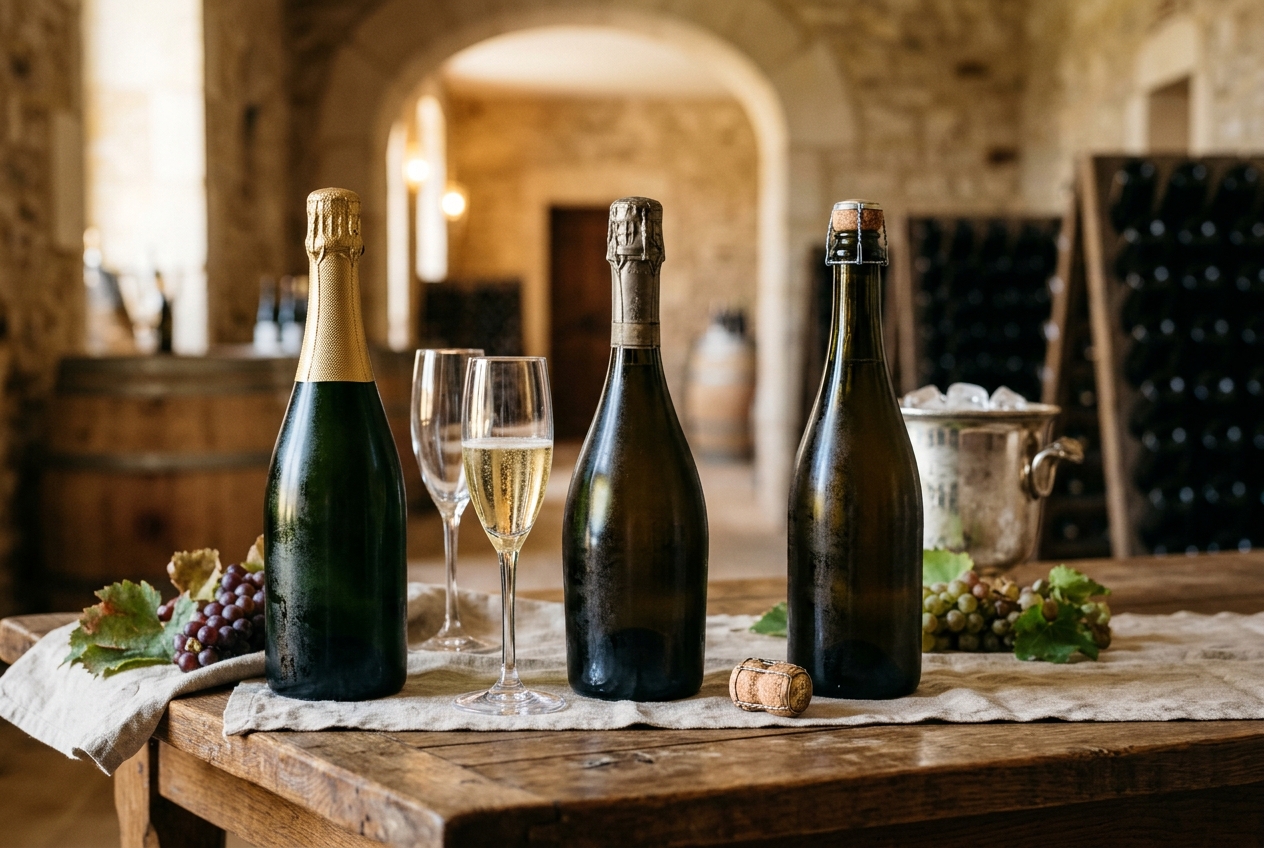
What beverage container is designed to withstand three times the pressure of a car tire?
- Champagne bottles
- Pressurized beer kegs
- Nitrogen-infused cold brew cans
- Carbonated soda bottles
Answer: champagne bottles — A champagne bottle holds carbon dioxide at approximately 90 pounds per square inch—about three times the pressure in an automobile tire. That's why the glass is so thick and the punt (the dimple in the bottom) is so deep: without them, the bottle would explode. In fact, early champagne cellars required workers to wear iron masks because spontaneous ruptures sent glass shrapnel flying through the air, and losses routinely reached 20 to 30 percent of inventory. The pressure is also why champagne corks fly at 40 miles per hour when uncaged, and why sommeliers aim them away from faces.
The Physics of Contained Celebration
Champagne ferments twice. Winemakers bottle still wine with yeast and sugar, seal it tight, and let biology do the rest. Over weeks or months, yeast consumes the sugar and releases carbon dioxide, but because the bottle is sealed, the gas has nowhere to go—it dissolves into the wine under mounting pressure. By the time fermentation stops, the bottle contains roughly 90 pounds per square inch of pressure, or about six atmospheres. That is three times the pressure in a standard automobile tire and comparable to the pressure inside a fire extinguisher.
The glass must be thick enough to contain it without shattering, which is why champagne bottles weigh nearly twice as much as a standard wine bottle of the same volume. The deep punt at the bottom—the dimple that looks decorative—is structural: it redistributes stress across the base and prevents the bottle from blowing out its weakest point. The pressure is not distributed evenly. The cork, secured by a wire cage called a muselet, is the single point of failure. Left uncaged, a champagne cork will rocket out at roughly 40 miles per hour, propelled by the expanding gas inside.
The Dangers of Uncorking Under Pressure
That speed is faster than Usain Bolt's top sprint, and it makes an uncorking champagne bottle a genuine projectile hazard. Ophthalmologists have documented dozens of eye injuries each year from flying corks, many resulting in permanent vision loss. A 2018 study in the British Journal of Ophthalmology found that champagne cork injuries accounted for nearly 7 percent of all sports and recreation-related eye trauma during New Year celebrations. The American Academy of Ophthalmology now includes champagne cork safety in its annual holiday injury prevention campaigns.
The wire cage was invented in the 1840s by Adolphe Jacquesson, a Champagne producer who wanted to reduce losses during shipping. Before the muselet, corks were tied down with string, which often frayed or snapped under pressure. Jacquesson's twisted wire cage became the industry standard within a decade. Modern muselets require exactly six half-turns to remove, a standardization agreed upon by French producers in 1844 to ensure consistency across the industry.
The Explosion Problem That Shaped an Industry
Early champagne production was a gamble. Glassmakers in the 17th and 18th centuries could not control the thickness or composition of bottle glass with precision, and many bottles contained microscopic flaws—air bubbles, impurities, uneven cooling—that became catastrophic under pressure. Cellars routinely lost 20 to 30 percent of their inventory to spontaneous ruptures, and in bad years the loss could reach 90 percent. Workers called these cellars "the devil's wine cellars" and wore iron masks when entering to protect their faces from flying glass shards.
The breakthrough came in 1823 when French pharmacist André François developed a method to measure sugar content in grape must using a hydrometer. This allowed producers to predict fermentation pressure with reasonable accuracy. By the 1830s, English coal-fired furnaces produced stronger glass than traditional wood-fired French kilns, and British bottles became the preferred container for Champagne houses. The combination of predictable sugar dosing and stronger glass reduced cellar losses to under 5 percent by 1850.
Engineering Modern Champagne Bottles
Today's champagne bottles undergo rigorous testing before production. Manufacturers use computer modeling to identify stress points and thickness requirements, then test sample bottles by pressurizing them to failure—typically between 12 and 15 atmospheres. The standard 750-milliliter champagne bottle contains about 35 grams of glass per cubic centimeter of wine, compared to 20 grams for still wine bottles. Larger format bottles like magnums and jeroboams are even thicker, as pressure scales with volume but glass strength does not.
Environmental concerns have prompted recent innovation. In 2023, the Comité Champagne launched an initiative to reduce bottle weight by 7 percent without compromising safety, potentially eliminating 8,000 tons of glass annually. Some producers now use recycled glass that includes up to 85 percent post-consumer material. Meanwhile, pressure remains the defining constraint: alternative materials like plastic and aluminum have been tested and rejected because they cannot reliably contain six atmospheres over months of aging while maintaining wine quality. The champagne bottle remains a specialized feat of glass engineering, designed for one of the most demanding applications in beverage packaging.
What most people get wrong
M ost pe op le ass ume c hampa gne b ott les a re thick be cau se the y hold e xpen si ve win e,o r tha t the p unt se rve s as a finger g rip for p ouri ng.I n f act,t he b ott le 's we i ght and s ha pe are pure ly str uct ur al:w ith out the thi ck g la ss and r einfor ced b ase,the 90 p si o f ca rbon di oxi de i nsi de w ould s ha tt er the c ont ai ner.E arl y c hampa gne c ell ars lo st up t o 30 p erc ent of b ott les to spon ta ne ous e xpl osi ons,and w orker s wo re ir on m asks t o pr ote ct a ga inst fl yi ng g la ss.
Word of the Day
effervescent adjective · ef-er-VES-ent
Giving off bubbles; fizzy. From the Latin 'effervescere,' meaning 'to boil up,' from 'ex-' (out) and 'fervescere' (begin to boil). The word entered English in the 1680s, precisely when European chemists were beginning to understand carbonation and when champagne makers were learning to bottle sparkling wine without losing half their inventory to explosions.
“The effervescent cider hissed softly as she poured it into the glass. Her effervescent personality made even the dullest committee meeting feel like a celebration.”
Joke of the Day
Why did the champagne bottle refuse to testify at the pressure vessel safety hearing?
It didn't want to crack under cross-examination.
This Day in History
1947 — The British Overseas Airways Corporation Avro Tudor IV airliner 'Star Tiger' disappeared without a trace on November 2, 1947, while flying from the Azores to Bermuda with 25 passengers and 6 crew aboard. Despite an extensive search involving ships and aircraft from multiple nations, no wreckage, bodies, or debris was ever found. The weather was clear, the pilot had radioed his position as expected just hours before the scheduled landing, and the aircraft simply vanished. One year later, the same airline lost another Tudor IV, 'Star Ariel,' on the same route under nearly identical circumstances. The double loss contributed to the airline's decision to retire the Tudor fleet and fed decades of speculation about the so-called Bermuda Triangle, though investigators found no evidence of sabotage, structural failure, or unusual atmospheric conditions.
Enjoyed this issue?
Get the next one free, every morning.
More from Words IQ