Saturday, October 24, 2026
California restaurants still serve an 'import' actually invented in San Francisco
By Corey Lewis · Editorial standards
Trivia of the Day
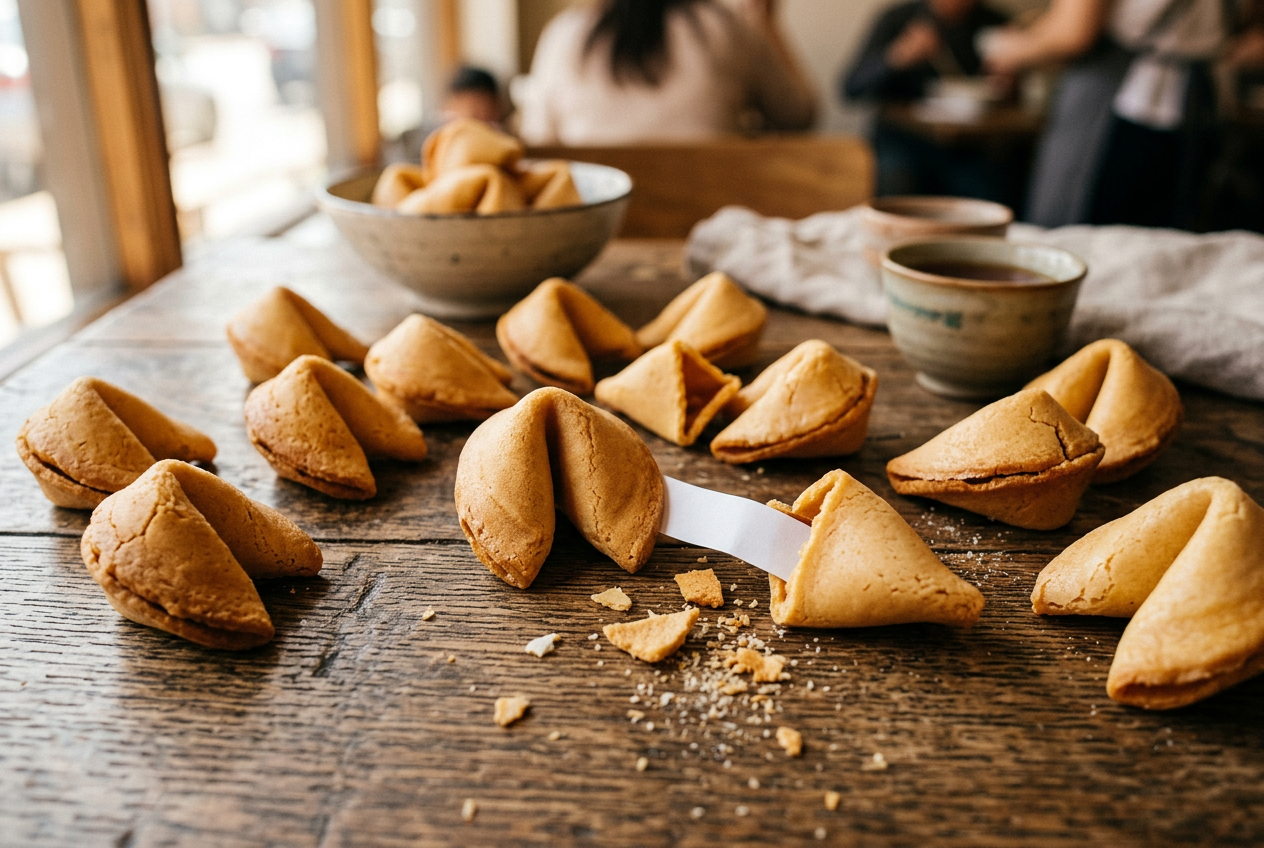
What popular Chinese restaurant item actually originated in California?
- Fortune cookies
- Chop suey
- General Tso's chicken
- Crab Rangoon
Answer: Fortune cookies — Fortune cookies were invented in California in the early 1900s and remain virtually unknown in China today—travelers to Beijing or Shanghai looking for the after-dinner tradition find nothing but puzzled restaurant staff. The cookies are so thoroughly American that Japanese troops arriving in California during World War II were genuinely surprised to discover them served at Chinese restaurants, since similar crackers had existed in Japan for centuries. When a San Francisco baker tried exporting fortune cookies to China in the 1990s, they flopped completely: customers found them too sweet, and the concept of a dessert predicting your future seemed bizarre rather than charming.
The California Bakery Wars
Fortune cookies emerged in California sometime between 1907 and 1914, but three separate claimants fought over the origin story for decades. Makoto Hagiwara, who designed the Japanese Tea Garden in San Francisco's Golden Gate Park, served crescent-shaped cookies with thank-you notes tucked inside to visitors around 1914, and his family maintained he invented them. David Jung, founder of the Hong Kong Noodle Company in Los Angeles, insisted he created fortune cookies in 1918 and handed them to poor people on the streets. Meanwhile, Seiichi Kito of Fugetsu-do in Los Angeles also laid claim to the invention in roughly the same era. In 1983, a mock trial at San Francisco's Court of Historical Review ruled in favor of Hagiwara, though the judge was from San Francisco and the decision carried a home-town whiff. What all three stories share: Japanese-American bakers, California locations, and the 1910s—not a single Chinese chef in the bunch.
The cookies actually descend from Japanese crackers called tsujiura senbei, which date back centuries in Kyoto. These were larger, darker, made with sesame and miso, and contained fortunes tucked into the bend rather than baked inside. Japanese immigrants brought the concept to California, where it morphed: American tastes demanded vanilla and butter, creating the lighter, sweeter cookie we know. Photographs from 1920s San Francisco show Japanese bakers—not Chinese—hand-folding the cookies while still hot off flat grills. The fortunes started as thank-you messages or Confucian aphorisms but quickly adopted the vague, optimistic tone Americans expected. By the 1930s fortune cookies had become a minor fixture in California's Japanese restaurants and tea gardens, a charming novelty that bridged cultures without claiming deep authenticity.
How Chinese Restaurants Took Over
World War II abruptly transferred fortune cookies from Japanese to Chinese hands. After Pearl Harbor, President Roosevelt's Executive Order 9066 forced over 110,000 Japanese Americans into internment camps, including nearly every West Coast baker who had been making fortune cookies. Japanese-owned businesses were shuttered or sold at frantic discounts. Chinese-owned bakeries and restaurants, facing no such persecution, stepped into the vacuum and began producing the cookies themselves to meet ongoing demand. By 1945, fortune cookies had been rebranded in the public mind as Chinese, a culinary sleight of hand made possible by wartime xenophobia and the fact that most white Americans could not distinguish Japanese from Chinese culture in the first place. When Japanese Americans returned from the camps after 1945, the cookie's identity had permanently shifted.
Chinese restaurants embraced fortune cookies enthusiastically, and the timing was perfect. Post-war America saw an explosion of suburban Chinese restaurants catering to white middle-class diners who wanted exotic novelty without actual challenge. Fortune cookies delivered: a sweet ending, a parlor-game fortune, and zero cultural homework required. By 1960, an estimated 250 million fortune cookies were being produced annually in the United States, nearly all distributed through Chinese restaurants. Shuck Yee, a San Francisco entrepreneur, mechanized production in the 1960s, making mass distribution economically viable and cementing the cookie's place on every check tray from coast to coast.
The Billion-Dollar Fortune Industry
Today fortune cookies constitute a $150 million annual industry, with roughly three billion cookies baked each year in the United States. Wonton Food Company in Queens, New York, manufactures about half of all fortune cookies sold nationwide, producing four million daily from a single factory. Competitors like Baily International in San Francisco and Peking Noodle in Los Angeles handle the West Coast market. The fortunes themselves have spawned cottage industries: freelance writers earn modest fees composing the banal prophecies, while specialty orders allow marriage proposals, corporate branding, and even ransom notes in noir-themed dinner parties.
Mechanization revolutionized production but the basic process remains unchanged. Batter drops onto hot molds, bakes for roughly 30 seconds, then machines fold the circles around paper slips before they cool and harden. Quality control workers remove malformed cookies at speeds exceeding 200 units per minute. The fortunes, printed on tissue-thin paper in massive rolls, range from pseudo-Confucian wisdom to lottery numbers, which have occasionally caused chaos—in 2005, 110 Powerball players won second-tier prizes using numbers from a single fortune cookie batch, prompting fraud investigations that ultimately confirmed sheer coincidence.
Going Global and Coming Home
Ironically, fortune cookies barely exist in China itself. When American Chinese restaurant chains like Panda Express expanded into China in the 2000s, Chinese customers rejected fortune cookies as baffling and too sweet, viewing them as distinctly foreign. Japanese tourists to America, however, recognize the cookies' ancestry and often photograph them as curiosities, aware of the historical irony. In Japan, tsujiura senbei remain available at Shinto shrines in Kyoto, preserving the original tradition largely forgotten in the country where fortune cookies became famous.
The cookie's confused identity persists in modern pop culture. Films and television routinely use fortune cookies as shorthand for Chinese cuisine, while academic papers cite them as textbook examples of invented tradition and immigrant adaptation. In 2022, California's legislature considered designating the fortune cookie the official state snack, a proposal that stalled but highlighted the cookie's place in regional mythology. Fortune cookies endure not despite their fake Chinese authenticity but because of it—an American invention that revealed more about American desires than Asian culture, now too embedded in the national imagination to dislodge or correct.
What most people get wrong
Most people assume fortune cookies are an ancient Chinese tradition, perhaps tied to secret messages hidden during the Mongol occupation or to Confucian wisdom passed down for centuries. In reality, fortune cookies are a twentieth-century American invention created by Japanese immigrants in California, and they remain almost completely unknown in China—so much so that when a San Francisco bakery tried to market them in Beijing and Hong Kong in the 1990s, they were rejected as a strange foreign novelty.
Sources & further reading
Word of the Day
ersatz adjective · ER-zahts
Made or used as a substitute, typically an inferior one; artificial or synthetic, often carrying a note of disappointing imitation. From the German 'Ersatz,' meaning replacement or substitute, the term entered English during World War I when Germany, blockaded and resource-starved, produced ersatz coffee from acorns and ersatz rubber from chemical processes, giving the word its lasting connotation of second-rate substitution born of necessity.
“The hotel lobby featured ersatz marble columns—convincing from a distance but revealed as painted plaster up close. During the sugar shortage, home bakers experimented with ersatz sweeteners that left cakes tasting vaguely medicinal.”
Joke of the Day
Why did the time traveler bring an hourglass to the fortune cookie factory?
To prove the future was already running out before it got baked in.
This Day in History
1945 — The United Nations was officially established on October 24, 1945, when the UN Charter—ratified by China, France, the Soviet Union, the United Kingdom, the United States, and a majority of other signatories—entered into force in the aftermath of World War II. Delegates had spent months in San Francisco drafting the charter that spring, determined to create an international body with more teeth than the failed League of Nations. The UN's founding came just weeks after Japan's formal surrender, and its early mission focused on preventing another global conflagration, coordinating humanitarian relief across war-shattered Europe and Asia, and beginning the long, often-frustrating work of collective security that would define the Cold War era and beyond.
Enjoyed this issue?
Get the next one free, every morning.
More from Words IQ