Saturday, October 17, 2026
A sea punch packs the force of a .22 caliber round—from what?
By Corey Lewis · Editorial standards
Trivia of the Day
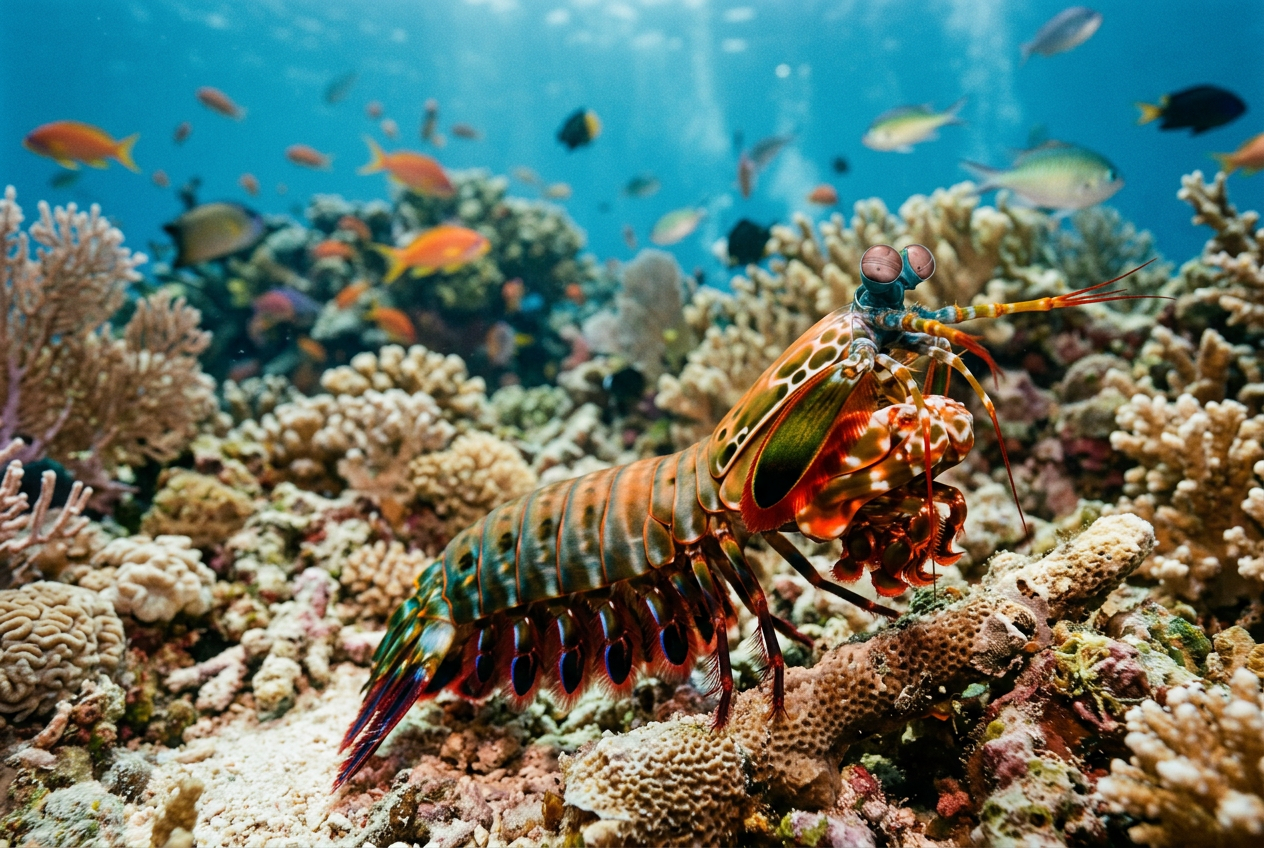
Which sea creature can punch with the acceleration of a bullet and see colors humans cannot perceive?
- the pistol shrimp
- the mantis shrimp
- the mimic octopus
- the cone snail
Answer: the mantis shrimp — The mantis shrimp's strike generates cavitation bubbles that collapse with a flash of light—a phenomenon called sonoluminescence—and temperatures briefly rivaling the surface of the sun. Its sixteen types of photoreceptors allow it to see polarized light and detect ten times more color information than the human eye, making our three-receptor vision look like monochrome by comparison. This crustacean is both pugilist and painter, perceiving a reef in hues we can't name.
The Fastest Punch in the Ocean
The mantis shrimp—technically a stomatopod, not a true shrimp—wields two raptorial appendages that function as spring-loaded clubs or spears depending on the species. The clubs of smashers like Odontodactylus scyllarus accelerate at over 10,000 times the force of gravity, reaching speeds of 23 meters per second in water, roughly 51 miles per hour. That velocity matches a .22 caliber bullet leaving the barrel. The strike lasts under three milliseconds, too fast for prey to react, and delivers up to 1,500 newtons of force—enough to crack open clam shells, snail carapaces, and the occasional aquarium glass. Researchers at the University of California, Berkeley, used high-speed cameras recording at 5,000 frames per second to capture the appendage's motion, revealing that the shrimp cocks its club backward, storing energy in a saddle-shaped spring made of resilient chitin and protein. When a latch releases, the spring uncoils and the club hurtles forward, striking with kinetic energy that would shatter the shrimp's own limb if not for a hyperbolic paraboloid geometry that distributes stress across the impact surface.
The punch itself is only half the damage. As the club slams into a target, it pushes water forward so violently that the local pressure drops below the vapor point, creating cavitation bubbles. These bubbles collapse microseconds later in a secondary shockwave, releasing heat estimated at 4,700 degrees Celsius and emitting a faint flash of light called sonoluminescence. The prey experiences two impacts in rapid succession: the physical blow and the implosion. High-speed videography has shown that even if the first strike misses, the cavitation bubble can stun or injure a fish. Sheila Patek, a biologist at Duke University, has spent two decades studying these appendages and notes that the mantis shrimp must molt and regrow its clubs regularly because repeated strikes cause microfractures in the chitin. The animal has evolved a herringbone microstructure in the club's impact region—alternating layers of mineralized chitin oriented at right angles—that arrests crack propagation the way a composite material does in aerospace engineering. Engineers at the University of California, Riverside, have begun mimicking this design in body armor and aircraft panels.
A Sixteen-Channel Vision System
Most humans possess three types of cone cells sensitive to red, green, and blue wavelengths. The mantis shrimp has sixteen types of photoreceptors in its compound eyes, each tuned to a narrow slice of the spectrum from deep ultraviolet through visible light into the near infrared. Conventional wisdom held that more receptors meant richer color discrimination, but research published in Science in 2014 by Hanne Thoen and colleagues at the University of Queensland upended that assumption. The team trained mantis shrimps to associate colored lights with food rewards, then tested their ability to distinguish similar hues. Surprisingly, the animals performed worse than humans at fine color matching, confusing wavelengths only 25 nanometers apart. The researchers concluded that the mantis shrimp does not blend signals from multiple receptors to perceive intermediate colors; instead, it uses its sixteen channels as a parallel processing array, recognizing colors in a single glance without the computational overhead of comparison. This speeds decision-making underwater, where survival depends on instant identification of prey, predators, or mates. The eyes also contain specialized receptors for circular polarization, a property of light that no other animal is known to detect.
Each eye moves independently on a mobile stalk, and the middle band of each eye—a horizontal stripe called the midband—houses the sixteen photoreceptor types in six parallel rows. Four rows detect different linear polarizations, while the upper and lower hemispheres of the eye provide spatial resolution and motion tracking. Justin Marshall, a neuroscientist at Queensland, has shown that mantis shrimps use polarization vision to spot transparent prey like jellyfish and to read polarized body patterns during mating displays and territorial disputes. The animals reflect polarized light from their bodies in patterns invisible to most predators, creating a secret communication channel. Lab experiments have demonstrated that mantis shrimps respond aggressively to rivals displaying certain polarization signatures, even when chemical and visual cues are otherwise identical. This multi-layered sensory system transforms the coral reef into a landscape of signals we cannot see, a reminder that the visible spectrum is a narrow slice of physical reality. Engineers are now developing camera sensors inspired by the mantis shrimp's midband, hoping to improve underwater imaging and satellite remote sensing.
When Labs Meet Aquariums
Mantis shrimps are popular—and occasionally regretted—additions to home aquariums. Aquarists call the larger species
What most people get wrong
Most people believe the mantis shrimp's colorful vision allows it to see a vastly richer palette than humans, but research shows it actually discriminates colors more coarsely. The sixteen photoreceptors function as a rapid-recognition system rather than a blending mechanism, trading fine color resolution for speed.
Word of the Day
coruscate verb · KOR-uh-skayt
To give off flashes of light; to sparkle or gleam, especially with quick, intermittent bursts. From the Latin coruscare, meaning 'to vibrate or glitter,' the word originally described the flicker of lightning or armor catching sunlight in battle, and it retains that sense of sudden, eye-catching brilliance rather than steady radiance.
“The mantis shrimp's cavitation bubbles coruscate for a microsecond, emitting light as they collapse. In a second sense, her wit coruscated through the evening, each retort a small detonation of insight.”
Joke of the Day
Why did the mantis shrimp refuse to join the boxing league?
It kept breaking the speed limit and the ring.
This Day in History
1777 — British forces under General John Burgoyne surrendered to American General Horatio Gates at Saratoga, New York, marking the first major American victory of the Revolutionary War and the turning point that convinced France to enter the conflict as an ally. The defeat of 5,895 British and Hessian troops stunned London, where many had expected the rebellion to collapse within months. Benjamin Franklin, then in Paris negotiating on behalf of the Continental Congress, leveraged news of Saratoga to secure the Treaty of Alliance in February 1778, bringing French troops, naval power, and funds that would prove decisive at Yorktown four years later. The battle demonstrated that colonial militias could defeat professional European armies in open battle, a psychological shift that reverberated through both the American ranks and the courts of Europe.
Enjoyed this issue?
Get the next one free, every morning.
More from Words IQ