Tuesday, November 10, 2026
Viking ships steered from the right—which nautical word?
By Corey Lewis · Editorial standards
Trivia of the Day
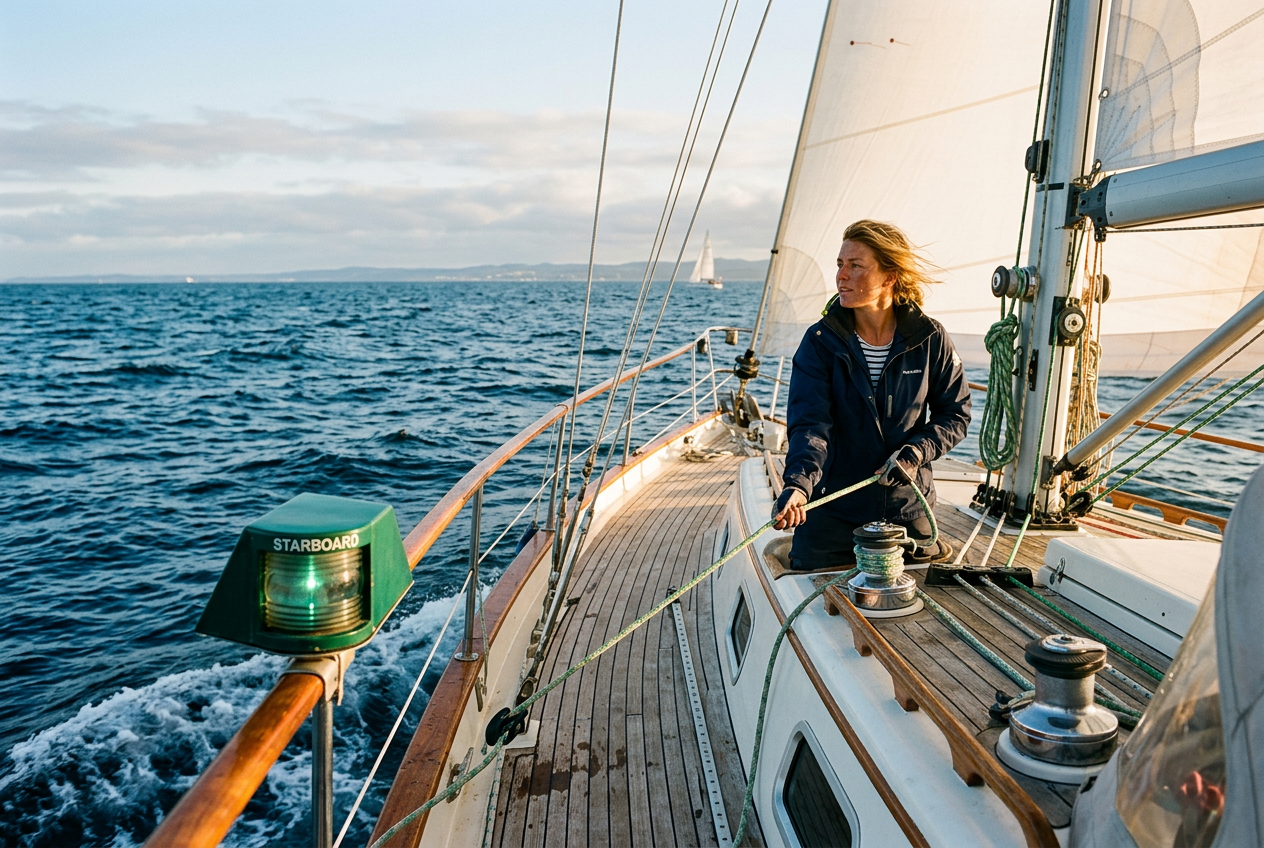
Which maritime term comes from the Old English for 'steering side,' because Viking ships had their steering oar on the right?
- the word 'starboard'
- the word 'larboard'
- the word 'steerage'
- the word 'helmsman'
Answer: the word 'starboard' — The word 'starboard' derives from Old English 'steorbord,' meaning steering side, because Viking longships mounted their steering oar on the right side of the vessel. This wasn't arbitrary—most sailors were right-handed, making right-side steering mechanically easier and more precise in heavy seas. The term survives unchanged in modern navigation, where 'starboard' remains the universal right-side designation on every vessel from kayaks to supertankers, and international maritime law mandates green lights on the starboard side—a color-coding system that prevents collisions in waters worldwide, all because medieval Norsemen favored their dominant hand when gripping a wooden oar in the North Atlantic.
The Oar That Named a Direction
Viking longships dominated northern European waters from the eighth through eleventh centuries, and their design carried one unmistakable asymmetry: a single steering oar, or styri, mounted on the right rear quarter of the hull. The Old English compound 'steorbord'—literally 'steering side'—described this arrangement, and sailors used it to distinguish right from left when barking orders in storms or battles. The oar itself was a massive wooden blade, often fifteen feet long, that pivoted on a wooden boss protruding from the hull. A helmsman stood on the raised aftcastle and gripped the horizontal tiller, using his body weight to lever the blade through the water. Archaeological finds from the Oseberg and Gokstad ship burials confirm that the oar was always on the right, a consistency driven by the fact that most crews were right-handed. Steering from the right gave the helmsman better leverage and a clearer sightline along the starboard rail, crucial when threading through skerries or beaching on a hostile shore. The word 'steorbord' appears in manuscripts from the reign of King Alfred the Great in the late ninth century, and by the time of the Norman Conquest in 1066, it had evolved into the Middle English 'sterbord,' then 'starboard.'
Why the Right, Not the Left
Mounting the steering oar on the right wasn't merely tradition—it was biomechanics. A right-handed helmsman pulling a tiller toward his body generates far more force than pushing it away, and in a following sea or crosswind, that difference could mean the gap between holding course and broaching. Viking crews learned this through trial and catastrophe: sagas record ships that 'turned turtle' or 'broke their backs' when helmsmen lost control in the North Atlantic's notorious squalls. The right-side placement also dictated how Vikings moored and loaded cargo. Because the oar projected several feet beyond the hull, captains always docked with the left side—the 'port' side—against the wharf, protecting the fragile steering mechanism from impact. This practice became so universal that 'port' eventually replaced the older term 'larboard' (from 'loading side') in the nineteenth century, precisely to avoid confusion with 'starboard' in shouted commands. The Bayeux Tapestry, embroidered around 1070, depicts William the Conqueror's invasion fleet with every ship showing its steering oar on the right, evidence that the convention had spread across all of maritime northern Europe. Even after the sternpost rudder—an invention from China that reached Europe in the thirteenth century—rendered steering oars obsolete, the vocabulary persisted, because sailors' lives depended on instant, unambiguous communication.
The Word's Journey Through the Centuries
As English evolved from Old to Middle to Modern forms, 'steorbord' underwent predictable phonetic shifts: the unstressed middle syllable weakened, the 'eo' diphthong simplified to 'a,' and by Shakespeare's time the spelling had standardized as 'starboard.' Yet its meaning never wavered. When Henry VIII commissioned the Mary Rose in 1511, shipwrights inscribed 'starboard' and 'larboard' on opposite sides of the main deck, and when the vessel was raised from the Solent in 1982, those carvings were still legible. The word sailed into global English during the Age of Exploration: Magellan's crew used 'estribor' (the Spanish cognate), Drake's logs record 'starboard tack,' and Cook's Endeavour carried the term to the Pacific. By the nineteenth century, international maritime codes had adopted 'starboard' and 'port' as the official designations, translated into dozens of languages but often left in their English forms—French sailors say 'tribord' (a corruption of 'starboard'), while Russian and Japanese merchant fleets teach the English terms directly. The 1889 International Regulations for Preventing Collisions at Sea mandated that vessels show a green light on the starboard side and red on the port side, a rule that remains in force today. A Boeing 747 pilot, a submarine commander, and a kayaker in Patagonia all use 'starboard' to mean the same thing, a lexical consistency almost unmatched in technical vocabulary—and all because Viking shipwrights needed a word to distinguish the side where they lashed a wooden oar.
Why It Still Matters in the Twenty-First Century
In an era of GPS autopilots and radar-guided navigation, 'starboard' endures because ambiguity at sea kills. The 1972 Convention on the International Regulations for Preventing Collisions at Sea—known as COLREGS—runs to seventy-five pages of rules, and 'starboard' appears in thirty-eight of them. Rule 14 states that when two vessels meet head-on, each must alter course to starboard, passing port-to-port; Rule 15 governs crossing situations, giving way to the vessel on one's starboard side. These protocols prevent disasters like the 2017 collision between the USS Fitzgerald and a container ship off Japan, an accident investigators attributed in part to confusion over which vessel should yield. Modern naval academies drill midshipmen on the terms until they respond without thinking, because a helmsman who hesitates or mistranslates 'starboard' in a crisis can sink a ship. The word also anchors a web of maritime metaphors in English: 'even keel' (balanced fore and aft), 'by and large' (sailing into and away from the wind), 'three sheets to the wind' (drunk, from loose sail-control ropes). Linguists note that while most Old English nautical terms—'bune' (drinking cup), 'ceol' (ship), 'lithe' (sailor)—vanished by 1400, 'starboard' survived because it named something navigators needed to reference instantly and unambiguously, a function that neither technology nor time has rendered obsolete.
What most people get wrong
Many people believe 'starboard' comes from 'star' as in celestial navigation, or that it's an arbitrary maritime tradition like 'ahoy.' In fact, it derives directly from 'steer-board,' the side where Vikings mounted their steering oar, and the etymology is transparently literal.
Sources & further reading
Word of the Day
pluvial adjective · PLOO-vee-ul
Relating to or characterized by rain, especially abundant rainfall. From the Latin 'pluvialis,' derived from 'pluvia' (rain), which gives us 'pluvial periods'—epochs when regions received far more precipitation than they do today—and the related word 'pluviometer,' a rain gauge. Geologists use 'pluvial' to describe the wet phases of the Pleistocene epoch, when today's deserts held vast lakes; climatologists apply it to monsoon-dominated regions where seasonal rainfall shapes every aspect of life.
“The pluvial forests of the Pacific Northwest owe their temperate rainforest character to storms rolling in from the ocean nine months a year, depositing over one hundred inches annually in some valleys and sustaining ecosystems found almost nowhere else on the continent.”
Joke of the Day
Why did the Viking helmsman refuse to write a memoir after crossing the North Atlantic in 873?
He didn't want to steer the conversation toward himself.
This Day in History
1969 — The children's television program Sesame Street premiered on the National Educational Television network, introducing a format that combined puppetry, animation, and live action to teach literacy and numeracy to preschoolers. Created by Joan Ganz Cooney and Lloyd Morrisett, the show was designed with input from child psychologists and educators who believed television could be an effective learning tool if structured around research-backed curricula. The premiere episode featured Big Bird, Bert and Ernie, and other Muppets created by Jim Henson, and within two years the show was reaching millions of children across the United States. Sesame Street became one of the longest-running programs in television history, airing in more than 150 countries and adapting its content to local languages and cultures, fundamentally reshaping early childhood education and proving that educational media could be both pedagogically rigorous and widely popular.
Enjoyed this issue?
Get the next one free, every morning.
More from Words IQ