Saturday, October 24, 2026
Bronze gears buried at sea in 100 BCE predicted what decades out?
By Corey Lewis · Editorial standards
Trivia of the Day
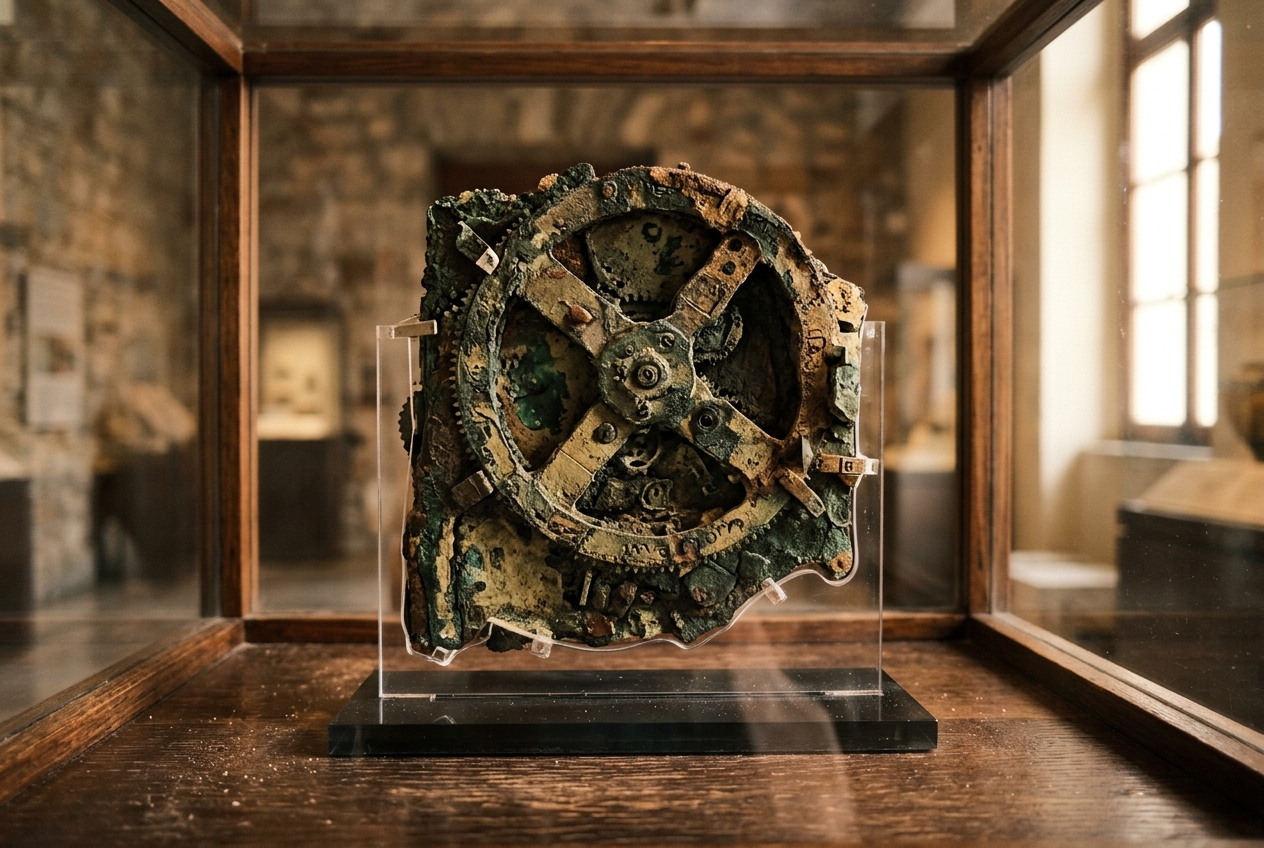
What ancient Greek device from around 100 BCE could predict eclipses and calculate Olympic Games dates decades in advance?
- the Antikythera mechanism
- the Archimedean Sphere
- the Ptolemaic Orrery
- the Rhodes Astrolabe
Answer: the Antikythera mechanism — The Antikythera mechanism, recovered from a shipwreck in 1901, contained at least 30 bronze gears and could predict astronomical positions years ahead—making it the world's oldest known analog computer, more than a millennium before anything of comparable complexity appeared in medieval Europe. It encoded the Metonic cycle (the 19-year pattern aligning solar and lunar calendars), displayed the four-year Olympiad cycle, and even corrected for the Moon's elliptical orbit using an ingenious pin-and-slot epicyclic design that wasn't rediscovered until Copernicus. Why it matters: the mechanism proves that Hellenistic Greece possessed gear-train technology and mathematical astronomy sophisticated enough to automate prediction—a technological leap that vanished for over a thousand years, leaving us to wonder what other knowledge was lost in antiquity.
The Wreck That Rewrote History
In the spring of 1900, a crew of Greek sponge divers sheltering from a storm near the tiny island of Antikythera stumbled upon a Roman-era shipwreck 150 feet below the surface. Among amphorae, marble statues, and corroded bronze, they hauled up a barnacle-encrusted lump that archaeologists initially dismissed as scrap. A year later, in May 1901, the lump split open in storage at the National Archaeological Museum in Athens, revealing the edge of a bronze gear wheel. No one in the Roman world—or the medieval one—was supposed to have built anything like it. The wreck itself dated to roughly 70–60 BCE, but the device inside, now called the Antikythera mechanism, was crafted around 100 BCE, possibly on the island of Rhodes, and was already ancient when the ship went down.
Physicist Derek de Solla Price spent two decades studying the fragments and published the first breakthrough analysis in 1974, identifying at least 30 interlocking gears and several inscribed dials. X-ray tomography in 2005 by the Antikythera Mechanism Research Project revealed another 35 gears and thousands of Greek characters engraved inside—operating instructions, essentially, for a machine that could model the cosmos. The mechanism wasn't a toy or a teaching prop; it was a precision instrument capable of calculating the positions of the Sun, Moon, and possibly all five known planets years into the future, and it did so by turning a single hand crank.
How the Gears Encoded the Sky
The front face of the mechanism displayed two concentric dials: an outer zodiac scale marking the Sun's annual journey through the ecliptic, and an inner Egyptian calendar ring of 365 days. A pointer tracked the Sun's position, while a second pointer with a small sphere showed the Moon's phase and place in the sky. The gear train driving these pointers calculated the Moon's anomalistic motion—the fact that it moves faster at perigee and slower at apogee—using an epicyclic pin-and-slot system that mimicked Hipparchus's lunar theory, centuries before Ptolemy codified it in the Almagest. This correction required a level of mechanical ingenuity that didn't reappear in European clockwork until the fourteenth century.
The back of the device held two large spiral dials. The upper one traced the Metonic cycle, a 19-year period discovered by the astronomer Meton of Athens in 432 BCE that reconciles 235 lunar months with 19 solar years—critical for fixing the dates of lunar-based festivals like the Olympics. Subsidiary dials within the Metonic spiral displayed the four-year Olympiad cycle and the eight-year Panhellenic Games calendar, meaning the user could turn the crank to any future date and see which athletic festivals would occur. The lower spiral, the Saros dial, predicted eclipses over an 18-year, 223-month cycle known to Babylonian astronomers; a smaller sub-dial, the Exeligmos, refined eclipse predictions over a 54-year triple-Saros span, accounting for the fact that every third Saros shifts longitude by eight hours.
The Human Detail Nobody Expects
The mechanism's bronze gears—each cut by hand with a file or lathe—were so finely made that their teeth had triangular profiles optimized to reduce friction and backlash, a refinement that suggests the builder understood load distribution in ways not documented in any surviving Greek text. Inscriptions on the surviving fragments name months from the Corinthian calendar used in northwest Greece and in Corinthian colonies like Syracuse, leading researchers to suspect the device was built on Rhodes, home to the astronomer Hipparchus and a thriving school of mechanical engineering. Cicero, writing a generation after the shipwreck, mentions that the Roman general Marcellus brought back a similar
What most people get wrong
Most people assume the Antikythera mechanism was unique or purely ceremonial, but ancient references by Cicero and Ovid describe similar devices built by Archimedes and Posidonius, suggesting gear-driven astronomical models were a recognized—if rare—class of Hellenistic instrument, not a one-off mystery.
Word of the Day
tessellate verb · TESS-uh-late
To cover a surface with repeated geometric shapes that fit together without gaps or overlaps, derived from the Latin tessella, a small square tile used in Roman mosaics; the technique appears in Islamic art, Escher prints, and honeycomb structures, where hexagons tessellate perfectly to maximize space.
“The bathroom floor tessellates white hexagons and black triangles in a pattern that seems to vibrate if you stare too long. Byzantine artists tessellated gold-leaf glass cubes into church domes, creating glittering celestial maps that shimmered by candlelight.”
Joke of the Day
Why did the Antikythera mechanism refuse to join LinkedIn?
It didn't want to network with anything built after 100 BCE.
This Day in History
1648 — The Treaty of Westphalia was signed on October 24, 1648, ending the Thirty Years' War in the Holy Roman Empire and the Eighty Years' War between Spain and the Dutch Republic. Negotiated simultaneously in the cities of Münster and Osnabrück, the treaty redrew the map of Europe, recognized Swiss and Dutch independence, and established the principle of cuius regio, eius religio—letting princes choose their territories' religions. Its doctrine of state sovereignty over religious authority became the foundation of the modern international system, often called the Westphalian order.
Enjoyed this issue?
Get the next one free, every morning.
More from Words IQ