Tuesday, October 27, 2026
'Could only have been painted by a madman'—who wrote that?
By Corey Lewis · Editorial standards
Trivia of the Day
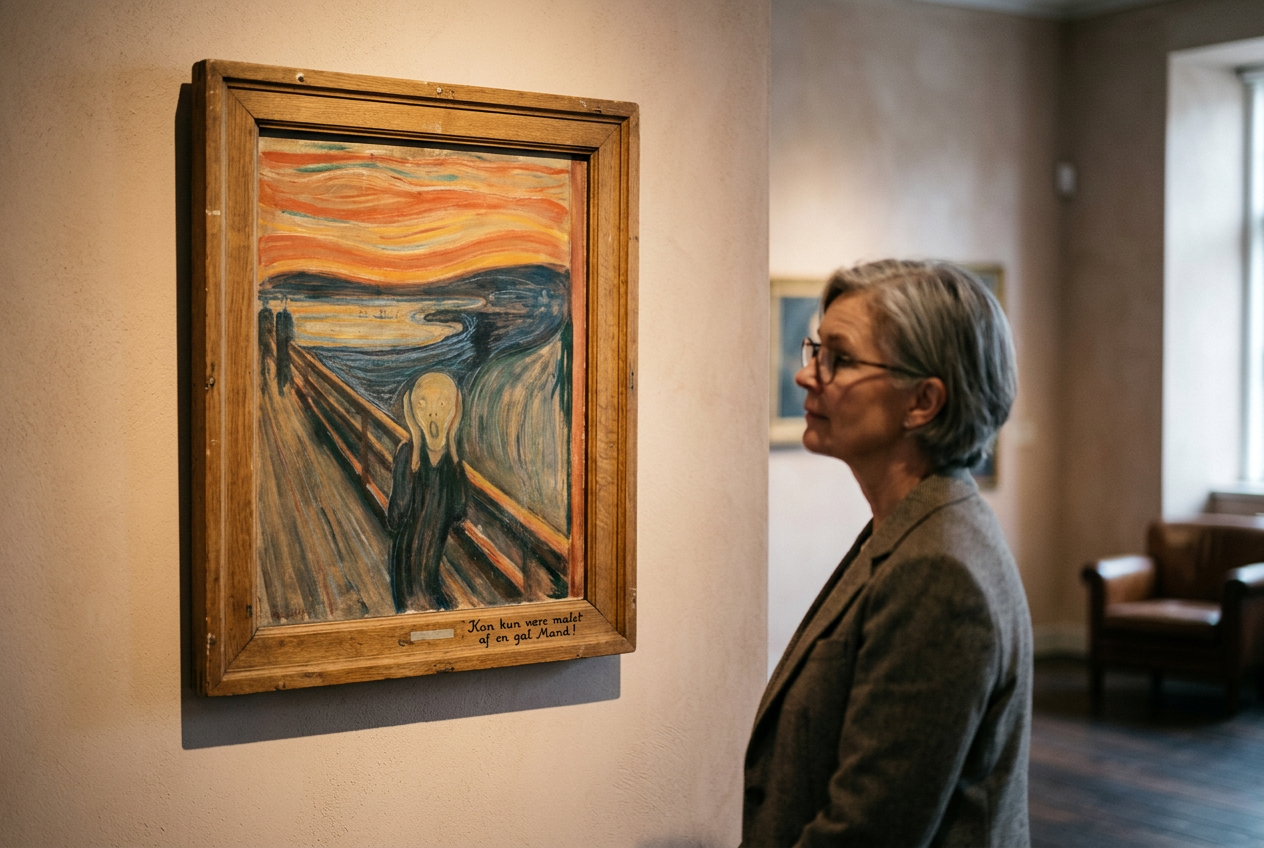
Which famous painting includes a pencil inscription by the artist himself that reads 'could only have been painted by a madman'?
- The Scream painting by Edvard Munch
- Starry Night painting by Vincent van Gogh
- The Persistence of Memory painting by Salvador Dalí
- Composition VII painting by Wassily Kandinsky
Answer: The Scream painting by Edvard Munch — In 1904, Edvard Munch wrote 'can only have been painted by a madman' in tiny pencil letters on his most famous work after critics openly questioned his mental stability at a Copenhagen exhibition. The inscription went unnoticed for decades until infrared photography revealed it in 2004, and handwriting analysis confirmed Munch himself had added the bitter rejoinder. The note transforms the painting from a universal symbol of anxiety into a deeply personal act of defiance—Munch answering his doubters by claiming the very label they'd used against him, turning their insult into his artistic signature and his fragility into his authority.
The Pencil Note That Hid for a Century
When conservators at Norway's National Museum trained infrared cameras on The Scream in 2004, they expected to find underdrawings or pigment degradation. Instead, they discovered eight words in faint pencil in the upper left corner: 'Kan kun være malet af en gal Mand' — 'can only have been painted by a madman.' The script was tiny, barely visible to the naked eye, and blended into the swirling orange sky. Handwriting experts compared the slant and letter forms to Munch's diaries and confirmed the artist himself had inscribed it, likely in 1904. The discovery electrified art historians because it reframed the painting's mythology: Munch hadn't passively absorbed the public's horror at his work, he'd answered it in the most intimate medium possible, writing directly onto the canvas as if whispering back to his accusers. The note had been there all along, hidden in plain sight for a hundred years, waiting for technology to catch up.
Munch painted the first version of The Scream in 1893, depicting a skeletal figure clutching its head on a bridge while the sky burns red and orange behind it. He called the series Der Schrei der Natur—The Scream of Nature—and described the inspiration in his diary: walking at sunset near Oslo, he felt 'a great, infinite scream piercing through nature.' Critics were bewilderered. At an 1895 Berlin exhibition, reviewers called the work 'sickly' and 'unhinged,' and one psychiatrist published an essay diagnosing Munch with melancholia based on his brushwork. By 1904, when Munch showed a pastel version in Copenhagen, whispers about his mental health had hardened into public speculation. One Danish critic wrote that only someone disturbed could see the world in such 'tortured, unnatural colors.' Munch read every review. He was already struggling—his father had died in an asylum, his sister Laura was institutionalized, and he'd recently ended a violent relationship. The accusations of madness weren't just aesthetic judgments; they were existential threats.
So Munch picked up a pencil and wrote his retort on the painting itself. The inscription wasn't a confession—it was a reclaiming. By owning the word 'madman,' he stripped it of its power to shame him and repositioned it as proof of his vision. The choice of pencil mattered: pencil is impermanent, easily erased, a private medium compared to the boldness of oil paint. Munch wasn't making a public statement for gallery-goers; he was leaving a message for himself, or perhaps for future viewers who might look closely enough. The note also suggests he saw the painting as unfinished or unsettled, still open to alteration and annotation. In 1908, Munch did suffer a breakdown and spent eight months in a Copenhagen clinic. When he emerged, he painted more calmly, with brighter palettes and less anguish. But he never removed the pencil note. It stayed, a relic of the moment when the world called him mad and he wrote it down as his credential.
Why the Inscription Still Resonates
The discovery of the note changed how museums present The Scream. Before 2004, curators framed it as a universal symbol—anyone could feel that scream, that dread, that alienation. After 2004, it became impossible to ignore the painting's origin as a deeply personal act of self-defense. Munch wasn't painting for the ages; he was painting to survive, and the note proves it. Today, the inscription is highlighted in exhibitions, discussed in audio guides, and reproduced in catalogs. It turns viewers into detectives, peering at the upper left corner to spot the faint letters themselves. The note also legitimizes the emotion in the painting: Munch's anxiety wasn't a flaw or a disorder to be corrected, it was the raw material of his art, and he knew it. In an era when mental health is openly discussed and destigmatized, the pencil note reads as an early act of radical honesty—Munch claiming his inner life as valid, vital, and worth rendering in paint. The madman label, once an insult, is now a badge of his courage to see and depict what others refused to acknowledge.
What most people get wrong
Many assume Vincent van Gogh inscribed notes on his paintings during his mental health struggles, but van Gogh never added text to his canvases—his annotations appeared only in letters to his brother Theo. Munch's pencil note on The Scream is exceptionally rare; few major artists wrote directly on their finished works as commentary.
Sources & further reading
Word of the Day
acerbic adjective · uh-SUR-bik
Sharp and biting in tone or manner, often used to describe criticism or wit that is harshly direct. The word derives from Latin acerbus meaning 'harsh' or 'bitter,' originally referring to the sour taste of unripe fruit—the same root that gives us 'acrid' and 'exacerbate.' Over time, it migrated from describing physical bitterness to describing verbal sharpness, capturing the sting of a remark that leaves no room for misunderstanding.
“The reviewer's acerbic dismissal of the novel—'a bloated exercise in self-regard'—made the author wince, but even she admitted it wasn't entirely wrong. His acerbic humor worked well in small doses, but after an hour of his cutting observations about everyone in the room, the dinner party felt less like entertainment and more like an endurance test.”
Joke of the Day
Why did the philosopher refuse to hang a mirror in his office?
He didn't want to reflect on his work.
This Day in History
1904 — The New York City subway system opened to the public on October 27, 1904, with a ceremonial trip from City Hall to 145th Street carrying Mayor George McClellan, who seized the controls from the motorman and piloted the train himself at speeds topping forty miles per hour. The initial line ran 9.1 miles and cost 5 cents to ride, a fare that wouldn't increase for forty-four years. Within a year, the subway was carrying 600,000 passengers daily, and by 1908 ridership hit 800,000—transforming Manhattan from a crowded island where the wealthy lived downtown near work into a sprawling metropolis where anyone with a nickel could live in the Bronx or Harlem and commute in minutes. The subway didn't just move people; it redrew the city's class and residential geography, making New York the first truly vertical, high-capacity city in the world.
Enjoyed this issue?
Get the next one free, every morning.
More from Words IQ