Wednesday, November 11, 2026
This Atlantic auk went extinct, then its name sailed south
By Corey Lewis · Editorial standards
Trivia of the Day
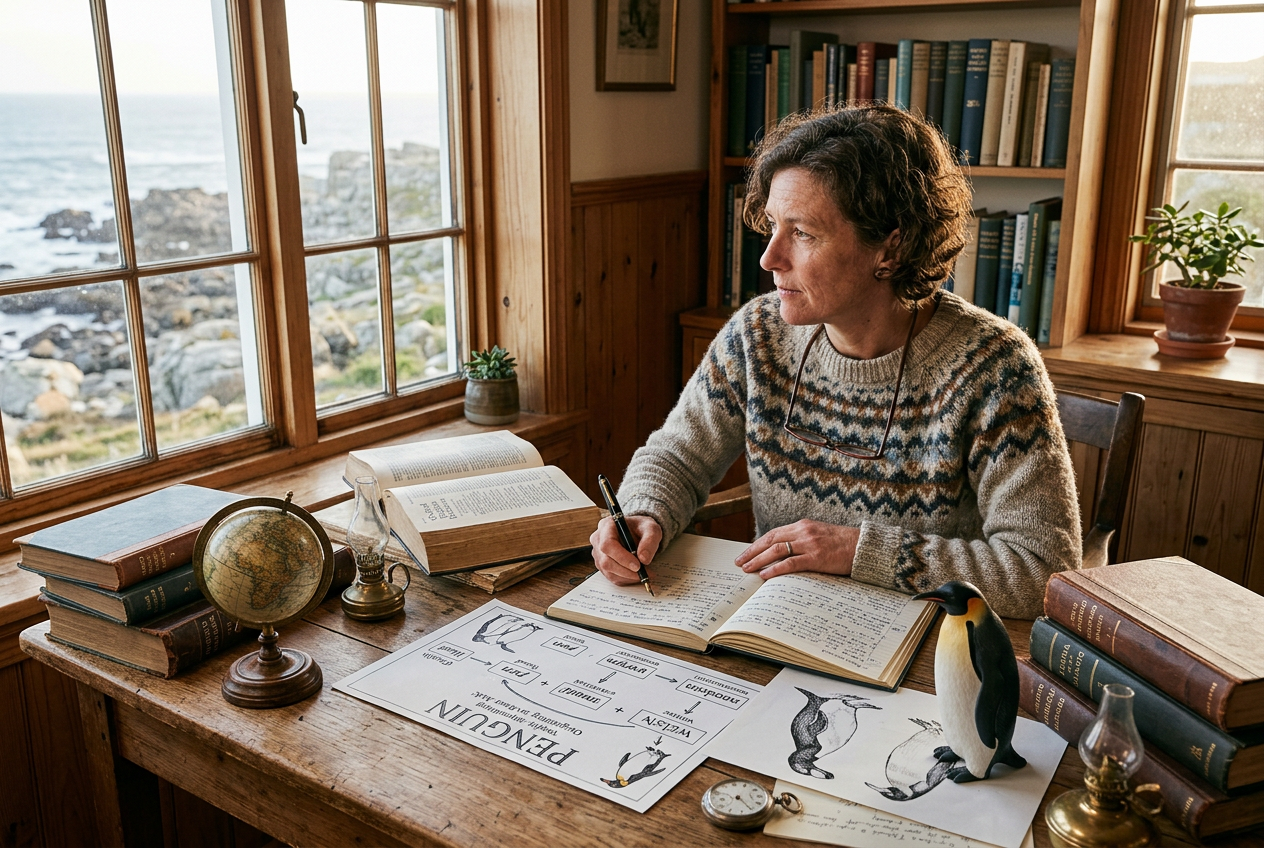
Which flightless seabird's name may originally have belonged to a completely different extinct bird?
- the word 'dodo'
- the word 'penguin'
- the word 'kiwi'
- the word 'cassowary'
Answer: the word 'penguin' — The word 'penguin' was first used for the great auk, a now-extinct flightless bird of the North Atlantic, before being transferred to the similar-looking Southern Hemisphere birds we know today. The great auk vanished in 1844, hunted to extinction, but its name lives on in the creatures that replaced it in European imagination. The linguistic handoff reveals how explorers often named new discoveries after familiar things from home, even when the resemblance was only superficial, and why it matters: the confusion has led generations to misunderstand the biogeography of flightless seabirds and the independent evolution of similar body plans on opposite sides of the planet.
The Original Penguin
The great auk stood two and a half feet tall, wore a sharp black-and-white tuxedo, and lived along the rocky coasts of the North Atlantic from Newfoundland to Norway. Europeans knew it as the *pengwyn* in Welsh, possibly meaning 'white head'—a reference to the white patches near its eyes—or from the Latin *pinguis*, meaning 'fat,' describing its plump, oil-rich body prized by sailors. By the 1500s, Basque whalers and Breton fishermen hunted great auks for meat, eggs, and feathers on remote islands like Funk Island off Newfoundland, where the birds nested in colonies of hundreds of thousands. The great auk could not fly; its wings had evolved into powerful flippers for underwater pursuit of fish, making it helpless on land against hunters who simply walked up and clubbed it. Jacques Cartier's crew killed enough great auks on one island in 1534 to salt down barrels for the voyage home, and the bird's name—penguin—became standard maritime English by 1577, appearing in explorer's logs and naval charts across the Atlantic.
When European ships rounded the Cape of Good Hope and pushed into southern waters in the 1590s, sailors encountered entirely different birds: black-and-white seabirds that stood upright, nested in massive coastal colonies, and swam with flipper-like wings. Dutch navigator Jacob Corneliszoon van Neck called them *pinguijns* in 1598, applying the familiar North Atlantic name to these unfamiliar Southern Ocean creatures. The resemblance was superficial—Southern Hemisphere penguins belong to the family Spheniscidae, while the great auk was an alcid, more closely related to puffins and razorbills—but both groups had independently evolved the same flightless, flippered body plan for diving. English sailors adopted the Dutch usage, and by the 1600s 'penguin' referred almost exclusively to the southern birds, even as the great auk still swam in northern seas. The linguistic transfer was so complete that when the great auk finally went extinct in 1844—the last breeding pair was killed on Eldey Island off Iceland on June 3—most English speakers had already forgotten it ever carried the penguin name.
The Convergent Evolution Nobody Expected
The great auk and modern penguins never met; ten thousand miles of ocean separated their ranges, and they descended from completely different ancestral lineages. Yet both evolved nearly identical solutions to the same problem: how to catch fish underwater while nesting on land. The great auk's wings measured only about six inches long, useless for flight but perfect for propelling the bird through cold Atlantic water at speeds reaching fifteen miles per hour. Antarctic penguins developed the same adaptation independently, their wings transforming into rigid, flat flippers covered in scale-like feathers that functioned more like fins than limbs. Both groups evolved dense bones—unlike the hollow, air-filled skeletons of flying birds—to reduce buoyancy and enable deep dives: great auks reached depths of 250 feet, emperor penguins exceed 1,800 feet. The tuxedo coloration was another convergence: a white belly made the bird harder to see from below against bright surface water, while a dark back camouflaged it from above against the ocean depths, a pattern marine biologists call countershading.
The name confusion misled naturalists for centuries. Carl Linnaeus, cataloging species in the 1750s, placed the great auk in the genus *Pinguinus* and assigned it the species name *impennis*, meaning 'wingless.' By then, true penguins were known from dozens of species across the Southern Ocean, and Linnaeus recognized they were not closely related to the great auk despite the shared name. French naturalist Georges-Louis Leclerc, Comte de Buffon, argued in the 1770s that the great auk and penguins represented a single stock of flightless seabirds that had somehow dispersed across the globe, but anatomical studies in the 1800s—especially comparisons of skull structure and feather arrangement—proved the two groups had no recent common ancestor. The parallel evolution was so exact that even museum visitors today often assume the taxidermied great auk in the Natural History Museum in London is simply a large penguin species, unaware they are looking at a bird from a completely different family that evolved its flightlessness independently, tens of millions of years apart.
The Extinction That Erased the Name
The great auk's decline accelerated after 1800 as European and American demand for feathers—used to stuff mattresses and pillows—drove industrial-scale hunting. On Funk Island, workers herded flightless auks into stone pens, boiled them alive in iron cauldrons to loosen their feathers, and burned the bodies as fuel to keep the fires going. By 1810, the Funk Island colony was gone. The species retreated to a handful of remote North Atlantic islets, but collectors soon targeted these last refuges: a breeding great auk fetched high prices from museums assembling natural history cabinets, and its eggs—pale green with dark streaks—became prized specimens. On June 3, 1844, fishermen Jón Brandsson, Sigurður Ísleifsson, and Ketil Ketilsson landed on Eldey Island and found the last known breeding pair of great auks incubating a single egg. They strangled both birds and smashed the egg. No confirmed sightings followed, though unverified reports trickled in until the 1850s from Newfoundland and the Faroe Islands.
The great auk's extinction came just as the word 'penguin' was cementing its association with the Antarctic birds. Ornithologists in the 1850s began using 'great auk' exclusively to avoid confusion, relegating *Pinguinus impennis* to museum specimen labels. The bird's disappearance from living memory meant that by 1900, few English speakers realized penguins had ever been named after a completely different creature. The reversal was total: today, when biologists refer to the family Alcidae, they carefully note that despite the superficial resemblance, alcids are Northern Hemisphere birds unrelated to penguins, as if the original penguin never existed. Only about 80 great auk skins and 75 eggs survive in museum collections worldwide, including a mounted specimen at the Smithsonian that still carries a faded label reading 'penguin'—a ghost of the word's first meaning, preserved in a bird that no longer swims the North Atlantic.
Why the Name Swap Still Matters
The penguin-to-penguin transfer illustrates how human language shapes scientific understanding in unexpected ways. When Charles Darwin visited the Galápagos Islands in 1835, he noted the flightless cormorant and immediately compared it to 'the penguins of the southern seas,' never mentioning the great auk—by then, the northern bird was nearly extinct and the name had fully migrated south. The linguistic shift reinforced a false geographic narrative: that flightless seabirds were inherently Southern Ocean creatures, an accident of evolution confined to Antarctica and nearby coasts. In reality, flightlessness evolved independently at least four times in seabird lineages—alcids in the north, penguins in the south, and isolated cases like the Galápagos cormorant and the extinct plotopterids of the North Pacific—but the name 'penguin' now implies a single Antarctic origin. Modern conservation language still carries the bias: 'penguin habitat' means subantarctic islands, never the rocky North Atlantic coasts where the original penguins nested.
The great auk's extinction and name erasure also offer a cautionary tale about baseline shifting. By the time systematic seabird conservation began in the early 1900s, the great auk was already gone, and no living memory remained of the vast colonies that once covered Funk Island. Fishermen and naturalists assumed the northern oceans had always been dominated by flying alcids—puffins, murres, razorbills—and never knew they were looking at an impoverished ecosystem missing its largest, most specialized diver. When biologists debate penguin conservation today, they reference historical population sizes from the 1800s and 1900s, unaware that those baselines may already reflect human-depleted populations. The name 'penguin,' passed from an extinct bird to its southern doppelgänger, carries no memory of the loss encoded in the transfer—only the modern species remains, swimming in seas half a world away from where the word was born.
What most people get wrong
Most people assume the word 'penguin' has always referred to the Antarctic birds we know today, unaware it originally named the now-extinct great auk of the North Atlantic before European explorers transferred the term to the superficially similar flightless seabirds of the Southern Hemisphere.
Sources & further reading
Word of the Day
exiguous adjective · ig-ZIG-yoo-us
Extremely small in size or amount; scanty or meager. From the Latin *exiguus*, meaning 'small' or 'petty,' derived from *exigere* ('to drive out, demand, measure'), the word entered English in the 1650s to describe anything insufficient or barely adequate—whether portions, resources, or living space.
“The graduate student survived on an exiguous stipend that covered rent but left little for anything else. In a different sense, the designer worked within the exiguous confines of a studio apartment, turning twelve square meters into a surprisingly functional home.”
Joke of the Day
Why did the ornithologist refuse to correct the sailor's penguin story?
Because by the time anyone noticed the mistake, the original bird had gone extinct.
This Day in History
1918 — At 11:00 a.m. on November 11, 1918, the armistice ending World War I took effect across the Western Front, silencing guns that had fired continuously for over four years. The agreement had been signed six hours earlier in a railway carriage in the Forest of Compiègne, northeast of Paris, where German representatives met Allied supreme commander Marshal Ferdinand Foch to accept terms that included immediate withdrawal from occupied territories and surrender of heavy weapons. News of the ceasefire spread by telegraph and field telephone, but fighting continued until the final minute—Canadian Private George Lawrence Price was shot at 10:58 a.m. and became the last Commonwealth soldier killed in action, while American Henry Gunther died charging a German roadblock at 10:59 a.m., one minute before the war officially ended. The 11th hour of the 11th day of the 11th month became Armistice Day, later renamed Veterans Day in the United States and Remembrance Day across the Commonwealth, marking the end of a conflict that killed an estimated 20 million people and redrew the map of Europe.
Enjoyed this issue?
Get the next one free, every morning.
More from Words IQ