Sunday, November 1, 2026
An evil spirit's name became a word for a bad dream—which?
By Corey Lewis · Editorial standards
Trivia of the Day
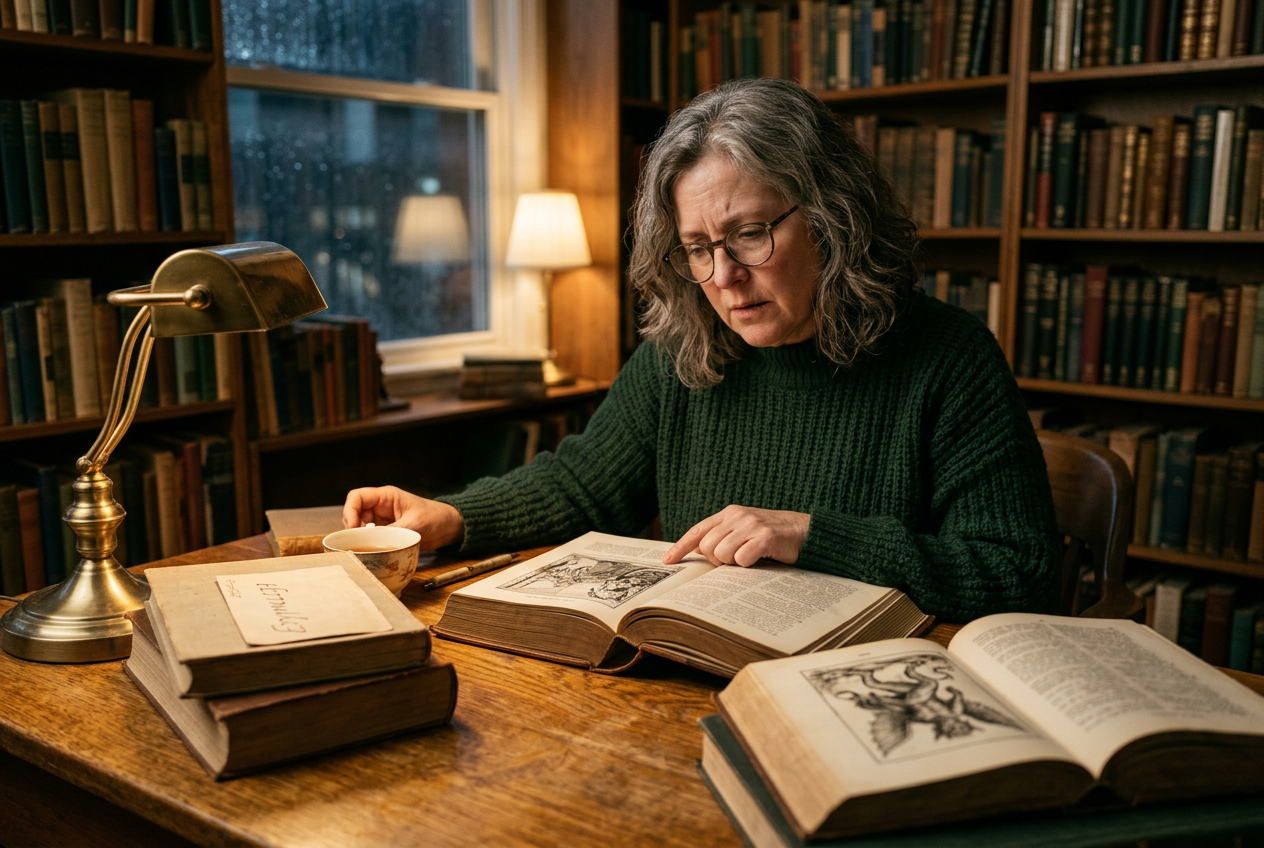
Which common English word originally referred to an evil spirit that sat on sleepers' chests, not to a bad dream?
- the word 'insomnia'
- the word 'nightmare'
- the word 'terror'
- the word 'phantom'
Answer: the word 'nightmare' — The Old English 'mare' was a demon of the night, and for centuries people woke gasping not from frightening visions but from the suffocating weight of an invisible creature pressing down on their ribs. The word 'nightmare' named the attacker, not the dream—and the shift to our modern meaning didn't fully settle until the 1800s, when science replaced superstition and the demon became a metaphor. Yet the old belief lingers in every language: German 'Nachtmahr,' French 'cauchemar,' all descended from the same crushing sprite. Sleep paralysis, now understood as a neurological hiccup when REM atonia outlasts the dream, was once proof that malevolent beings prowled the bedroom—and the word we use today still carries the shadow of that ancient terror.
The Mare in the Dark
In Anglo-Saxon England, the 'mare' was no horse. It was a demon, specifically female, who crept through keyholes and crouched on the chests of sleepers, pinning them in a breathless, paralyzed state between waking and sleep. The Old English 'mare' shares roots with the Proto-Germanic '*marōn,' meaning 'crusher' or 'oppressor,' and by the year 1000 the compound 'niht-mare'—night-crusher—was common currency in medical texts and folklore. The Scots called it the 'mair,' the Dutch the 'nachtmerrie,' the Icelandic the 'mara.' Descriptions were startlingly consistent: victims woke unable to move or cry out, sensing a malevolent presence in the room, often seeing a shadowy figure or feeling crushing weight on the sternum. In 1639, the physician John Browne wrote of patients 'tormented by the Mare' and prescribed everything from iron horseshoes hung over beds to prayers muttered backward. The nightmare was not a vision you had—it was a creature that had you.
When the Demon Became the Dream
For centuries, 'nightmare' meant only the demon. If you wanted to describe a frightening dream, you said 'a fearful dream' or 'a vision of dread.' Shakespeare used 'dream' and 'vision' for nocturnal horrors; 'nightmare' appears nowhere in his works. The semantic shift began in the 1700s, when Enlightenment physicians started attributing the phenomenon to indigestion, bad air, or nervous disorders rather than demonic visitation. By 1768, the painter Henry Fuseli could title his famous canvas 'The Nightmare' and depict both the incubus squatting on a sleeping woman's chest and the wild-eyed horse emerging from curtains—visual puns on both the old and new meanings. Samuel Johnson's 1755 dictionary defined 'nightmare' as 'a morbid oppression in the night, resembling the pressure of weight upon the breast,' still clinging to the physical sensation. But by 1828, Noah Webster's American dictionary included 'a terrifying dream' as the primary definition, and the demon had been fully linguistically domesticated into a metaphor. The creature became the experience, and the word we inherited names a ghost that no longer haunts.
The Biology Behind the Belief
What medieval Englishmen called the mare, modern neuroscience calls sleep paralysis—a glitch in the brain's transition between REM sleep and wakefulness. During REM, the body enters atonia, a temporary paralysis that prevents us from acting out dreams. Normally this shuts off the instant you wake. In sleep paralysis, the atonia lingers while consciousness returns, leaving the victim awake, aware, and utterly immobile. The brainstem's pons and medulla are still issuing 'freeze' signals to the limbs. Meanwhile, the amygdala—the brain's fear center—remains hyperactive from the dream state, flooding the conscious mind with dread in the absence of any external threat. In a 2011 study at the University of Waterloo, 8 percent of the general population reported at least one episode, with incidence spiking among shift workers, narcoleptics, and the sleep-deprived. Hallucinations are common: the brain, receiving no sensory input from the paralyzed body, invents explanations for the terror and immobility, conjuring shadowy intruders, crushing weights, or the sensation of being dragged from bed. Cultures worldwide have named the phenomenon—Newfoundland's 'Old Hag,' Japan's 'kanashibari,' Mexico's 'se me subió el muerto'—but all describe the same neurological event our ancestors personified as the mare.
Why the Word Still Haunts Us
The nightmare survives in English not because we believe in demons, but because the metaphor is too vivid to abandon. We say 'living nightmare' for waking horror, 'nightmare scenario' for catastrophic outcomes, 'bureaucratic nightmare' for Kafkaesque frustration—the word has become our go-to intensifier for dread. In 1992, the FDA even coined 'drug-induced nightmare' as a formal adverse-event category, codifying a folk term into medical taxonomy. Meanwhile, sleep paralysis remains underdiagnosed and often mistaken for psychiatric disorder; a 2017 review in *Sleep Medicine Reviews* found that fewer than half of sufferers ever mention it to a doctor, and many still interpret the experience through cultural or supernatural lenses. The mare may be dead, but her linguistic ghost presses on our chests every time we describe a bad dream, a rough day, or a policy disaster—and every Halloween, when costume shops sell 'nightmare' masks, they resurrect the demon one more time, proof that a word can outlive the creature it named and still carry its weight a thousand years on.
What most people get wrong
Most people assume 'nightmare' has always meant a bad dream, but for nearly five centuries it named a demon, not a vision. The mare was a malevolent spirit; the dream was her calling card, not her identity.
Word of the Day
caliginous adjective · kuh-LIJ-in-us
Misty, dim, or dark; obscured by fog or murk. From Latin 'calīginōsus,' derived from 'calīgō' meaning 'mist' or 'darkness'—the same root that gave us 'Caligula,' the Roman emperor whose nickname meant 'little boot' but whose reign was metaphorically shrouded in moral fog. The word carries both literal atmospheric gloom and figurative obscurity, whether of thought, motive, or prose.
“The caliginous morning made it impossible to see the lighthouse from the harbor, and the fishermen refused to sail. Her explanation for missing the board meeting was so caliginous that even her allies suspected evasion rather than confusion.”
Joke of the Day
Why did the sleep researcher refuse to testify about the nightmare study?
She didn't want to give evidence under a mare.
This Day in History
1512 — Michelangelo's Sistine Chapel ceiling was unveiled to the public for the first time on All Saints' Day, after four years of backbreaking work on scaffolding 60 feet above the floor. Pope Julius II had commissioned the project in 1508, originally asking only for twelve apostles; Michelangelo countered with a cosmic drama of 300 figures spanning Creation to the Flood, painting over 5,000 square feet of plaster in fresco—pigment applied to wet lime that bonds as it dries, allowing no correction. The unveiling drew gasps: the vibrant colors, the twisting nudes, the God reaching toward Adam with a fingertip gap that became the most reproduced hand in art history. The work redefined what painting could be and confirmed Michelangelo, then 37, as the greatest artist of his age. Today, half a million visitors crane their necks beneath that ceiling every month, and conservators still debate whether the controversial 1980s cleaning, which removed centuries of grime and candle soot, revealed Michelangelo's true palette or stripped away his final shadowing glazes.
Enjoyed this issue?
Get the next one free, every morning.
More from Words IQ