Saturday, July 18, 2026
Trivia of the Day
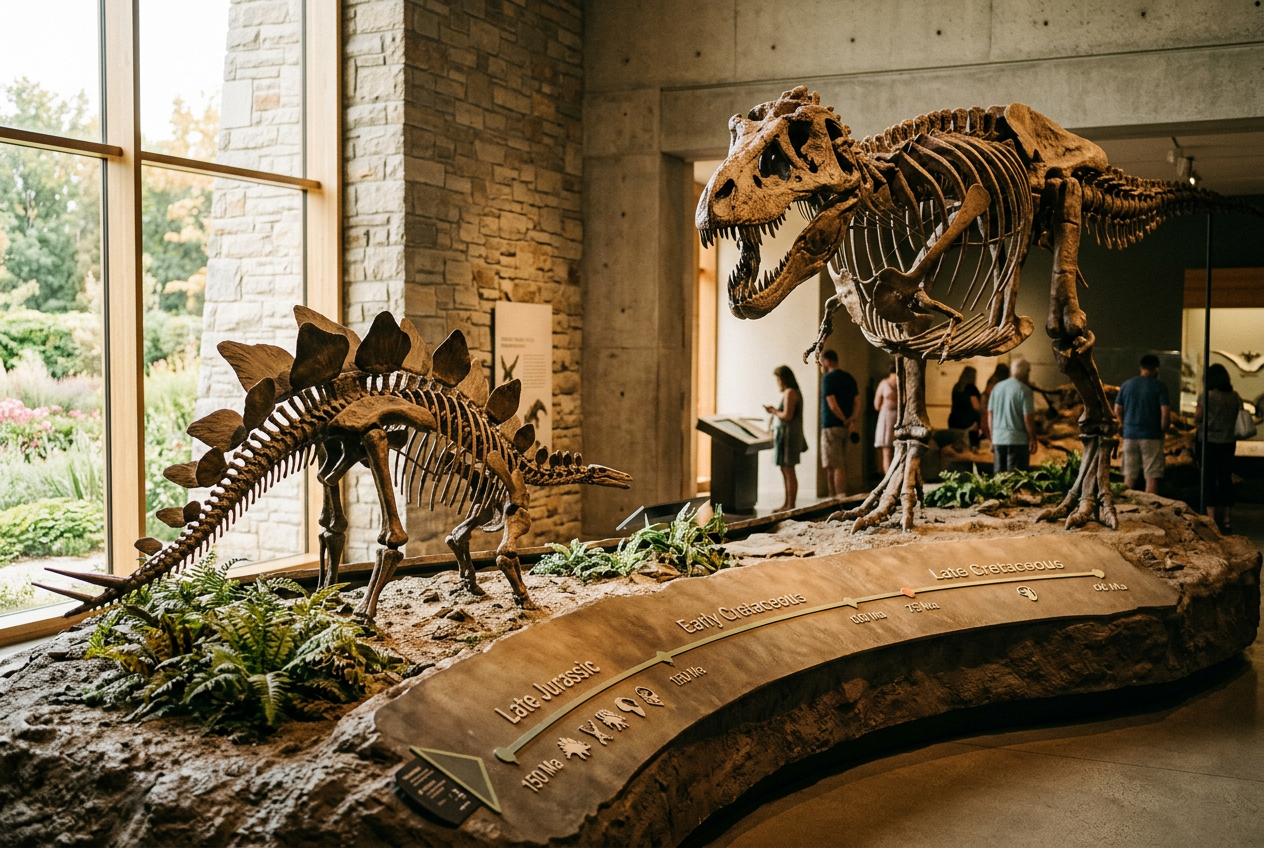
Which famous predator lived closer in time to seeing a live Stegosaurus than we live to seeing a live Tyrannosaurus rex?
- The Velociraptor
- The Allosaurus
- The Tyrannosaurus rex
- The Spinosaurus
Answer: The Tyrannosaurus rex — Tyrannosaurus rex roamed North America around 68 million years ago, while Stegosaurus went extinct roughly 150 million years ago—leaving an 82-million-year chasm between them, wider than the 68 million years separating us from T. rex. That means you and I are closer in time to watching a living Tyrannosaurus than that tyrannosaur ever was to encountering a plated Stegosaurus. The Jurassic and Cretaceous periods feel like a single
When Dinosaurs Missed Each Other by Epochs
The Tyrannosaurus rex stalked the floodplains of what is now Montana, Wyoming, and South Dakota during the final two million years of the Cretaceous period, between roughly 68 and 66 million years ago. Stegosaurus, the plate-backed herbivore immortalized in museum halls, disappeared at the close of the Jurassic period around 150 million years ago. That 82-million-year gap is longer than the entire span separating T. rex's extinction from the present day.
In geological terms, T. rex lived closer to witnessing the first iPhone than to glimpsing a living Stegosaurus. The two never shared a landscape, a continent-scale ecosystem, or even the same climate regime—Stegosaurus knew a world of shallow seas and cycad forests, while T. rex prowled under flowering magnolias and alongside early mammals. Popular culture conflates "the age of dinosaurs" into a single era, but the Mesozoic spanned 186 million years, longer than the entire Cenozoic that followed.
The Jurassic World of Stegosaurus
Stegosaurus roamed the Morrison Formation ecosystem during the Kimmeridgian and Tithonian stages, approximately 155 to 150 million years ago. Its contemporaries included sauropods like Brachiosaurus and Diplodocus, along with predators such as Allosaurus and Ceratosaurus. The climate was warm and seasonally arid, with vast river systems draining into an interior seaway that split North America.
Fossil evidence from Colorado, Utah, and Wyoming reveals Stegosaurus inhabited floodplains dominated by conifers, ferns, and primitive cycads. No grasses existed yet, and flowering plants wouldn't evolve for another 20 million years. The supercontinent Pangaea had recently fragmented, but the Atlantic Ocean remained narrow. By the time Stegosaurus went extinct at the Jurassic-Cretaceous boundary, sea levels had risen dramatically, and the Morrison ecosystem had transformed completely.
The Cretaceous Reign of Tyrannosaurus
T. rex emerged in the Maastrichtian stage as North America had become fully divided by the Western Interior Seaway, creating the island continent Laramidia. This apex predator reached lengths of 12.3 meters and weights approaching 9,000 kilograms, with bone-crushing bite forces exceeding 12,800 pounds. Specimens like "Sue" and "Scotty" provide detailed anatomical evidence from the Hell Creek Formation.
The Late Cretaceous landscape bore no resemblance to Stegosaurus's world. Angiosperms—flowering plants—had revolutionized terrestrial ecosystems, with magnolias, laurels, and early palms forming complex forests. T. rex shared its environment with Triceratops, Ankylosaurus, and Edmontosaurus, plus early mammals like Didelphodon. Global temperatures averaged 4°C warmer than today, with no polar ice caps. This world persisted until the Chicxulub asteroid impact 66 million years ago erased non-avian dinosaurs entirely.
Why the Timeline Matters Today
Understanding deep time reshapes how paleontologists interpret evolutionary patterns and extinction events. The K-Pg boundary that killed T. rex represents just 0.36% of dinosaur history, yet it fundamentally reset terrestrial ecosystems. Modern birds, the only surviving dinosaur lineage, descended from small theropods that lived alongside T. rex, not the more ancient Archaeopteryx from Stegosaurus's era.
This temporal perspective influences conservation biology and climate science. Species turnover occurred continuously throughout the Mesozoic, with average species duration ranging from 2 to 10 million years. Current extinction rates, driven by human activity, now exceed background rates by 100 to 1,000 times. The 66 million years since T. rex's demise allowed mammals to diversify into 6,400 species—a reminder that evolutionary recovery from mass extinction operates on timescales that dwarf human civilization's entire 10,000-year existence.
What most people get wrong
Most people picture dinosaurs as a single, overlapping cast populating one long
Sources & further reading
Word of the Day
chronometric adjective · kron-uh-MET-rik
Relating to the measurement of time with precision, derived from Greek 'chronos' (time) and 'metron' (measure); used especially in geology and archaeology to describe dating methods that yield absolute ages in years rather than relative sequences.
“Radiometric dating provided chronometric evidence that the Cretaceous-Paleogene boundary occurred 66 million years ago. The archaeologist preferred chronometric techniques like carbon-14 analysis over stratigraphy alone, since they pinned artifacts to exact centuries rather than vague cultural phases.”
Joke of the Day
Why did the paleontologist refuse to organize the museum's dinosaur exhibit by era?
Because putting T. rex and Stegosaurus in the same display case would be like rooming Cleopatra with a pyramid builder.
This Day in History
1925 — On July 18, 1925, Adolf Hitler published the first volume of 'Mein Kampf' while imprisoned in Landsberg after his failed Beer Hall Putsch. The 400-page manifesto combined autobiography with antisemitic ideology and territorial ambitions, initially selling poorly—about 9,000 copies in 1925. By the time Hitler became chancellor in 1933, the book had sold over 240,000 copies; by 1945, it had reached ten million, making Hitler wealthy and embedding his worldview into German culture.
Enjoyed this issue?
Get the next one free, every morning.
More from Words IQ