Saturday, November 7, 2026
Entire streets and markets opened on a river in winter—which?
By Corey Lewis · Editorial standards
Trivia of the Day
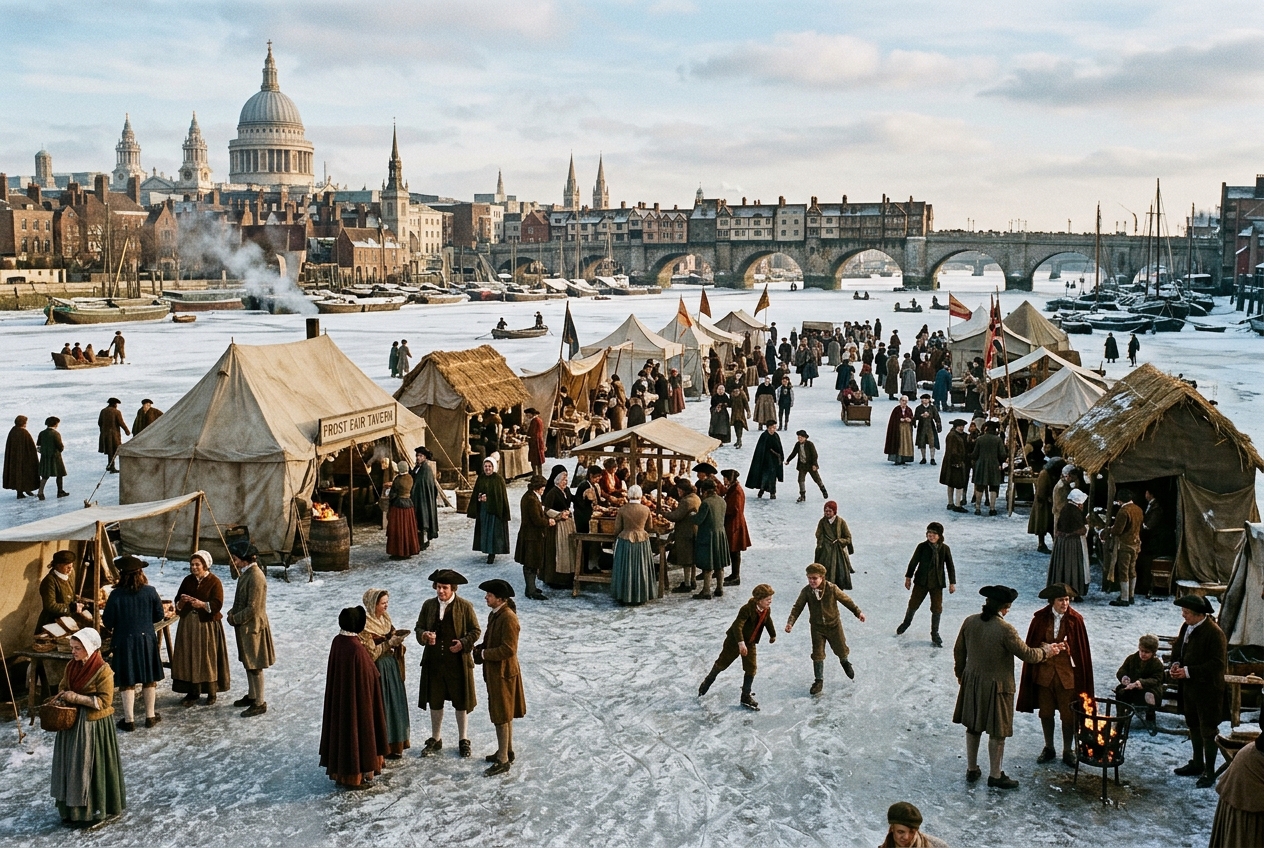
Which major river once froze so solidly that Londoners held 'Frost Fairs' on its surface with entire streets of market stalls?
- Thames River
- Seine River
- Danube River
- Tiber River
Answer: Thames River — Between 1608 and 1814, the Thames froze completely solid during the Little Ice Age, allowing Londoners to hold elaborate Frost Fairs with printing presses, food vendors, and even an elephant walking on the ice. The last great frost fair in 1814 saw thousands gather on the frozen river for four days before a sudden thaw sent tents, merchandise, and revelers scrambling for the banks. The medieval London Bridge, with its nineteen narrow arches acting as a dam, slowed the river's flow enough to let ice accumulate—but when the bridge was replaced in 1831 with a wider design, the Thames never froze solid again, ending a tradition that had lasted over two centuries.
When London's Lifeline Became a Winter Carnival Ground
The Thames River, London's commercial artery and sewage channel, transformed into a bustling fairground whenever winter temperatures plunged below freezing for weeks on end. The first recorded Frost Fair occurred in 1608, when the river froze solid enough to support the weight of entire temporary villages erected on the ice. By 1683–84, the Thames remained frozen for two months straight, and Londoners built an entire street of booths running from the Temple to Southwark, complete with a printing press that churned out souvenir certificates commemorating the event. The 1716 fair saw an entire ox roasted on the ice, while the 1740 freeze lasted so long that entrepreneurs erected puppet theaters, skittle alleys, and even a fox hunt across the frozen expanse. These weren't spontaneous gatherings—they were organized commercial enterprises where merchants paid rent for stall space, and hawkers sold everything from gingerbread to mulled wine. The river's unusual freezing pattern stemmed from a combination of the Little Ice Age's brutal winters and the Old London Bridge's peculiar architecture, which narrowed the river's flow and created conditions ripe for ice accumulation.
The Physics Behind a Frozen Highway
The medieval London Bridge, completed in 1209, featured nineteen stone arches that spanned the Thames—but these arches were so narrow that they constricted the river's natural flow by as much as two-thirds during low tide. This bottleneck effect slowed the water dramatically, giving ice crystals time to form and accumulate rather than being swept downstream. During the coldest winters of the Little Ice Age, a climatic period lasting roughly from 1300 to 1850, temperatures in London regularly dropped to levels that would freeze the slowed Thames within days. The bridge's starlings—massive wooden foundations protecting each stone pier—further impeded the current, creating calm pools where ice formed thick sheets rather than drifting floes. Scientists estimate the ice needed to reach at least eleven inches thick to safely support human weight, and during the most severe freezes, it grew to more than a foot. The tidal nature of the Thames added another layer of complexity: at high tide, seawater pushed upstream, and when it froze, the salt content lowered the freezing point slightly, but the sheer volume of freshwater overwhelmed this effect during prolonged cold snaps. By contrast, the Seine in Paris rarely froze solid because it flowed faster and lacked such restrictive bridges, while the Tiber in Rome and Danube in Vienna had different climatic and geographic conditions that prevented the same phenomenon.
Life and Commerce on the Ice
The 1814 Frost Fair, the last and most famous, epitomized the scale and chaos these events could reach. From February 1 to February 5, tens of thousands of Londoners descended onto the frozen Thames between Blackfriars Bridge and London Bridge, where an entire temporary city sprang up overnight. Entrepreneurs erected printing presses that sold personalized certificates—"Printed on the River Thames, Feb. 5, 1814"—for a shilling each, creating souvenirs that survive in archives today. One vendor roasted a sheep in a makeshift oven and sold mutton pies labeled "Lapland Mutton," while publicans set up canvas-roofed taverns serving gin and beer at inflated prices. A man named Davis brought an elephant named Chunee onto the ice near Blackfriars and charged spectators a shilling to watch the animal walk across the frozen river, an event recorded in contemporary newspapers as proof of the ice's astonishing strength. Pickpockets worked the crowds, and at least one blanket stall collapsed when a thaw crack opened beneath it, though no deaths were recorded that year. The fair ended abruptly on February 6 when temperatures rose and the ice began breaking apart; merchants abandoned their goods in a frantic retreat to shore, and chunks of ice carried away entire stalls downriver. The economic impact was substantial—watermen who normally ferried passengers across the Thames lost income, but enterprising fairground operators made small fortunes in just four days.
Why the Thames Will Never Freeze Again
The demolition of the Old London Bridge in 1831 and its replacement with a modern structure featuring wider arches fundamentally altered the Thames's hydrology, allowing the river to flow unimpeded and preventing ice accumulation even during severe winters. The new bridge eliminated the bottleneck effect that had been essential to creating the freeze conditions, and subsequent engineering projects further dredged and widened the river to accommodate steam-powered vessels. The end of the Little Ice Age around 1850 brought milder winters to Britain, with fewer prolonged cold spells capable of sustaining ice formation. Modern London's urban heat island effect, generated by millions of residents and dense infrastructure, raises ambient temperatures by several degrees compared to surrounding countryside, making river freezing virtually impossible. Additionally, the Thames Barrier, completed in 1982 to prevent flooding, regulates water flow in ways that would disrupt any nascent ice formation. The last time the Thames froze at all was in 1963, and even then, only small sections near the banks iced over—nothing resembling the solid sheets of earlier centuries. Climatologists note that even if another Little Ice Age occurred, today's engineered river would resist freezing due to its increased depth, faster flow, and warmer discharge from industrial and residential sources. The Frost Fairs remain a vivid reminder of how a city's geography, climate, and infrastructure intersect to create ephemeral phenomena that, once altered, vanish permanently from the landscape of possibility.
What most people get wrong
Many assume the Thames froze regularly because Britain was simply colder in past centuries, but the river's freezing depended on the Old London Bridge's narrow arches creating a bottleneck—without that specific infrastructure, even Little Ice Age winters wouldn't have produced the solid ice sheets that supported Frost Fairs.
Word of the Day
natant adjective · NAY-tuhnt
Floating or swimming on the surface of water; in heraldry, depicted as swimming horizontally. From the Latin *natant-*, present participle of *natare* ('to swim'), which also gave English 'natatorium' and shares a root with 'natation.' The term entered English in the 16th century through heraldic terminology, where it described fish or other creatures shown in profile as if gliding through water, distinguishing them from 'hauriant' (upright) or 'naiant' (diagonal) positions.
“The koi remained natant near the pond's surface, their orange backs breaking the water's mirror-like calm. In the medieval coat of arms, three pike were blazoned natant in pale, symbolizing the family's ancestral fishing rights along the River Wye.”
Joke of the Day
Why did the Frost Fair vendor refuse to offer a money-back guarantee?
His return policy had a thaw clause.
This Day in History
1991 — The Soviet Union's State Council officially recognized the independence of the three Baltic states—Estonia, Latvia, and Lithuania—after more than fifty years of forced annexation. The recognition came four months after the failed August coup against Mikhail Gorbachev, during which Baltic citizens had formed human chains and resisted Soviet troops attempting to reassert control. Estonia had declared independence on August 20, followed by Latvia on August 21 and Lithuania reaffirming its March 1990 declaration, but Moscow's formal acknowledgment on November 7 marked the legal dissolution of Soviet authority over territories seized under the 1939 Molotov-Ribbentrop Pact. The move accelerated the USSR's disintegration, which would be complete by December 26, 1991, and opened the door for the Baltic nations to join NATO and the European Union within the next fifteen years.
Enjoyed this issue?
Get the next one free, every morning.
More from Words IQ