Wednesday, October 28, 2026
Trivia of the Day
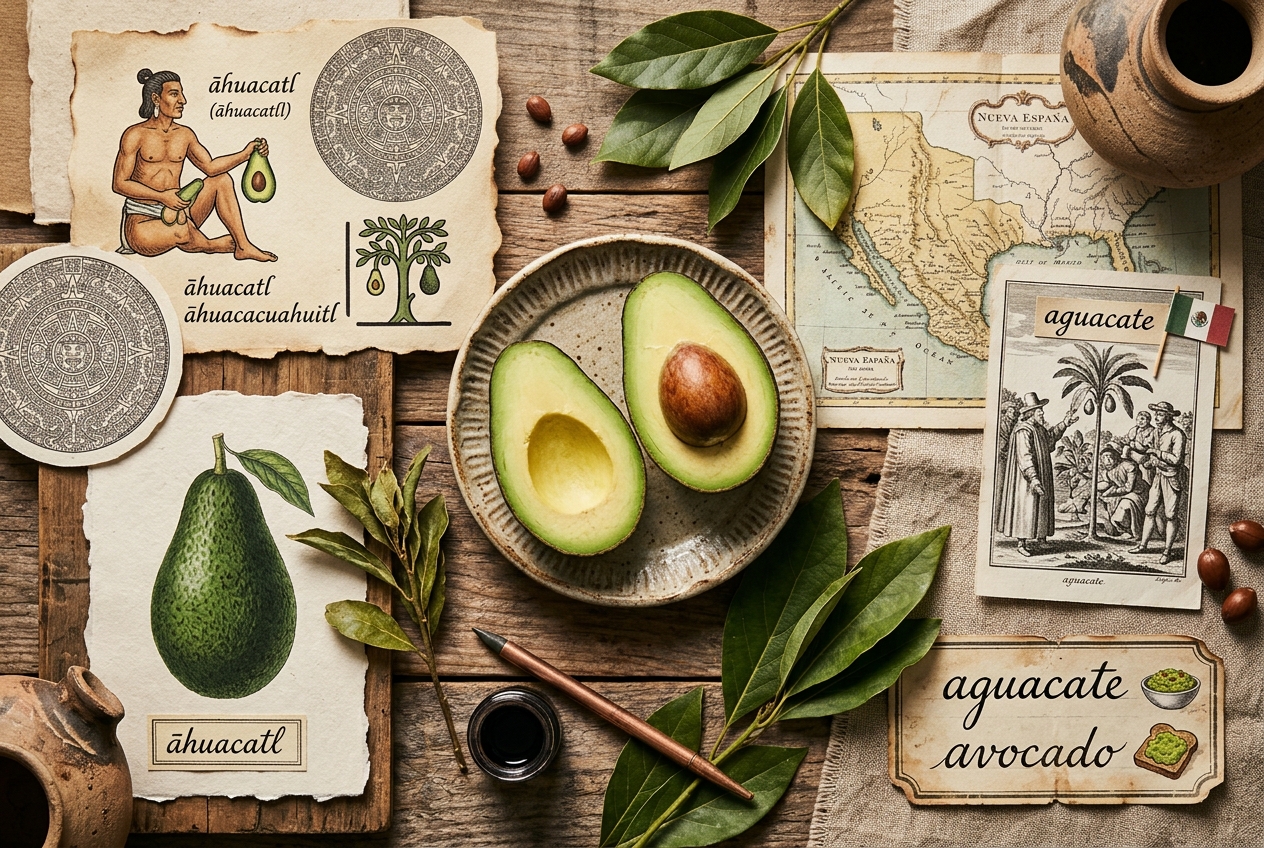
Which fruit's name comes from the Aztec word for 'testicle'?
- the word 'avocado'
- the word 'papaya'
- the word 'guava'
- the word 'tomato'
Answer: the word 'avocado' — The word 'avocado' derives from the Aztec Nahuatl word 'āhuacatl,' which meant testicle, referring to the fruit's shape and how it grows in pairs hanging from the tree. Spanish conquistadors found the original pronunciation difficult and corrupted it to 'aguacate,' which English speakers eventually softened into 'avocado.' The euphemistic renaming hints at the linguistic squeamishness that attended this anatomically suggestive fruit as it traveled from Mesoamerica to Europe and beyond—though modern eaters have largely forgotten the etymology.
The Aztec Origins of a Botanical Obscenity
When Spanish conquistadors encountered the alligator-pear in 16th-century Mexico, they were tasting a fruit the Nahuatl-speaking Aztecs had cultivated for centuries under the name 'āhuacatl'—literally, testicle. The comparison was both visual and observational: avocados grow in pairs, dangling from long stems, and their rough, dimpled skin and ovoid shape evoked the anatomy the Nahuatl speakers saw plainly. The fruit's name was not metaphorical; it was descriptive botany, part of a linguistic tradition in which many Mesoamerican plants bore names tied to their physical forms. Spanish priests and soldiers, uncomfortable with the crudeness, softened āhuacatl into 'aguacate,' a phonetic compromise that preserved the sound while obscuring the meaning. By the time English speakers adopted the word in the 17th century, further corruption had produced 'avocado,' a term so distant from its etymological root that most modern consumers never suspect the connection. The fruit's journey from Aztec markets to global grocery aisles thus carried an invisible linguistic cargo: a perfectly ordinary word that once shocked Spanish ears.
The Nahuatl language, still spoken by roughly 1.7 million people in Mexico today, classified plants and animals with a precision rooted in close observation. Āhuacatl belonged to a broader vocabulary of anatomical plant names—tomatoes were 'tomatl' (the swelling fruit), and the cacao bean's name hinted at bitterness rather than body parts. The Aztecs cultivated avocados as early as 5000 BCE in the Tehuacán Valley, selecting for larger fruit and creamier flesh over millennia. By the time of the Spanish conquest in 1521, avocado trees grew throughout the empire, valued not only as food but as a source of oil and a symbol of fertility. The fruit's name reflected its role in Aztec culture, where connections between agriculture and human reproduction were neither taboo nor surprising. When Hernán Cortés and his men first tasted avocados, they noted the fruit's richness and novelty, but the name posed a problem. Spanish missionaries, translating Nahuatl texts and compiling dictionaries, chose to Latinize or soften words they deemed offensive. Āhuacatl became aguacate, a word that retained none of the original's directness but all of its phonetic shape, a compromise between accuracy and propriety.
How a Fruit's Name Became a Euphemism
The transformation from āhuacatl to avocado was gradual and multi-stage, involving Spanish, French, and English intermediaries. Early Spanish accounts from the 1550s referred to the fruit as 'aguacate' or, occasionally, 'palta,' a Quechua word borrowed from indigenous groups in South America. English speakers first encountered avocados in the Caribbean and Central America during the 17th century, rendering aguacate as 'avogato' or 'avigato' before settling on 'avocado' by the 1690s. The final form bore no resemblance to testicles in English, and by the 19th century, most English dictionaries offered no hint of the word's etymology. The fruit itself remained rare in Europe and North America until the 20th century, when California growers began commercial cultivation in the 1910s. Those growers, aware that 'alligator pear'—the fruit's colloquial English name—sounded unappetizing, promoted 'avocado' as an exotic, sophisticated alternative. They never mentioned testicles. The marketing worked: U.S. avocado consumption soared, and by the 1950s, the fruit had shed its association with tropical oddity and become a suburban staple.
Linguistic bowdlerization was common in the colonial encounter. Spanish missionaries routinely sanitized Nahuatl terms they found vulgar or pagan, and English speakers inherited those sanitized versions without question. The result is a modern culinary vocabulary full of hidden etymologies—words whose origins, if widely known, might surprise or amuse. Avocado is perhaps the most successful example, a word so thoroughly divorced from its anatomical roots that even food historians often overlook the connection. The Nahuatl original, āhuacatl, survives in modern Mexican Spanish as 'aguacate,' still the standard term for the fruit in Mexico, but English 'avocado' has become the global standard, adopted into dozens of languages from Japanese to Swahili. The word's journey from Aztec marketplace to international trade reflects not only botanical exchange but the layers of translation, euphemism, and marketing that shape how we name the foods we eat. The fruit itself remains unchanged—rich, green, and anatomically suggestive—but its name has been carefully scrubbed of offense.
Why the Etymology Still Matters
Understanding the true origin of 'avocado' offers a window into how language evolves under cultural pressure and how colonial encounters reshape vocabulary. The Spanish conquest of the Aztec Empire in the 1520s was not only military and political; it was linguistic, as Nahuatl words entered Spanish and, eventually, global circulation. Many of those words—chocolate (from 'xocolatl'), tomato (from 'tomatl'), chili (from 'chilli')—retained their Nahuatl roots with minimal alteration. But āhuacatl was different, its anatomical meaning deemed too coarse for polite European tables. The euphemization of āhuacatl into avocado is a case study in how discomfort drives linguistic change, and how a word's meaning can be quietly erased across generations. Modern avocado consumers, whether spreading guacamole or slicing fruit onto toast, rarely pause to consider that they are invoking an Aztec word for testicles, filtered through five centuries of translation and marketing. The erasure is so complete that the etymology surprises even linguists when they first encounter it. Yet the original meaning persists in scholarly texts and Nahuatl-speaking communities, a reminder that language carries history—often hidden, sometimes uncomfortable, always revealing.
What most people get wrong
Many people assume 'avocado' is a Spanish or purely invented word, unaware it derives from the Nahuatl 'āhuacatl,' meaning testicle. The term was euphemized by Spanish speakers and further softened into English, erasing its anatomical origins entirely.
Word of the Day
risorgimento noun · ree-zor-jee-MEN-toh
A period of revival or resurgence, especially cultural or political rebirth; originally the 19th-century movement for Italian unification (from Italian 'risorgimento,' meaning 'rising again,' from Latin 'resurgere'). The word entered English in the 1850s to describe Italy's national awakening, but now applies to any renaissance or renewal.
“After decades of decline, the neighborhood experienced a cultural risorgimento, with new galleries and theaters opening every month. Historians also speak of the Harlem Renaissance as a risorgimento of African American art and literature in the 1920s.”
Joke of the Day
Why did the avocado refuse to explain its name at the etymological conference?
It didn't want to make a pit stop in awkward Nahuatl territory.
This Day in History
1886 — The Statue of Liberty was dedicated on Bedloe's Island in New York Harbor on October 28, 1886, a gift from France symbolizing freedom and democracy. French sculptor Frédéric Auguste Bartholdi designed the copper colossus, which stood 151 feet tall and required a decade of fundraising and construction on both sides of the Atlantic. President Grover Cleveland presided over the ceremony as the statue's torch was unveiled, marking the completion of one of the era's most ambitious engineering feats. The statue became an enduring icon of immigration and American ideals, greeting millions of newcomers arriving at nearby Ellis Island in the decades that followed.
Enjoyed this issue?
Get the next one free, every morning.
More from Words IQ