Wednesday, October 21, 2026
British cannonballs bounced off one ship's hull in 1812—what did sailors call it?
By Corey Lewis · Editorial standards
Trivia of the Day
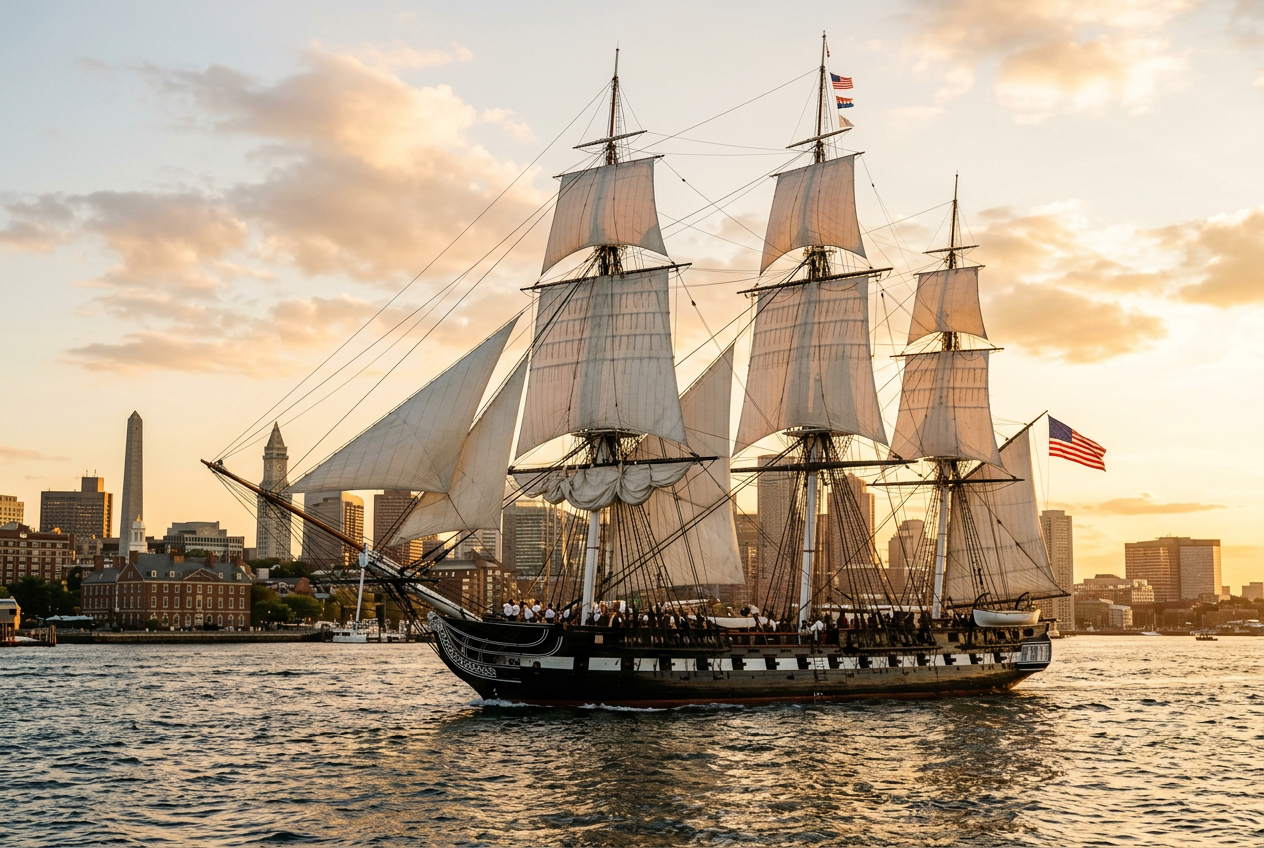
Which American warship earned the nickname 'Old Ironsides' during the War of 1812 when British cannonballs were seen bouncing off its hull?
- the USS Constitution's nickname
- the USS Chesapeake's nickname
- the USS United States' nickname
- the HMS Victory's nickname
Answer: the USS Constitution's nickname — The USS Constitution earned its nickname 'Old Ironsides' in August 1812 when sailors witnessed British cannonballs bouncing off its oak hull during battle with HMS Guerriere. The ship's live-oak planking—up to seven inches thick in places and cut from dense Southern timber—proved so resilient that spent shot rolled across the deck while splinters from Guerriere's masts rained down on Constitution's crew. That single engagement, lasting less than thirty-five minutes, turned a frigate into legend and gave the young United States Navy its first iconic symbol, one that still matters because Constitution remains afloat today as the world's oldest commissioned warship, a floating reminder that material superiority and tactical audacity can win wars as decisively as numerical strength.
The Battle That Made a Legend
On August 19, 1812, USS Constitution spotted HMS Guerriere roughly 750 miles east of Boston, and Captain Isaac Hull ordered his crew to battle stations. Guerriere's commander, James Dacres, confidently closed the distance—British frigates had dominated the seas for decades, and few expected an American upstart to challenge Royal Navy supremacy. The two ships exchanged broadsides at close range for twenty minutes, the thunder of thirty-two-pound cannons shaking both hulls. Then a Constitution sailor shouted the words that would echo through naval history:
"Huzzah! Her sides are made of iron!" Seaman witnesses reported seeing British eighteen-pound shot literally bouncing off Constitution's dense oak planking and falling harmlessly into the Atlantic. The frigate's hull consisted of live oak timber from Georgia's coastal islands—wood so hard and heavy it had taken three years to harvest enough for construction. Each of Constitution's sides measured twenty-one inches thick at the waterline, nearly double the protection of typical frigates.
Birth of Old Ironsides
The nickname spread through the fleet within days of Constitution's victory over Guerriere. Newspapers from Portsmouth to Charleston printed accounts of the miraculous hull, and "Old Ironsides" appeared in the Boston Columbian Centinel on September 16, 1812. Constitution had actually launched in 1797, making her only fifteen years old when she earned the moniker, but sailors appreciated the irony. The ship's designer, Joshua Humphreys, had revolutionized American naval architecture by creating frigates that outsized and outgunned British counterparts.
Constitution carried forty-four guns to Guerriere's thirty-eight, and her twenty-four-pound long guns outranged British armament by nearly three hundred yards. Captain Hull exploited this advantage brilliantly, maneuvering to rake Guerriere's stern while avoiding her broadsides. Within thirty-five minutes of the first exchange, Guerriere's mizzenmast crashed down, then her mainmast, leaving her helpless and rolling in heavy seas. Dacres struck his colors at 6:00 PM, and Constitution took 272 British sailors prisoner.
A String of Impossible Victories
Constitution's triumph over Guerriere proved no fluke. Under Captain William Bainbridge, she encountered HMS Java off Brazil's coast on December 29, 1812. Java's commander, Henry Lambert, fought ferociously for nearly four hours before his ship became an unmanageable wreck. Lambert died from his wounds on January 3, 1813. Constitution suffered fourteen killed and twenty-five wounded but sailed away under her own power, her legendary hull again deflecting scores of British shot.
On February 20, 1815, Constitution captured HMS Cyane and HMS Levant simultaneously off Madeira—an unprecedented feat against two Royal Navy warships. Captain Charles Stewart executed complex sailing maneuvers that allowed Constitution to engage each enemy separately while they struggled to coordinate. These victories humiliated Britain and electrified Americans, proving the young republic could challenge the world's dominant naval power. Constitution had captured or destroyed eight British vessels by war's end.
Enduring Symbol of American Resilience
Constitution nearly met the scrapyard in 1830 when Navy officials deemed her unseaworthy and scheduled demolition. Oliver Wendell Holmes Sr. published "Old Ironsides" in the Boston Daily Advertiser on September 16, 1830, igniting public outrage that saved the ship. His poem's opening lines—"Ay, tear her tattered ensign down! Long has it waved on high"—rallied Americans who saw Constitution as embodying national spirit. Congress authorized $300,000 for restoration, equivalent to roughly $9.5 million today.
The warship remains the world's oldest commissioned naval vessel still afloat, berthed at Boston's Charlestown Navy Yard since 1897. Constitution underwent major restorations in 1927–1931, 1992–1996, and 2015–2017, with the most recent work costing $12 million and replacing 100 tons of structural components. She sails Boston Harbor annually on July 4th, her forty-four gun ports still visible, her white oak ribs still bearing scars from British cannonballs. More than 500,000 visitors tour Old Ironsides each year, walking the same decks where sailors first marveled at her iron-like strength and forged American naval legend.
What most people get wrong
Ma ny believe 'O ld Iron sides' referred to iron plating or armor, when in fact the Constitution was built entirely of wood—specifically dense Southern live oak, red cedar, and white oak. The nickname arose from the oak's unusual ability to resist penetration by round shot, not from any metal reinforcement. The ship carried no iron armor; its resilience came from timber density and hull thickness, combined with careful construction under naval architect Joshua Humphreys' innovative design that prioritized strength and firepower over speed alone.
Word of the Day
puissant adjective · PWEE-sunt or PYOO-ih-sunt
Possessing great power, might, or influence; formidable in strength or authority. From Old French 'puissant' (powerful), derived from Latin 'posse' (to be able)—the same root that gives us 'possible' and 'potent.' The word entered English in the fifteenth century to describe monarchs and military commanders whose reach extended across continents.
“Hull's puissant broadside reduced Guerriere's mizzenmast to splinters in minutes. In diplomacy, a puissant argument backed by economic leverage often secures treaties that mere rhetoric cannot.”
Joke of the Day
Why did the USS Constitution refuse to update its Tinder profile after 1812?
It already had the perfect nickname from the first date.
This Day in History
1520 — Portuguese explorer Ferdinand Magellan navigated the strait at the southern tip of South America that now bears his name, discovering the passage between the Atlantic and Pacific oceans on October 21, 1520. His fleet of three remaining ships took thirty-eight days to thread the 350-mile maze of channels, battling fierce winds and treacherous currents while one vessel deserted and sailed back to Spain. The strait's discovery allowed European ships to avoid the even more dangerous route around Cape Horn and opened a critical trade corridor between Europe and Asia. Magellan called the calm ocean beyond 'Pacific,' though he would die in the Philippines before completing the first circumnavigation—a voyage finished by eighteen survivors under Juan Sebastián Elcano in 1522.
Enjoyed this issue?
Get the next one free, every morning.
More from Words IQ