Monday, October 26, 2026
A midcentury tycoon bought 10,276 tons of granite and shipped it west—what?
By Corey Lewis · Editorial standards
Trivia of the Day
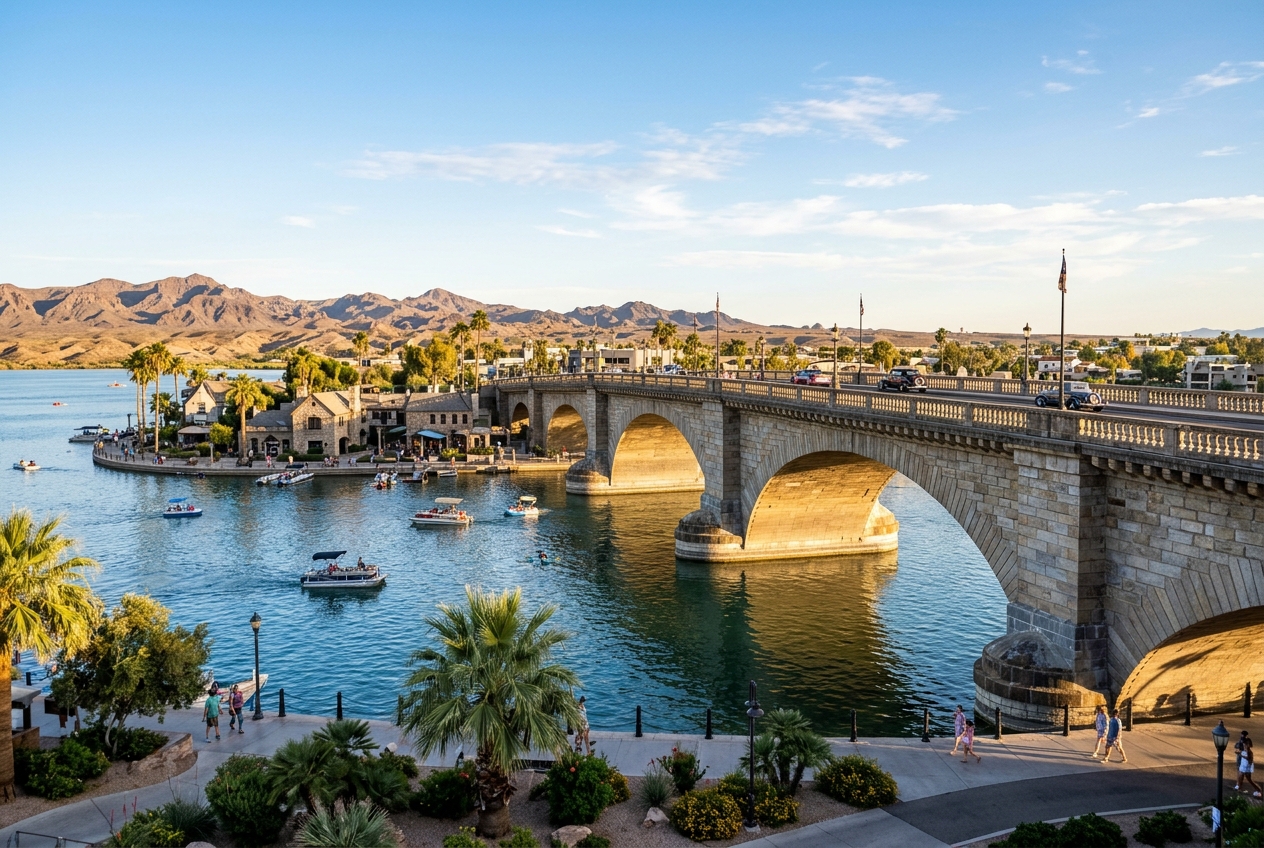
Which famous bridge was purchased by an American businessman and rebuilt brick-by-brick in Arizona?
- Tower Bridge
- London Bridge
- Brooklyn Bridge
- Westminster Bridge
Answer: London Bridge — London Bridge was bought by Robert McCulloch in 1968 for $2.46 million and reconstructed in Lake Havasu City, Arizona. The entire structure was disassembled in England, each of its 10,246 granite blocks numbered, shipped across the Atlantic, and reassembled over three years in the Mojave Desert. A persistent urban legend claims McCulloch thought he was buying the much more ornate Tower Bridge, but his company records show he knew exactly what he was getting — and the sale saved the City of London from demolition costs while giving Lake Havasu a landmark that now draws three million tourists a year. The bridge opened in Arizona in 1971 and still spans a channel carved specifically for it off Lake Havasu, making it the world's largest antique ever sold.
The Sale That Saved a Monument
In April 1968, the City of London auctioned a 140-year-old bridge that was slowly sinking into the Thames under the weight of modern traffic. London Bridge, completed in 1831 by engineer John Rennie, had been designed for horse-drawn carts, not double-decker buses and delivery lorries. By the 1960s, it was subsiding an inch every eight years, and the city faced either expensive reinforcement or demolition.
Robert McCulloch, founder of McCulloch Chainsaws and developer of Lake Havasu City, Arizona, placed the winning bid: $2,460,000. The sale made international headlines — not just because a 130-foot-wide granite bridge was changing continents, but because McCulloch planned to reconstruct it stone by stone in a desert town of 2,000 people that had no natural river. The City of London was delighted to offload the problem; McCulloch was buying the world's most improbable tourist attraction. The contract was signed on April 18, 1968, and demolition crews began numbering each of the bridge's 10,246 exterior granite blocks for shipment across the Atlantic.
Disassembly, Shipment, and Desert Resurrection
Dismantling London Bridge took two years. British laborers marked every block with four-digit codes, photographed each section, and crated the stones for a 10,000-mile journey by sea to California, then overland by truck to Arizona. The granite facing stones weighed up to three tons each; the internal brickwork, which provided the bridge's structural strength in London, was left behind because Arizona's reconstruction would use a modern steel-reinforced concrete frame.
The stones arrived in Long Beach in 1968 and were trucked in 200-ton shipments to Lake Havasu City, where McCulloch's engineers had already begun pouring a concrete core. The reassembly, overseen by Sundt Construction, followed the original blueprints exactly — masons fitted each numbered block back into its precise 1831 position, preserving even the tool marks and Victorian-era graffiti. By 1971, the bridge stood complete, spanning a mile-long channel that McCulloch's crews dredged through the desert peninsula to create an artificial island. The Channel, as locals call it, was filled with water diverted from Lake Havasu, and London Bridge finally had a river again — man-made, but real.
The Legend That Refuses to Die
Almost immediately, a rumor took hold: McCulloch had confused London Bridge with Tower Bridge, the far more photogenic Victorian Gothic drawbridge a half-mile downstream, and realized his mistake only when the crates arrived in Arizona. Newspaper columnists loved the story — the bumbling American tycoon hoodwinked by wily British auctioneers. But McCulloch's purchase records, interviews, and company correspondence all confirm he knew exactly what he was buying.
His bid specified "London Bridge (Rennie, 1831)" and included technical surveys of the structure's granite composition and load-bearing capacity. Ivan Luckin, McCulloch's British representative who negotiated the sale, repeatedly denied the mix-up in interviews before his death in 1985. McCulloch himself addressed the rumor in a 1977 interview with the Arizona Republic, stating he'd visited London twice before bidding and walked across the bridge both times. The confusion myth persists partly because Tower Bridge dominates London postcards, making Rennie's simpler design forgettable by comparison.
A Desert Landmark's Lasting Impact
The bridge's dedication on October 10, 1971, drew 50,000 visitors and featured the Lord Mayor of London in full ceremonial regalia. McCulloch's gamble paid off spectacularly: Lake Havasu City's population exploded from 2,000 residents in 1968 to over 15,000 by 1980, fueled almost entirely by bridge tourism. Today, the city has 57,000 residents, and London Bridge remains Arizona's second-most-visited tourist attraction after the Grand Canyon, drawing three million annual visitors.
The bridge spans 930 feet across Bridgewater Channel, connecting the mainland to a 1,200-acre island dotted with hotels, restaurants, and the Lake Havasu Museum of History, which houses original construction photographs and purchase documents. In London, a modernist replacement bridge designed by architect Lord Holford opened in 1973 on the original site, engineered to support projected traffic through 2050. McCulloch died in 1977, four years before Lake Havasu City incorporated as an official municipality. The original Rennie bridge cost £2.5 million to build in 1831; accounting for inflation and shipping, McCulloch spent the equivalent of nearly $20 million in today's currency to relocate a piece of Victorian London to the Mojave Desert — and transform both monuments in the process.
What most people get wrong
Most people believe Robert McCulloch mistakenly thought he was buying the ornate Tower Bridge instead of the plainer London Bridge. In truth, McCulloch's company records, photographs taken during his London visit, and the detailed auction contract all confirm he knew precisely which bridge he was purchasing — the 1831 John Rennie design — and that the 'mistaken identity' story was a myth spread by journalists who found it too good to check.
Sources & further reading
Word of the Day
anfractuous adjective · an-FRAK-choo-us
Full of twists and turns; winding and intricate, often maddeningly so. From the Latin 'anfractus' (a bending or winding), the word originally described the coiled paths of Roman roads through mountain passes before English borrowed it in the 1620s to describe anything — arguments, corridors, plots — that refuses to go straight.
“The anfractuous negotiations lasted six months, each session introducing new clauses that unwound the previous week's agreements. His anfractuous prose delighted scholars but baffled general readers, every sentence spiraling through dependent clauses like a vine through a trellis.”
Joke of the Day
Why did the cartographer refuse to give driving directions through Lake Havasu City?
Because after they moved London Bridge, all roads led to disorientation.
This Day in History
1955 — The Austrian State Treaty was signed in Vienna, restoring Austria's sovereignty after a decade of Allied occupation following World War II. The treaty, signed by the Soviet Union, the United States, Britain, and France, required Austria to declare permanent neutrality — a condition that allowed Soviet forces to withdraw without fear of Austria joining NATO. On October 26, Austria's parliament formally passed the Neutrality Act, and the date became Austria's National Day. The treaty ended the only four-power occupation to conclude peacefully during the Cold War, and Austrian neutrality became a model for Cold War diplomacy, allowing Vienna to host UN agencies and diplomatic summits for decades.
Enjoyed this issue?
Get the next one free, every morning.
More from Words IQ