Friday, November 6, 2026
A $2.5 billion mirror was off by millimeters—what orbited?
By Corey Lewis · Editorial standards
Trivia of the Day
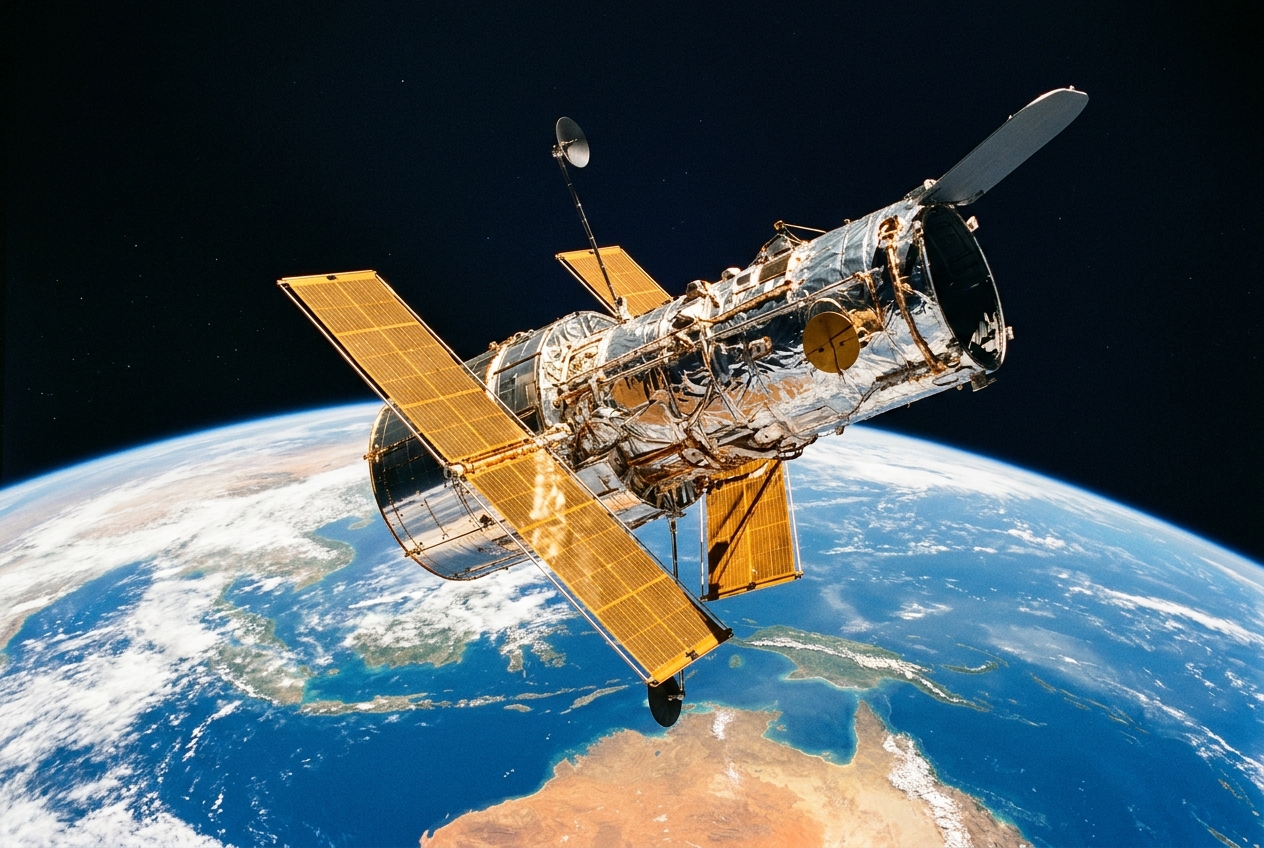
What famous space telescope was launched with a mirror flaw so severe that astronomers called it 'astronomically embarrassing' until a repair mission fixed it in 1993?
- the Chandra X-ray Observatory
- the Hubble Space Telescope
- the Spitzer Space Telescope
- the Compton Gamma Ray Observatory
Answer: the Hubble Space Telescope — The Hubble Space Telescope was launched in 1990 with a mirror ground to the wrong shape by 2.2 micrometers—about one-fiftieth the width of a human hair—producing blurry images until astronauts installed corrective optics three years later. The error stemmed from a single miscalibrated testing instrument at Perkin-Elmer, the contractor that ground the primary mirror, and the mistake went undetected through multiple quality checks because engineers trusted the faulty device over conflicting measurements. The fix, delivered by Space Shuttle Endeavour astronauts in December 1993, transformed Hubble into the most productive scientific instrument ever launched, generating data for more than 18,000 peer-reviewed papers and rewriting cosmology—a reminder that even a microscopic flaw can be overcome with ingenuity, and that the greatest discoveries sometimes begin with the most public failures.
A Two-Micron Catastrophe
On April 24, 1990, Space Shuttle Discovery lifted the Hubble Space Telescope into orbit 340 miles above Earth, marking the culmination of decades of planning, $2.5 billion in funding, and the hopes of astronomers worldwide. Within weeks, operators at the Space Telescope Science Institute in Baltimore began receiving the first images—and immediately knew something was catastrophically wrong. Stars appeared as fuzzy blobs surrounded by halos, not the crisp points of light Hubble was designed to capture. Engineers traced the problem to the telescope's 2.4-meter primary mirror, painstakingly ground and polished over three years at Perkin-Elmer Corporation in Connecticut. The mirror's curvature was off by 2.2 micrometers at the edge—about one-fiftieth the thickness of a human hair—rendering it the most precisely made wrong thing ever launched into space. The error had been baked in by a single miscalibrated optical testing device called a null corrector, and because that instrument was trusted implicitly, engineers dismissed conflicting measurements from two backup tests as anomalies. NASA faced a public relations nightmare: late-night comedians joked about the agency needing glasses, Congress demanded explanations, and the scientific community mourned the loss of what should have been a transformative tool.
The Perkin-Elmer Mistake
The mirror itself was a marvel—ultra-low-expansion glass polished to a tolerance of one-millionth of an inch over most of its surface—but the null corrector used to verify its shape during manufacture had been assembled incorrectly. A small lens inside the device was positioned 1.3 millimeters too far from where it should have been, a spacing error caused by technicians measuring from the wrong reference point on a mounting fixture. That tiny offset instructed Perkin-Elmer's grinding machines to create a perfectly smooth but wrongly curved mirror, one suffering from spherical aberration: light hitting the edge focused at a slightly different point than light hitting the center. Perkin-Elmer had conducted two independent tests using different methods—both flagged the aberration—but managers concluded the backup tests were flawed and proceeded with the null corrector's readings. No one at NASA ordered an end-to-end optical test of the fully assembled telescope before launch; such a test would have caught the error, but it was deemed too expensive and schedule-threatening. When Hubble reached orbit and engineers analyzed the blurry images, they reverse-engineered the exact shape of the mirror and confirmed the nightmare: the flaw was permanent, baked into $1.5 billion worth of hardware orbiting beyond reach of any repair facility on Earth.
Astronauts to the Rescue
NASA convened an investigative board, which recommended a servicing mission to install corrective optics—essentially eyeglasses for the telescope. Engineers at Goddard Space Flight Center designed an instrument called COSTAR (Corrective Optics Space Telescope Axial Replacement), a refrigerator-sized device containing ten small mirrors that would intercept Hubble's distorted light and refocus it before it reached the scientific instruments. On December 2, 1993, Space Shuttle Endeavour launched with a crew of seven astronauts trained for five back-to-back spacewalks, the most complex repair mission ever attempted. Over eleven days, astronauts Story Musgrave, Jeffrey Hoffman, Kathryn Thornton, and Thomas Akers installed COSTAR, replaced Hubble's solar arrays, swapped out gyroscopes, and upgraded the Wide Field and Planetary Camera with a newer model that had corrective optics built in. Each spacewalk lasted six to seven hours in the cramped confines of Hubble's instrument bays, where a single mistake—a dropped bolt, a torn glove, a misaligned connector—could doom the mission. The world watched live as the crew worked through their checklist with the precision of surgeons, and on January 13, 1994, NASA released the first post-repair images: the core of the galaxy M100 resolved into thousands of individual stars, sharp and clear. Astronomers wept with relief.
A Legacy Rewritten in Light
The repaired Hubble became the most scientifically productive observatory in history, generating data for more than 18,000 peer-reviewed papers between 1994 and the present. It measured the universe's expansion rate with unprecedented precision, helping astronomers discover dark energy and pin down the cosmos's age at 13.8 billion years. It captured the deepest images ever taken—the Hubble Deep Field and Ultra Deep Field—revealing galaxies formed just 400 million years after the Big Bang and demonstrating that the observable universe contains at least two trillion galaxies. Hubble photographed planets orbiting distant stars, detected water vapor in their atmospheres, and captured the breakup of Comet Shoemaker-Levy 9 as it slammed into Jupiter in 1994, each impact releasing energy equivalent to 600 times Earth's nuclear arsenal. Four additional servicing missions between 1997 and 2009 replaced instruments, installed new cameras, and extended Hubble's operational life well beyond its original fifteen-year design. The telescope that began as NASA's greatest embarrassment ended as its most celebrated success, proof that a two-micron error—and the courage to fix it—could reshape humanity's understanding of the universe. Engineers now cite Hubble as a case study in quality control and the dangers of groupthink, while astronomers simply call it irreplaceable.
What most people get wrong
Many believe Hubble was the first space telescope, but NASA launched several earlier orbiting observatories, including the Orbiting Astronomical Observatory series in the 1960s and the Copernicus satellite in 1972; Hubble was the first large, general-purpose optical telescope designed for in-orbit servicing and long-term use.
Word of the Day
anfractuous adjective · an-FRAK-choo-us
Full of twists and turns; winding, circuitous, or tortuous. From Latin anfractus, meaning 'a bending' or 'winding,' itself from ambi- (around) and frangere (to break), the word entered English in the early 17th century to describe physical paths—mountain trails, river courses—and later extended to labyrinthine arguments or convoluted prose.
“The anfractuous logic of the defense attorney's closing argument left the jury more confused than persuaded. In a lighter context: We followed an anfractuous hiking trail through the canyon, doubling back so many times that our GPS trace looked like tangled yarn.”
Joke of the Day
Why did the Hubble engineers refuse to play darts after the 1990 launch?
Every shot was two micrometers off-target—close enough to hit the board, far enough to miss the bullseye.
This Day in History
1860 — On November 6, 1860, Abraham Lincoln was elected the sixteenth president of the United States, winning a four-way race without carrying a single Southern state. His victory on a platform opposing the expansion of slavery into new territories triggered the secession crisis: South Carolina left the Union five weeks later, followed by six more states before Lincoln's March 1861 inauguration. The election fractured the Democratic Party—Northern Democrats nominated Stephen Douglas, Southern Democrats ran John C. Breckinridge, and the Constitutional Union Party fielded John Bell—splitting the anti-Lincoln vote and handing him the presidency with just 39.8 percent of the popular vote but a decisive Electoral College majority. Lincoln's election set in motion the sequence of events that led to the Civil War, the bloodiest conflict in American history and the end of slavery, reshaping the nation's political and social order for generations.
Enjoyed this issue?
Get the next one free, every morning.
More from Words IQ