Wednesday, November 4, 2026
Cranes and concrete re-erected a famous monument—which one?
By Corey Lewis · Editorial standards
Trivia of the Day
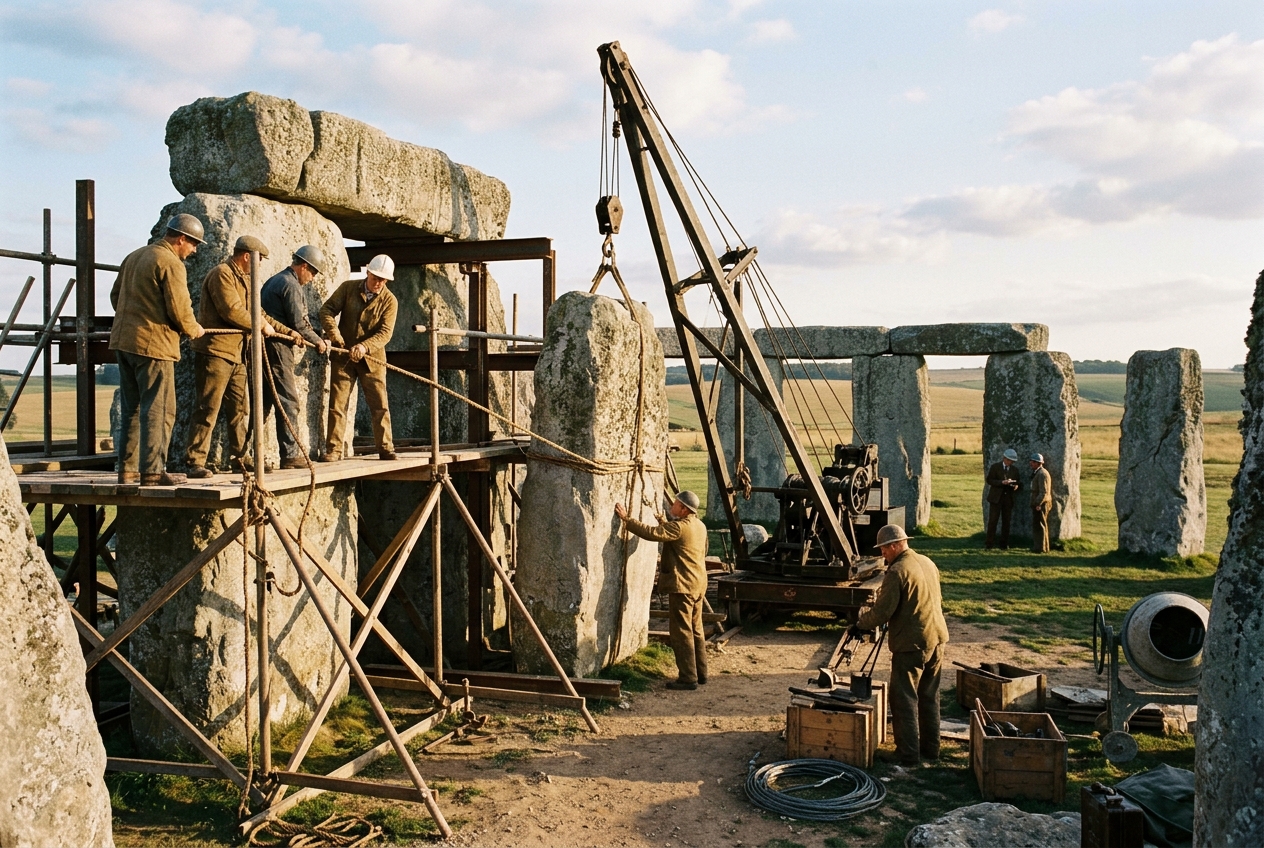
What ancient monument was extensively rebuilt and straightened using concrete and cranes in the 1950s and 1960s?
- Parthenon structural stabilization in 1950s
- Stonehenge complete restoration in 20th century
- Great Sphinx of Giza repair in 1950s
- Machu Picchu terrace reconstruction in 1960s
Answer: Stonehenge complete restoration in 20th century — Between 1901 and 1964, more than half of Stonehenge's stones were re-erected, straightened, or reset in concrete to prevent collapse—turning the iconic ruin into a heavily restored 20th-century reconstruction. The work included diesel cranes, steel reinforcements, and hidden concrete footings that now anchor many of the massive sarsens. Modern archaeology has revealed that the "timeless" silhouette visitors photograph today owes as much to mid-century engineering as to Neolithic builders, raising questions about what counts as authentic preservation versus reconstruction.
The Great Stonehenge Restoration Campaign
Stonehenge underwent its most extensive physical intervention between 1901 and 1964, when engineers and archaeologists re-erected, straightened, and stabilized dozens of its massive stones using techniques that would be unthinkable today. The work began in earnest in 1901 after Stone 56, a towering sarsen in the outer circle, leaned precariously and threatened to topple. William Gowland, a mining engineer and archaeologist, supervised the first modern restoration, using timber props, jacks, and concrete footings to right the stone and anchor it permanently.
Over the following six decades, the Office of Works authorized repeated campaigns to prevent further collapse, employing diesel cranes, steel rods, and reinforced concrete to stabilize the monument. By 1964, when the final restoration concluded, more than half of Stonehenge's standing stones had been lifted, repositioned, or set in concrete—a scale of intervention that transformed the site from a picturesque ruin into a carefully managed reconstruction. Colonel William Hawley conducted excavations from 1919 to 1926, removing cremated remains and artifacts but leaving such poor records that archaeologists still struggle to reconstruct what he found.
How Mid-Century Engineering Rebuilt the Monument
The 1950s and 1960s restorations relied on heavy machinery that left permanent marks on the landscape and the stones themselves. In 1958, three massive trilithons in the inner horseshoe were re-erected using a diesel crane capable of lifting 50-ton sarsens, while workers poured concrete into excavated pits to create stable bases. Steel dowels and rods were driven into some stones to secure capstones that had slipped or fallen, and damaged surfaces were patched with cement-based mortars. Professor Richard Atkinson supervised much of this work, prioritizing structural stability over archaeological purity.
The 1964 phase alone involved lifting and resetting four stones in the outer sarsen circle, straightening leaning uprights, and replacing rotted timber supports with concealed steel braces. Photographs from the era show Stonehenge surrounded by scaffolding, cranes, and cement mixers—an image at odds with the monument's mystical reputation. The concrete footings, still in place today, extend up to two meters below ground and were designed to last indefinitely, locking the stones into positions that may or may not reflect their original Neolithic arrangement. Engineers used spirit levels and plumb lines to achieve perfect verticality, imposing geometric precision on stones that may have deliberately leaned or tilted in antiquity.
The Human Details Nobody Expects
The restoration workers left behind graffiti, cigarette butts, and even a bottle of beer inside the excavated stone sockets—artifacts that modern archaeologists have recovered during recent surveys. In 1920, a wealthy landowner named Cecil Chubb donated Stonehenge to the nation after buying it at auction for £6,600 in 1915, and the Office of Works immediately began planning stabilization efforts. The 1958 crane operator, interviewed years later, recalled the nerve-wracking task of maneuvering a 25-ton capstone into place while tourists watched from just meters away, a scenario that would violate every modern safety protocol.
During the 1964 work, archaeologists discovered Roman coins, medieval pottery, and Victorian picnic debris beneath the stones, evidence of centuries of human interference. The restorations were not purely utilitarian: engineers deliberately chose the straightest possible alignments, creating a tidier monument than probably ever existed in prehistory. Workmen numbered each stone with paint and chiseled registration marks that remain faintly visible today, industrial annotations on supposedly pristine ancient surfaces.
Modern Controversy and Archaeological Reckoning
Contemporary archaeologists view the 20th-century restorations with profound ambivalence, recognizing that while the work prevented total collapse, it also destroyed irreplaceable stratigraphic information and imposed modernist aesthetics onto a 4,500-year-old structure. English Heritage now faces the dilemma of whether to document or remove the concrete foundations, which have themselves become historical artifacts of mid-century conservation philosophy. Laser scanning completed in 2012 revealed that many stones stand as much as 15 centimeters out of their original positions, fundamentally altering astronomical alignments that researchers had long assumed were intentional.
The interventions also created a false sense of permanence: Stonehenge now appears as a frozen monument rather than a dynamic ruin shaped by millennia of weathering, collapse, and human interaction. Recent soil analysis around re-set stones has shown compaction patterns inconsistent with Neolithic construction methods, complicating efforts to understand how the original builders positioned their megaliths. Paradoxically, the concrete that was meant to preserve Stonehenge for eternity may eventually require removal to prevent moisture damage, forcing future conservators to undo the very stabilization that defined 20th-century heritage management. The monument stands today as both an ancient wonder and a cautionary tale about the hubris of believing any generation fully understands what preservation truly means.
What most people get wrong
Most people believe Stonehenge stands exactly as its Neolithic builders left it around 2500 BCE, a testament to ancient engineering. In reality, the monument has been heavily restored and reconstructed throughout the 20th century, with many stones re-erected, straightened, and set in concrete footings that never existed in antiquity.
Word of the Day
exiguous adjective · ig-ZIG-yoo-us
Extremely small in size or amount; scanty or meager. From Latin *exiguus* 'small, petty,' from *exigere* 'to drive out, measure strictly,' the word arrived in English in the 17th century to describe anything barely sufficient or stripped to the bare minimum—resources, portions, or dimensions that offer little margin for comfort.
“The expedition survived on exiguous rations of hardtack and salted meat for three months. Her exiguous savings forced her to choose between rent and the surgery she desperately needed.”
Joke of the Day
Why did the Stonehenge tour guide refuse to explain the 1958 crane work?
Because every time someone asked, he'd say, 'Let's not get concrete about it.'
This Day in History
1979 — Iran's revolutionary government, led by Ayatollah Khomeini, authorized militant students to storm the U.S. Embassy in Tehran on November 4, 1979, taking 52 American diplomats and citizens hostage for 444 days. The crisis began as a protest against Washington's decision to admit the deposed Shah for cancer treatment, but it quickly escalated into a full-blown international standoff that paralyzed the Carter administration. Television audiences worldwide watched daily as blindfolded hostages were paraded before cameras, while failed rescue missions and frozen diplomatic channels deepened the humiliation. The hostages were finally released on January 20, 1981—minutes after Ronald Reagan was sworn in as president—marking the end of a crisis that reshaped U.S.-Middle East relations, fueled the rise of political Islam, and contributed directly to Carter's defeat in the 1980 election.
Enjoyed this issue?
Get the next one free, every morning.
More from Words IQ