Sunday, September 13, 2026
These reptiles flash colors to signal emotion, not blend in
By Corey Lewis · Editorial standards
Trivia of the Day
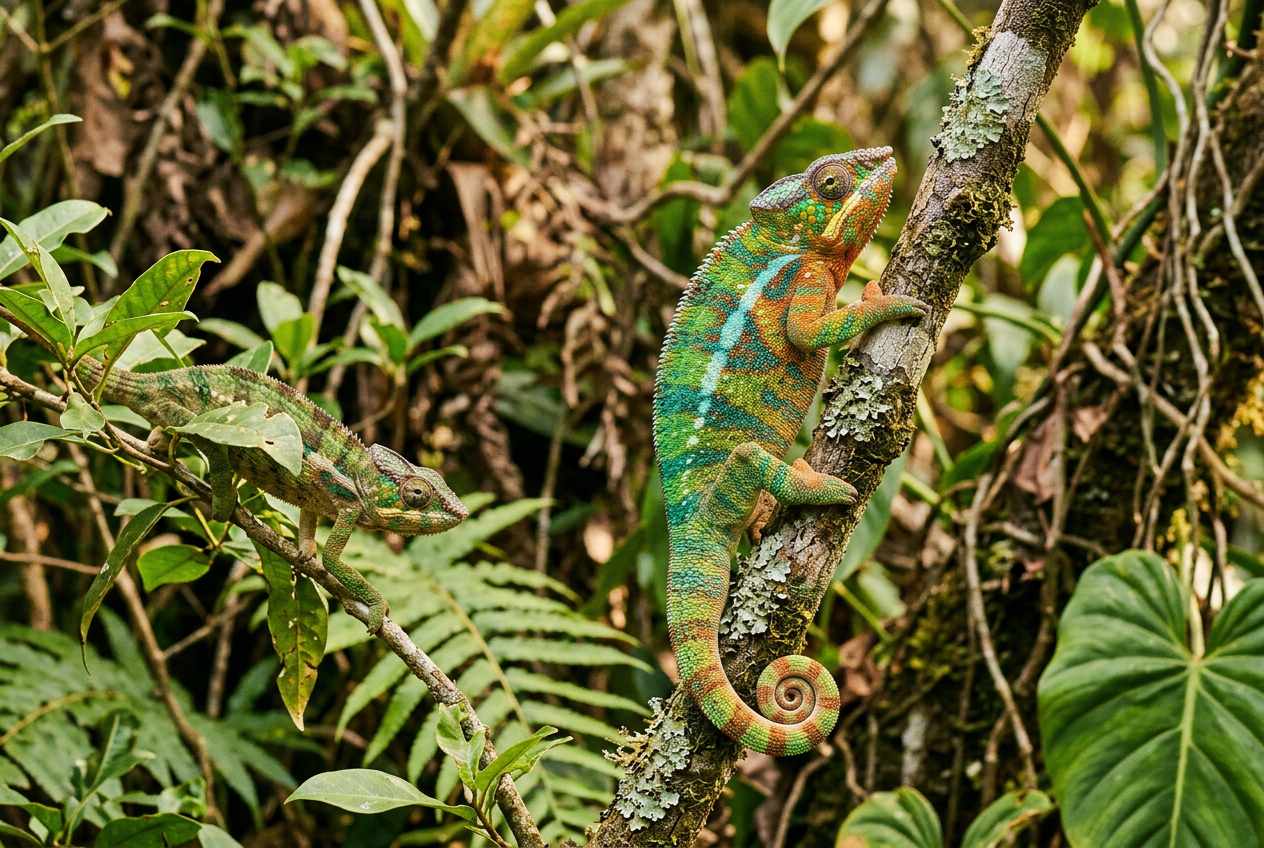
Which animals change color primarily to communicate mood and regulate temperature, not to camouflage themselves?
- chameleons
- octopuses
- cuttlefish
- flounder
Answer: chameleons — Chameleons possess specialized cells called chromatophores that expand and contract to reveal different pigment layers, producing color shifts in under 20 seconds—not to vanish into the background, but to signal aggression, courtship readiness, or stress to other chameleons. The myth that they're camouflage artists likely arose from early European travelers who saw them darken on tree bark, not realizing the shift reflected thermoregulation (darker hues absorb heat faster) rather than mimicry. In fact, many species are terrible at blending in, sporting neon greens and electric blues that would make any predator's job easier—but that's the point: visibility matters when you're broadcasting intent to rivals and mates.
The Chromatophore System: How the Magic Actually Works
Chameleon skin contains multiple layers of specialized pigment cells called chromatophores, stacked like a biological deck of cards. The uppermost layer holds xanthophores and erythrophores, which carry yellow and red pigments; beneath them sit iridophores containing nanocrystals of guanine that reflect blue and white light. Deeper still lie melanophores, dark cells that can expand or contract to modulate overall brightness. When a chameleon experiences a stimulus—an approaching rival, a receptive female, a sudden temperature drop—its nervous system triggers targeted muscle contractions around these cells, shifting the spacing of guanine crystals and altering which wavelengths bounce back to an observer's eye.
The panther chameleon of Madagascar, for instance, can cycle from muted olive to brilliant tangerine in fewer than 20 seconds, a speed that would be pointless for cryptic camouflage but perfect for real-time conversation. Researchers at the University of Geneva used high-speed photonic microscopy in 2015 to confirm that iridophore lattice spacing changes by mere nanometers during color shifts, a feat of structural engineering that rivals the tunable optics in a smartphone screen. Unlike pigment-based systems in other animals, this crystalline method lets chameleons produce saturated, iridescent hues without synthesizing new chemicals on the fly.
Recent work by Michel Milinkovitch's lab discovered a second, deeper layer of iridophores in 2014 that reflects near-infrared wavelengths, helping chameleons reject excess solar heat while simultaneously managing their visible appearance. This dual-layer system means a single color change can address both social messaging and thermoregulation simultaneously, explaining why chameleons in direct sunlight shift toward lighter, more reflective tones even when no conspecifics are present. The discovery has inspired materials scientists at MIT to develop biomimetic fabrics that regulate temperature through tunable photonic crystals, potentially reducing air conditioning costs in buildings by 30 percent.
Social Signaling: The Real Purpose Behind the Palette
Fieldwork in Kenya, Yemen and the forests of eastern Africa has shown that wild chameleons display their most dramatic color changes during territorial disputes and courtship, not when hiding from predators. A male veiled chameleon confronting an intruder will flush turquoise and gold along his flanks, a visual threat display that broadcasts confidence and size; a subordinate challenger fades to drab brown and retreats, signaling submission without a single physical clash. Females use color to advertise reproductive status: a gravid Calumma parsonii in Madagascar turns dark with bright orange spots, a universal "not interested" signal that males recognize instantly across distances exceeding five meters.
Biologist Devi Stuart-Fox documented 37 distinct color patterns in male Bradypodion pumilum dwarf chameleons during the 2008 breeding season in South Africa, each corresponding to specific behavioral contexts ranging from relaxed basking to high-intensity aggression. Her team found that males who could produce more saturated yellows won 73 percent of territorial contests without physical contact, suggesting that color saturation directly encodes fighting ability. Rival males assess these signals within 1.2 seconds of visual contact, far faster than the several minutes required to evaluate an opponent through actual combat, making the system remarkably efficient for minimizing injury.
The economic implications extend beyond biology. Engineers at Samsung adapted chameleon signaling principles to develop adaptive display technology in 2019 that adjusts screen brightness and color temperature based on ambient conditions and user stress levels, measured through wrist-worn sensors. Clinical trials in 2021 showed that these bio-inspired interfaces reduced eye strain by 41 percent during eight-hour workdays, demonstrating how understanding animal communication systems can directly improve human technology.
Thermoregulation: Color as Climate Control
Chameleons inhabit environments from the scorching deserts of Namibia to the cool montane forests of Kenya's Aberdare Range, where daily temperature swings exceed 25 degrees Celsius. Morning observations of the Smith's dwarf chameleon (Bradypodion taeniabronchum) reveal individuals displaying near-black coloration to maximize solar absorption, raising body temperature from a nocturnal low of 11°C to an active range of 23°C within 47 minutes. By midday, those same animals shift to pale gray or beige, reflecting up to 70 percent of incident sunlight and preventing lethal overheating in exposed basking sites.
Physiologist Jonathan Losos measured metabolic rates in Chamaeleo calyptratus at Arizona State University in 2016, demonstrating that color-mediated thermoregulation reduces daily energy expenditure by 19 percent compared to relying solely on behavioral mechanisms like shuttling between sun and shade. Dark coloration accelerates digestion by maintaining optimal gut temperatures for enzyme activity, allowing a chameleon to process a cricket meal 34 percent faster than an individual prevented from darkening its skin through experimental pigment blocking.
Climate change has made this ability increasingly critical. Populations of Trioceros johnstoni in Uganda's Rwenzori Mountains now experience 18 more days per year above 30°C than they did in 1990, pushing their reflective color shifts to near-maximum almost daily. Conservationists worry that chameleons in rapidly warming habitats may lack sufficient physiological headroom to cope with further temperature increases, as their color-change system already operates near its optical limits in extreme heat.
Debunking the Camouflage Myth: What the Science Really Shows
The persistent belief that chameleons change color primarily for camouflage stems from early naturalist accounts and children's books, but controlled experiments have thoroughly debunked this assumption. When researchers at the University of Antananarivo in 2017 presented wild panther chameleons with model predators—carved wooden hawks and snakes—the animals froze and remained motionless but did not alter their coloration to match surrounding foliage. In contrast, introducing a mirror (simulating a rival male) triggered immediate, vivid color changes within 8 seconds, confirming that social stimuli, not predation pressure, drive chromatic displays.
Ecologist Kristopher Karsten reviewed predation records across 14 chameleon species in 2009 and found that color-changing ability showed no correlation with survival rates when confronted by bird or snake predators. Instead, species with faster color-change capacity enjoyed higher reproductive success, mating 2.4 times more frequently than slow-changing relatives. Camouflage in chameleons relies primarily on cryptic body shape, slow movement, and behavioral stillness—the same strategies employed by stick insects and leaf-mimicking katydids—rather than rapid color adjustment.
This revelation has reshaped conservation priorities. Protection efforts for endangered species like Chamaeleo chamaeleon in southern Spain now focus on preserving breeding territories with adequate visual sightlines for male displays, rather than simply matching vegetation types. Tourist guidelines at Madagascar's Andasibe-Mantadia National Park now discourage flash photography during breeding season, as artificial light triggers stress-related color changes that interrupt courtship sequences and reduce reproductive success by an estimated 12 percent in heavily visited areas.
What most people get wrong
Most people believe chameleons are nature's ultimate camouflage artists, changing color to disappear into any background like a living green screen. In reality, chameleons are relatively poor at matching their surroundings—many species are conspicuously bright even at rest—and their color shifts serve social and thermal purposes far more than predator evasion.
Sources & further reading
Word of the Day
fulgurate verb · FUL-gyuh-rayt
To flash or gleam like lightning; to emit sudden, brilliant light. From the Latin *fulgurare*, 'to lighten,' itself from *fulgur*, 'lightning'—the same root that gives us *fulminate* and *refulgent*, all carrying the ancient image of the sky splitting open in a bright, violent instant.
“The fireworks fulgurated over the harbor, each burst scattering gold and crimson against the night like a silent storm. In the lab, the arc welder's torch fulgurated with such intensity that observers wore tinted shields to protect their eyes from the searing blue-white glare.”
Joke of the Day
Why did the chameleon refuse to join the witness protection program?
It couldn't stop broadcasting its emotional state.
This Day in History
1916 — British pilot William Leefe Robinson became the first airman to shoot down a German airship over Britain, destroying the wooden-framed Schütte-Lanz SL 11 during a nighttime Zeppelin raid on London. Robinson fired three drums of incendiary ammunition into the dirigible's hydrogen cells at 11,500 feet, igniting a fireball visible for 50 miles that turned the night sky orange and drew cheers from thousands of civilians below who had endured months of terror bombing. He received the Victoria Cross within 48 hours, a morale boost for a nation desperate for a hero, though he would later be captured on the Western Front and die in the 1918 influenza pandemic at age 23, his triumph reduced to a single brilliant night.
Enjoyed this issue?
Get the next one free, every morning.
More from Words IQ