Thursday, November 12, 2026
Trivia of the Day
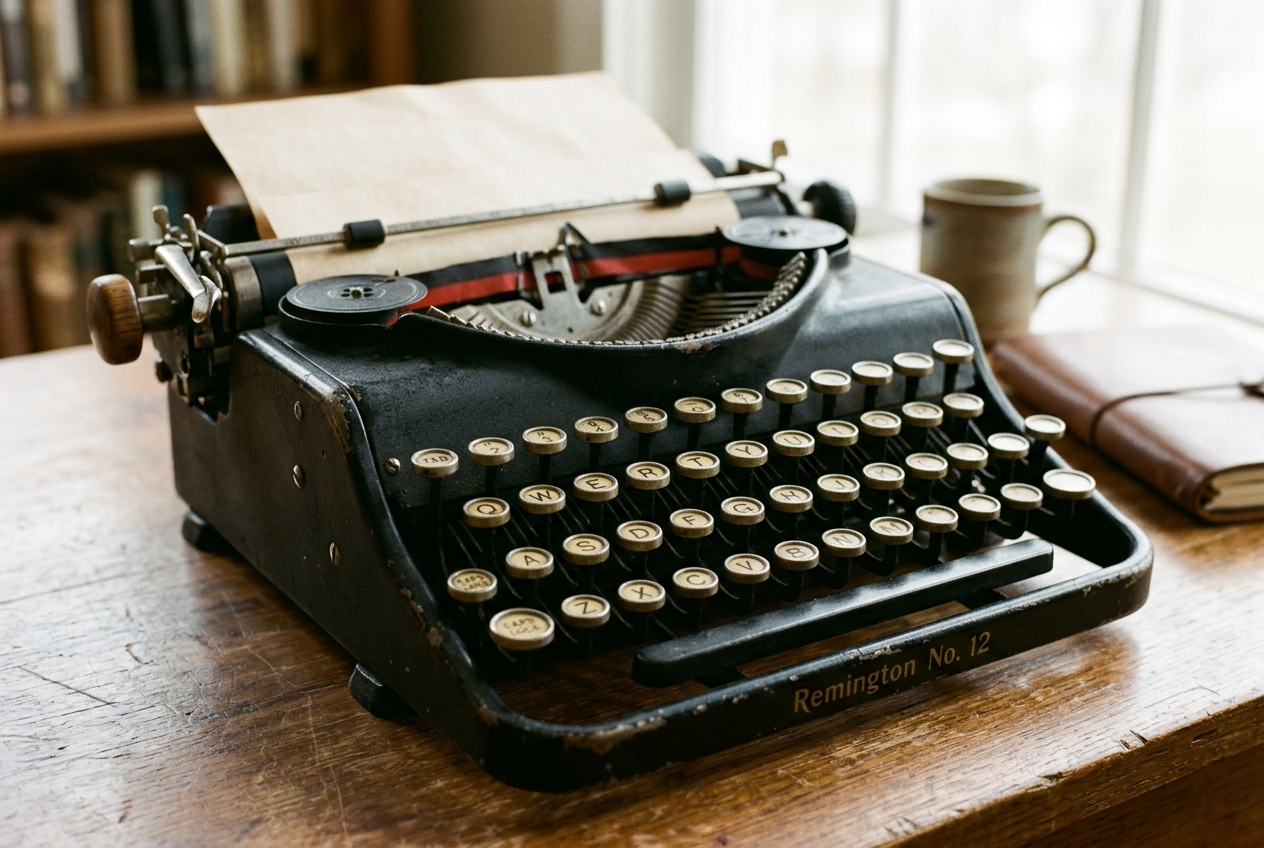
What common English word can be typed using only the top row of letters on a QWERTY keyboard?
- the word 'proprietor'
- the word 'typewriter'
- the word 'repertoire'
- the word 'territoire'
Answer: the word 'typewriter' — The word 'typewriter' can be typed using only the letters Q-W-E-R-T-Y-U-I-O-P on the top row of a standard keyboard, and this arrangement was deliberately designed in the 1870s to showcase the machine by allowing salesmen to quickly type its name. The layout wasn't random—it was an intentional demonstration tool that turned every sales pitch into a performance. The fact that this single word became the machine's own calling card helped cement the QWERTY layout's dominance, even after the mechanical constraints that originally shaped it became obsolete.
The Salesman's Secret Weapon
Christopher Latham Sholes patented the first practical typewriter in 1868, but the machine faced a daunting challenge: convincing skeptical customers that a mechanical device could actually replace handwriting. Early demonstrations were clunky and slow, giving potential buyers plenty of time to walk away. By the time Sholes and his business partner James Densmore refined the design in 1873, they had hit upon a brilliant solution embedded in the keyboard itself. The top row of letters—Q, W, E, R, T, Y, U, I, O, P—contained every letter needed to spell the word "typewriter." Salesmen traveling from town to town could bang out the machine's own name in seconds, using a single row of keys, creating an illusion of speed and simplicity that closed deals. The Remington company, which manufactured the Sholes & Glidden Type-Writer starting in 1874, trained its sales force to exploit this feature relentlessly. The keyboard's arrangement wasn't accidental; it was a marketing masterstroke disguised as engineering.
The Mechanical Compromise Behind QWERTY
The QWERTY layout is often described as a solution to mechanical jamming, but the reality is more nuanced. Early typewriters used a basket of type bars that swung up to strike the paper from below, and if a typist hit two adjacent keys in rapid succession, the bars could collide and tangle. Sholes experimented with dozens of keyboard arrangements between 1868 and 1873, trying to separate commonly paired letters—like "th" and "st"—so their type bars wouldn't be neighbors. But he also had to consider the sales pitch. Placing all the letters of "typewriter" on the top row wasn't just convenient; it made the machine look effortless to operate during a demonstration. The final QWERTY layout, patented in 1878, balanced mechanical necessity with showmanship. By 1890, Remington had sold tens of thousands of machines, and the layout had become the de facto standard. Competitors tried alternative keyboards—most notably the Dvorak Simplified Keyboard in 1936—but none could dislodge QWERTY's market dominance.
The Word That Stuck
The term "typewriter" itself was contested in the early years. Some manufacturers called their machines "writing machines" or "mechanical writers," hoping to avoid the utilitarian connotations of "typewriter," which sounded too much like a job title. By 1875, however, the word had stuck, partly because it was so easy to demonstrate. A salesman could type "typewriter" in three seconds flat, then hand the prospect a sheet of paper with the word spelled out in crisp, uniform letters. The psychological effect was powerful: if the machine could write its own name so quickly, surely it could handle anything else. This sales tactic became so widespread that by the 1880s, typing "typewriter" was a standard parlor trick. Mark Twain, an early adopter who bought a Remington in 1874, reportedly entertained guests by typing the word over and over, marveling at the mechanical precision. The word became inseparable from the machine, and the machine became inseparable from the keyboard.
Why the Top Row Still Matters
The QWERTY layout has outlasted the mechanical constraints that shaped it, surviving the shift to electric typewriters in the 1960s, computer keyboards in the 1980s, and touchscreens in the 2010s. Billions of people now carry a QWERTY keyboard in their pockets, though few know the word "typewriter" can still be typed on the top row alone. The layout's persistence is a testament to inertia: once millions of typists had learned QWERTY, switching to a more efficient system became economically impractical. Ergonomic studies have shown that alternative layouts like Dvorak or Colemak can reduce finger travel by up to 50 percent, but retraining a global workforce is a non-starter. Meanwhile, the word "typewriter" has become a linguistic curiosity, a relic of an era when machines were sold face-to-face and a clever keyboard trick could seal a deal. The top row of your keyboard is a 150-year-old advertisement, still quietly doing its job.
What most people get wrong
Many people believe the QWERTY keyboard was designed solely to slow typists down and prevent jamming, but the layout was actually a compromise between mechanical necessity and sales demonstration. The top row's ability to spell "typewriter" was a deliberate feature to help salesmen showcase the machine's speed and simplicity.
Sources & further reading
Word of the Day
syzygy noun · SIZ-uh-jee
A straight-line configuration of three or more celestial bodies in a gravitational system, most commonly the Sun, Earth, and Moon during an eclipse or full moon. The term comes from the Greek suzugia, meaning 'yoked together,' and was adopted by astronomers in the 17th century to describe the rare alignment when three bodies fall into a single line. In astrology and astronomy alike, syzygy marks moments of heightened gravitational interaction—spring tides occur during syzygy because the Sun and Moon's gravitational pulls combine.
“The solar eclipse of 2017 was a textbook syzygy, with millions watching the Moon pass directly between Earth and the Sun. Syzygy also applies to the alignment of Jupiter's moons, which Galileo observed falling into rare straight-line formations in 1610.”
Joke of the Day
Why did the QWERTY keyboard refuse to testify at the patent trial?
It didn't want to be typecast.
This Day in History
1954 — Ellis Island, the gateway through which more than 12 million immigrants entered the United States between 1892 and 1954, officially closed its doors as an immigration station on November 12, 1954. The last detainee, a Norwegian merchant seaman named Arne Peterssen, was released that day. The island had processed an average of 5,000 arrivals daily at its peak in the early 1900s, but postwar changes in immigration law and air travel had rendered the facility obsolete. After closure, Ellis Island sat abandoned for decades until it was reopened as a museum in 1990, preserving the Registry Room where inspectors once questioned new arrivals and the dormitories where families waited for clearance. The island remains a symbol of America's immigrant heritage, with over 100 million Americans—roughly 40 percent of the population—able to trace their ancestry to someone who passed through its halls.
Enjoyed this issue?
Get the next one free, every morning.
More from Words IQ