Friday, November 13, 2026
Ancient builders dragged 5-ton rocks 150+ miles—which site?
By Corey Lewis · Editorial standards
Trivia of the Day
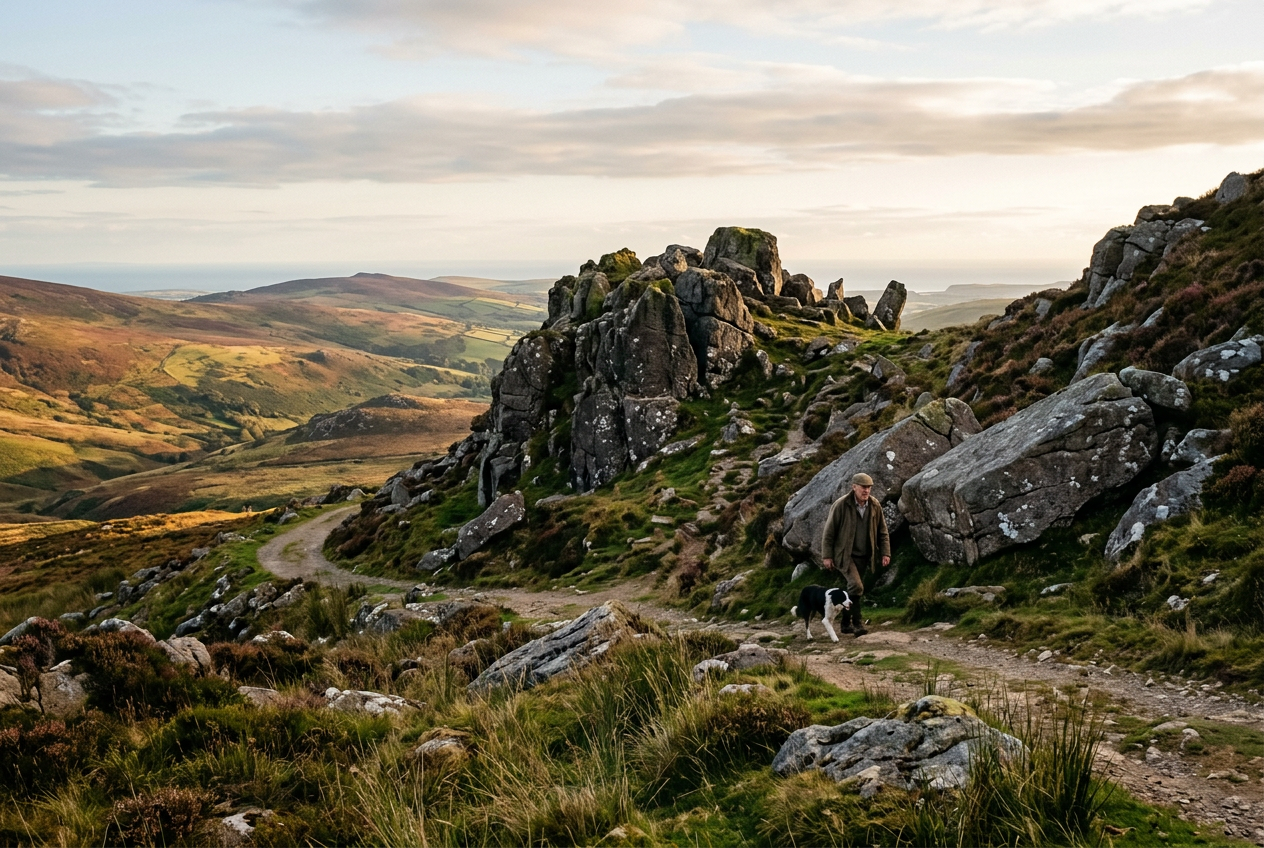
Which famous prehistoric monument's inner stones were transported over 150 miles from the Preseli Hills in Wales?
- Avebury Stone Circle in Wiltshire
- Stonehenge bluestones from Wales
- Callanish Stones on the Isle of Lewis
- Ring of Brodgar in Orkney
Answer: Stonehenge bluestones from Wales — The bluestones at Stonehenge were transported over 150 miles from the Preseli Hills in Wales around 3000 BC, an astonishing feat given that each stone weighs up to four tons and the journey crossed mountains, rivers, and the Bristol Channel. Geologists have pinpointed the exact quarries—Craig Rhos-y-felin and Carn Goedog—where Neolithic workers extracted these spotted dolerite stones, leaving behind distinctive tool marks and stone wedges. This monumental effort, predating the wheel in Britain, required hundreds of people dragging stones on sledges and rafts, likely over several generations, making it one of archaeology's most ambitious construction projects and raising enduring questions about why these particular stones mattered so profoundly to Bronze Age society.
The Preseli Quarries and the First Journey
Around 3000 BC, Neolithic workers in the Preseli Hills of southwest Wales began extracting spotted dolerite stones from two primary quarries: Craig Rhos-y-felin and Carn Goedog. These sites, perched on remote hillsides 140 to 180 miles from Salisbury Plain, show clear evidence of systematic stone removal—archaeologists have found wedge marks, abandoned half-extracted pillars, and stone debris matching Stonehenge's bluestones. Each stone weighed between two and four tons, requiring teams of dozens to lever them free using wooden wedges, antler picks, and sheer human force. The workers didn't select random boulders but chose specific geological seams where the dolerite fractured into usable pillars, suggesting they understood the stone's properties and planned the extraction with remarkable precision. Once freed, the stones likely moved downhill on sledges made of timber and hide, pulled by ropes of twisted leather or plant fiber, with the entire community—men, women, and children—contributing labor over years or even generations.
The journey from Wales to Wiltshire remains one of archaeology's great logistical puzzles, debated for over a century. The most accepted route combines overland sledging and water transport: stones traveled east through the Preseli valleys to the coast, were loaded onto rafts or dugout canoes lashed together, ferried across the Bristol Channel to the Severn Estuary, then hauled along river valleys—the Avon, Wye, and eventually the Hampshire Avon—before the final overland haul to Stonehenge. Experiments in 2000 demonstrated that a one-ton replica bluestone could float on a raft of logs, crewed by a dozen paddlers, though the venture nearly sank in choppy water, underscoring the peril ancient crews faced. Overland, modern reconstructions show that 60 people could haul a two-ton stone on a sledge greased with animal fat, covering perhaps a mile per day on level ground, far less over hills. The entire journey likely took months per stone, repeated for 80 individual bluestones, an investment of labor so vast it implies the stones held sacred or symbolic significance far beyond mere construction material.
Why These Particular Stones Mattered
Stonehenge's builders didn't choose the Preseli bluestones for convenience—they had massive sarsen stones available just 20 miles north on the Marlborough Downs, which they later used for the outer circle. The bluestones must have possessed unique cultural or spiritual value. One compelling theory, supported by recent isotope analysis of cremated remains at Stonehenge, suggests the stones connected two distant communities: people from Wales brought their sacred stones to Wiltshire, perhaps to unify tribes or mark a political alliance. Chemical signatures in bones buried at Stonehenge between 3000 and 2500 BC show that some individuals grew up in Wales, traveled to Wiltshire, and were interred at the monument, implying Stonehenge served as a pan-British gathering place, not just a local temple. Another hypothesis points to the stones' acoustic properties—when struck, the dolerite rings with a clear tone, leading some archaeologists to dub them "singing stones," potentially used in rituals or ceremonies to produce otherworldly sounds that reinforced the site's mystical aura.
The bluestones' geology also sets them apart. Spotted dolerite contains white feldspar crystals against dark volcanic rock, creating a distinctive appearance unlike the gray sarsens. When wet, the stones gleam with an almost metallic sheen, and fresh fractures reveal blue-gray interiors, possibly giving them their name. Neolithic people may have attributed healing or supernatural powers to these rocks; medieval legends claimed Stonehenge's stones cured ailments, and Geoffrey of Monmouth's 12th-century chronicle described Merlin transporting the "Giants' Dance" from Ireland (a garbled memory of the Welsh origin). Geological surveys have confirmed that no similar dolerite exists anywhere closer than the Preseli Hills, ruling out glacial transport—once a popular theory—and proving human agency. The effort to move these stones, when local alternatives existed, speaks to a belief system we can barely reconstruct, where stone itself carried ancestry, identity, and divine connection.
The Engineering Challenge Nobody Expected
Transporting the bluestones required innovations in Neolithic engineering that scholars underestimated for decades. The stones weren't uniform pillars but irregular, rough-hewn blocks, some over 13 feet long, making them awkward to balance and stabilize. On land, sledges had to navigate slopes, rivers, and soft ground; experiments show that without log rollers—which leave no archaeological trace and may not have been used—the friction of wood on mud or grass demanded constant replenishment of grease and frequent rest. Over the Bristol Channel, a 20-mile water crossing, crews faced tides, currents, and winter storms. A single capsized raft would lose a stone forever to the seabed, yet no evidence suggests any were lost, implying either extraordinary skill or multiple attempts we'll never uncover. The final approach to Stonehenge involved hauling stones uphill onto Salisbury Plain, a 300-foot elevation gain over the last few miles, requiring hundreds of workers pulling in coordinated teams, likely singing or chanting to synchronize effort—an echo of labor songs recorded in later Bronze Age and Iron Age cultures.
Once at Stonehenge, the bluestones were erected in a double circle around 2600 BC, predating the famous sarsen trilithons. Later, around 2500 BC, builders dismantled the original bluestone circle and rearranged the stones into the horseshoe and inner oval formations visible today, some shaped and dressed to fit. This remodeling shows the stones remained sacred enough to repurpose rather than discard, even as Stonehenge's design evolved. Tool marks on the bluestones reveal they were worked with sarsen hammerstones, a labor-intensive process that produced finer surfaces and mortise holes for lintel connections. The precision of these later modifications contrasts with the rough-hewn original transport stones, suggesting successive generations inherited and refined the monument, each adding their vision while honoring the ancestral effort that brought the stones from Wales.
Why It Still Resonates Today
Stonehenge's bluestones challenge our assumptions about prehistoric society. For centuries, scholars imagined Neolithic Britons as scattered, isolated tribes with limited organization, yet the bluestone transport required planning across generations, coordination among distant communities, and a shared belief system powerful enough to justify staggering labor. Modern archaeology increasingly views monuments like Stonehenge as evidence of sophisticated social networks, trade, and ideology spanning the British Isles. The discovery in 2015 of quarry sites in Wales, complete with stone platforms where workers camped, has rewritten timelines and confirmed that humans, not glaciers, moved the stones, settling a century-old debate. DNA analysis of Neolithic Britons shows surprising mobility—individuals buried at Stonehenge came from as far as Scotland and continental Europe—positioning the monument as a hub in a vast cultural web, not an isolated marvel.
The bluestones also resonate because their story mirrors our own relationship with place and memory. Just as Neolithic Britons carried stones from their homeland to a new sacred center, human cultures have always transported objects—relics, heirlooms, foundation stones—to anchor identity and continuity. The Vietnam Veterans Memorial in Washington includes stones from each U.S. state; the 9/11 Memorial incorporates steel from the Twin Towers. Stonehenge's bluestones, hauled across Bronze Age Britain, served a similar purpose: they were physical links to ancestors, homeland, and the numinous. Today, over a million visitors annually stand among those stones, touching rock that traveled further in 3000 BC than most people journeyed in a lifetime, a testament to the human need to build, gather, and remember. The bluestones endure not because they're impressive—though they are—but because they embody the extraordinary lengths communities will go to honor what they hold sacred, a truth as resonant now as it was 5,000 years ago.
What most people get wrong
Many people believe glaciers transported Stonehenge's bluestones from Wales during the Ice Age, a theory popular until the 2000s. In reality, the last glaciation that reached southern England ended 450,000 years ago, long before Stonehenge was built, and geological surveys show no glacial erratics of Preseli dolerite anywhere between Wales and Wiltshire—proof that humans, not ice, moved every stone.
Sources & further reading
Word of the Day
recondite adjective · REK-ən-dyt
Dealing with matters that are abstruse, obscure, or difficult to understand; requiring deep or specialized knowledge. From Latin *reconditus*, past participle of *recondere* (to put away, hide), from *re-* (back) + *condere* (to put together, store), the word originally meant "hidden away" and evolved to describe knowledge stored beyond ordinary reach—esoteric, arcane, known only to experts or scholars.
“The professor's lecture on quantum entanglement was so recondite that even the graduate students struggled to follow the mathematics. Her second book, however, proved equally recondite in a different sense—a meditation on medieval alchemy that demanded fluency in Latin, Arabic, and pre-modern chemistry to grasp its layered references.”
Joke of the Day
Why did the Neolithic sledge-puller refuse to read the Stonehenge construction manual?
It was too much of a drag.
This Day in History
1985 — The Nevado del Ruiz volcano erupted in Colombia, triggering massive lahars—volcanic mudflows—that buried the town of Armero and killed over 23,000 people in one of the 20th century's deadliest volcanic disasters. Despite warnings from vulcanologists hours before, evacuation orders were delayed by confusion and communication failures, and the mudflows reached Armero at 11 p.m., entombing residents in their homes within minutes. The catastrophe exposed fatal gaps in disaster preparedness and led to the creation of modern volcanic monitoring networks across Latin America, including early-warning systems that have since saved thousands of lives in subsequent eruptions. Armero remains buried under hardened mud, a ghost town and memorial to the victims.
Enjoyed this issue?
Get the next one free, every morning.
More from Words IQ