Sunday, November 22, 2026
The first addition to Morse code in decades arrived in 2004—which character?
By Corey Lewis · Editorial standards
Trivia of the Day
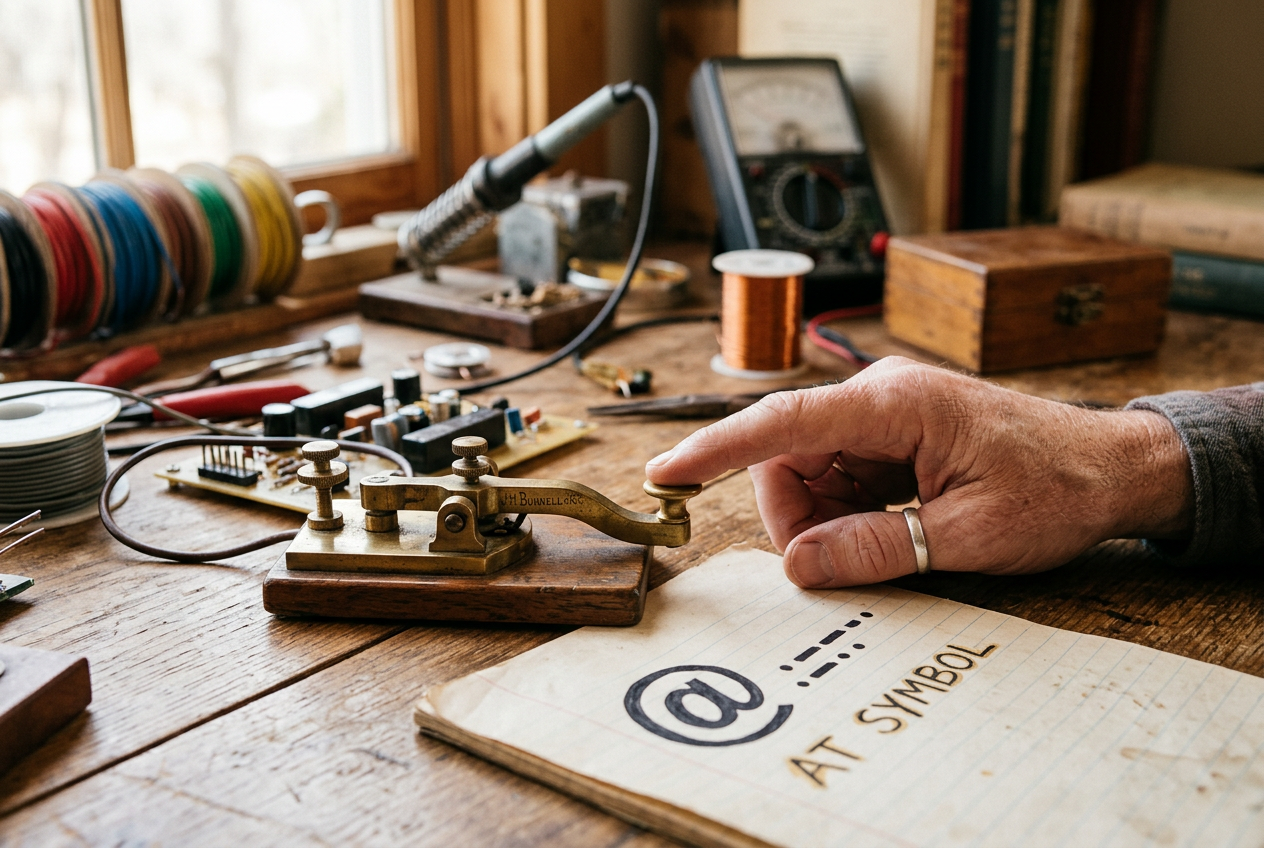
What keyboard symbol was officially added to Morse code in 2004, making it the first new character added in decades?
- the @ symbol
- the # symbol
- the & symbol
- the $ symbol
Answer: the @ symbol — The @ symbol was officially added to the International Morse Code standard in 2004, represented by the sequence dit-dah-dah-dit-dah-dit—a clever combination merging the existing codes for A and C with no pause between them. The addition came at the request of a group of Chinese telegraph operators who needed to transmit email addresses efficiently, bringing a 170-year-old communication system into the internet age. It marked the first new Morse character since the question mark was added in the 1860s, demonstrating that even venerable technologies can adapt when the need is genuine and the solution elegant.
The Internet Meets the Telegraph Age
In February 2004, the International Telecommunication Union quietly announced a modification to the Morse code standard that Samuel Morse himself would never have imagined: the @ symbol, essential to every email address, now had an official Morse representation. The sequence—dit-dah-dah-dit-dah-dit, technically written as ·––·–·—was ingeniously constructed by running together the codes for A (·–) and C (–·–·) without the usual pause between letters, creating what telegraphers call a ligature. This wasn't a committee's whim but a practical solution championed by a working group of Chinese radio operators who found themselves constantly spelling out email addresses letter by letter during maritime and emergency communications. The @ symbol had become so ubiquitous in digital communication that its absence from Morse code had transformed from a curiosity into a genuine operational problem, particularly for ships at sea and remote stations where Morse remained a backup communication method well into the 21st century.
The addition process took nearly three years of discussion within the ITU's radiocommunication sector, with engineers debating whether to create an entirely new sequence or repurpose an existing combination. The A-C ligature won because it was both mnemonic—A and C suggesting "at"—and efficient, requiring only six elements instead of the eleven needed to spell out "at" in full Morse. Radio amateurs and maritime operators began adopting the new symbol immediately after the February 2004 announcement, though formal inclusion in training materials and official code charts took another year. The timing proved prescient: by 2004, email had become essential even in contexts where bandwidth was scarce, and the ability to transmit an address like «[email protected]» in Morse meant that emergency communications could include modern contact information without resorting to voice transmission, which is often less reliable over long distances or in poor conditions.
The Surprising Persistence of Dots and Dashes
Morse code's survival into the email era surprises most people who assume the technology died with the telegraph office, but maritime law required ships to maintain Morse capability until 1999, and amateur radio operators never abandoned it. In 2004, when the @ symbol was added, an estimated 2 million licensed amateur radio operators worldwide still used Morse regularly, and commercial航空 and maritime services kept it as a backup to digital systems precisely because it requires so little bandwidth and can be understood through heavy interference that would render voice unintelligible. A skilled Morse operator can communicate at 25 to 30 words per minute using equipment simple enough to build from salvaged parts, a capability that proved its worth during the 2004 Indian Ocean tsunami when conventional communications infrastructure collapsed across vast regions. Coast guard stations from Indonesia to Sri Lanka found themselves relying on Morse transmissions from amateur operators who could punch through the chaos when satellite phones failed and cell towers lay underwater.
The @ symbol's addition also reflected a broader pattern in how old technologies absorb new cultural realities rather than simply vanishing. Semaphore flags gained new signals for helicopter and jet aircraft in the 1960s; lighthouse Morse lamps added codes for offshore oil platforms in the 1970s. The @ character itself has a surprisingly long pre-digital history—medieval monks used it as a shorthand for the Latin word "ad" (meaning "at" or "toward"), and Spanish and Portuguese merchants adopted it in the 15th century to denote units of measure, writing "2 @ 50" to mean "two units at 50 each." American typewriters included the @ key by the 1880s for commercial invoices, though it was considered a specialized business symbol until Ray Tomlinson chose it in 1971 to separate usernames from host names in the first networked email message. That choice, made because @ was unlikely to appear in anyone's name and was already on the keyboard, eventually forced Morse code to evolve 33 years later.
The Politics of Adding a Single Symbol
The bureaucratic journey from proposal to official adoption reveals how international standards evolve when multiple constituencies have competing interests. The initial 2001 request came from the Chinese Radio Sports Association, whose members found the lack of an @ code particularly frustrating because Morse competitions often included copying email addresses as part of message traffic tests. Western representatives on the ITU working group initially questioned whether adding a symbol for a potentially transient technology made sense—after all, some argued, email might eventually be replaced by voice communication or messaging systems that don't use the @ format. The Chinese delegation countered that email addresses had already appeared in dozens of international maritime and aeronautical emergency protocols, making the @ symbol a matter of communications safety rather than mere convenience. Russian and Japanese representatives joined the Chinese position, noting that their own radio operators faced identical problems.
The breakthrough came when a working group member from Finland demonstrated that ships transmitting distress information increasingly needed to include email contact addresses for shipping companies, rescue coordinators, and next-of-kin notification. Under the International Convention for the Safety of Life at Sea (SOLAS), vessels must be able to transmit detailed information in multiple formats, and the inability to send an email address in Morse without laboriously spelling it out violated the spirit of communications redundancy. The @ symbol's adoption was finalized at a Geneva meeting in January 2004, with formal publication in ITU Recommendation M.1677 the following month. Curiously, no equivalent symbol was ever standardized for other internet punctuation like the forward slash or colon, partly because the @ symbol's unique role in identifying communication endpoints made it special, and partly because by 2004 most other internet-related communication had moved to digital packet systems rather than continuous-wave Morse.
Why Morse Code Still Refuses to Die
The @ symbol addition in 2004 wasn't Morse code's last gasp but evidence of its peculiar immortality, rooted in physics rather than nostalgia. Morse transmissions can be detected at signal strengths 100 times weaker than voice transmissions because the human brain excels at picking patterns from noise, and a simple on-off carrier wave penetrates interference that would shred more complex modulation schemes. This matters enormously in emergency situations: when Hurricane Katrina destroyed communications infrastructure across the Gulf Coast in 2005, amateur radio operators using Morse were often the first to establish contact with isolated communities because their signals could be heard when voice transmissions disappeared into static. Military forces quietly retained Morse training long after officially dropping it from requirements, with U.S. Special Forces including it in communications courses specifically for contested environments where sophisticated digital systems become targets.
The code's educational value also persists in unexpected ways. Neuroscience research has shown that learning Morse code creates neural pathway development similar to learning a second language, with studies at the University of Trondheim in Norway demonstrating measurable improvements in pattern recognition and auditory processing among children who learned Morse alongside conventional literacy. Aviation still uses Morse identification for navigation beacons—when you tune a VOR station, the three-letter identifier you hear in the background is Morse code, maintained because it requires no complex electronics to generate or decode. As of 2024, the @ symbol remains part of the official ITU Morse code standard, used daily by thousands of operators worldwide who've adapted a 19th-century technology to 21st-century communication needs. The sequence dit-dah-dah-dit-dah-dit bridges three centuries: from Samuel Morse's first telegraph line in 1844, through Ray Tomlinson's first email in 1971, to a Chinese radio operator in 2004 who needed to send a rescue coordinator's email address through a storm.
What most people get wrong
Many people assume Morse code died with the telegraph and was completely obsolete by 2004, but maritime law required ships to maintain Morse capability until 1999, and millions of amateur radio operators still use it today because its simple on-off signal can penetrate interference that destroys more complex transmissions.
Word of the Day
anfractuosity noun · an-frak-choo-AH-sih-tee
A winding channel or intricate passage; a convoluted turning or anatomical fold. From Latin anfractus (a bending or turning), the term originally described the physical windings of intestines or brain tissue in medical texts before extending to any maze-like complexity, whether geographical canyons or bureaucratic procedures.
“The anfractuosity of the Antelope Canyon requires guides who've memorized every twist, as a single wrong turn in the sandstone maze can trap hikers when flash floods arrive. Legal scholars complained that the tax code's anfractuosity had reached the point where even accountants couldn't navigate its thousand-page convolutions without specialized software.”
Joke of the Day
Why did the Morse code operator refuse to date the @ symbol after 2004?
Because it kept showing up in the middle of every conversation—completely unpauseable.
This Day in History
1718 — French explorer Jean-Baptiste Le Moyne de Bienville founded New Orleans on November 22, 1718, establishing a settlement on the Mississippi River delta that would become the most strategically important port between the Atlantic Ocean and the continental interior. Named for Philippe II, Duke of Orléans, who served as regent of France, the city was positioned on a rare high-ground crescent where the river bent sharply, chosen despite the site's vulnerability to flooding because it controlled access to the entire Mississippi basin. Within two decades, New Orleans had become the linchpin of French colonial ambitions in North America, importing enslaved Africans, exporting furs and timber, and creating a unique Creole culture that blended French, Spanish, African, and Native American influences—a cultural mixing that would later give birth to jazz and define American music.
Enjoyed this issue?
Get the next one free, every morning.
More from Words IQ