Monday, November 23, 2026
A prisoner's number became a concert series name—which leader?
By Corey Lewis · Editorial standards
Trivia of the Day
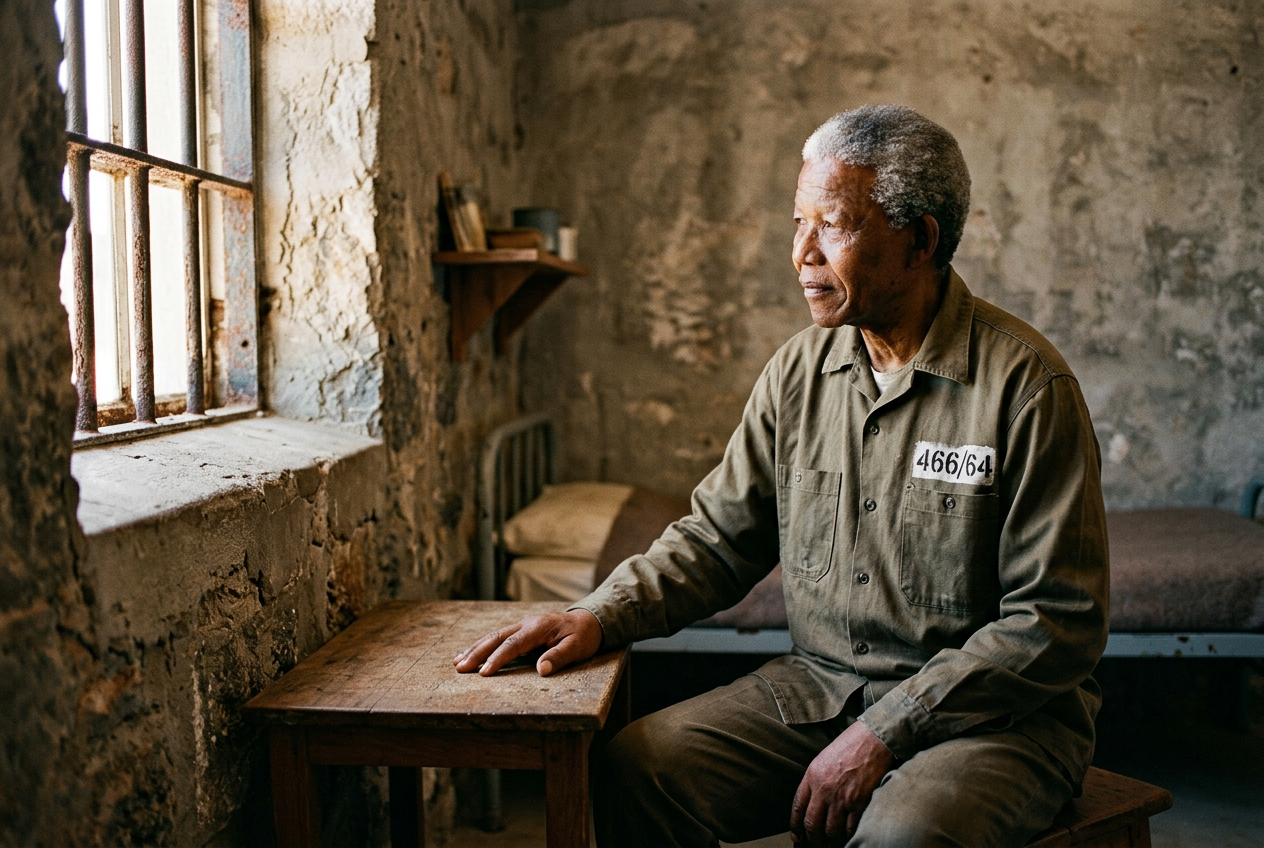
What South African leader's prison identification number became so iconic it inspired a global concert series called '46664'?
- Steve Biko's detention number
- Nelson Mandela's prison number
- Desmond Tutu's passport number
- Oliver Tambo's exile registration
Answer: Nelson Mandela's prison number — Nelson Mandela's prison number 46664 — indicating he was the 466th prisoner registered in 1964 — became the name of his HIV/AIDS awareness campaign and concert series launched in 2003, bringing together artists from Queen to Beyoncé to fight a disease killing 600 South Africans every day. The number that once marked his captivity became a symbol of hope reaching 47 countries and raising over $10 million. Mandela chose the name deliberately: 'I wanted to use my past to help build the future.'
The Number That Marked 27 Years
When Nelson Mandela arrived at Robben Island on June 13, 1964, prison officials assigned him number 46664: the 466th prisoner registered that year. The number appeared on every piece of his prison clothing, every document, every interaction with guards for the next 18 years on the island. Prison authorities used numbers instead of names as a deliberate dehumanization tactic, reducing political prisoners to administrative entries in a system designed to erase their identities. Mandela wore the number through limestone quarry labour that damaged his eyesight, through years in a cell measuring seven feet by nine, through the loss of his mother and his son while imprisoned. When he transferred to Pollsmoor Prison in 1982 and later to Victor Verster in 1988, the number followed him. By the time he walked free on February 11, 1990, the digits 46664 had marked more than a quarter-century of his life — nearly a decade longer than the average prison sentence for murder in South Africa.
From Prison ID to Campaign Brand
In November 2003, Mandela launched the 46664 campaign at a concert in Cape Town's Green Point Stadium, deliberately reclaiming his prison number as a weapon against HIV/AIDS. South Africa faced the world's largest HIV epidemic, with 5.3 million people infected and 600 dying every day — more than the country lost in decades of apartheid violence. Mandela had watched his own son Makgatho die of AIDS in January 2005, a loss he made public to break the stigma surrounding the disease. The campaign's name carried immediate recognition across Africa and around the world, transforming the number from a symbol of oppression into a rallying cry for action. The debut concert featured performances by Beyoncé, Queen, Bono, and the Eurythmics, broadcast to 2 billion people in 166 countries. Subsequent concerts in Norway, Spain, and South Africa raised over $10 million for HIV prevention, testing, and treatment programs. The campaign distributed 46664-branded prevention materials across 47 countries, reaching populations where government health programs barely functioned. Mandela's decision to use his prison number rather than his name carried strategic weight: it reminded the world that his moral authority came from suffering, not celebrity.
The Prisoner Who Became President
Mandela's imprisonment began with the Rivonia Trial verdict on June 12, 1964, when Judge Quartus de Wet sentenced him to life imprisonment for sabotage and conspiracy to overthrow the government. Eight co-defendants received the same sentence; prosecutors had sought the death penalty. Mandela had already served time from 1962 to 1964, so his total incarceration spanned 27 years across three facilities. Robben Island held him until 1982 in Section B, a wing reserved for political prisoners classified as 'dangerous.' Daily routine included breaking rocks in the limestone quarry, where reflected sunlight permanently damaged his tear ducts — a condition that plagued him for the rest of his life. Prison censors blacked out news articles, restricted letters to 500 words twice a year, and banned all physical contact during the brief visits allowed. His wife Winnie could visit only once every six months, speaking through a glass partition with guards monitoring every word. Despite this isolation, Mandela organized a secret university among prisoners, teaching history and politics in quarry breaks, smuggling news on toilet paper, building the intellectual foundation for the post-apartheid government he would later lead. His refusal of conditional release offers in 1985 forced the government to negotiate rather than dictate terms.
The Legacy That Numbers Cannot Measure
The 46664 campaign continued for more than a decade after Mandela's 2005 retirement from public life, adapting its message as HIV treatment transformed from a death sentence into a manageable chronic condition. By 2014, South Africa's antiretroviral program covered 2.9 million people, the world's largest, though the disease still killed 140,000 annually. The campaign's model — using celebrity concerts to fund grassroots health infrastructure — influenced later efforts like the Global Fund to Fight AIDS and Product Red. Mandela's original prison uniform bearing the number 46664 now sits in the Apartheid Museum in Johannesburg, displayed alongside the Rivonia Trial documents and his presidential inauguration suit. The uniform's coarse fabric and hand-stitched number stand in deliberate contrast to the elegance of his later life, a reminder that moral authority emerges from endurance rather than comfort. When Mandela died on December 5, 2013, at age 95, obituaries worldwide opened with his prisoner number alongside his name — a reversal that would have been unimaginable to the prison officials who assigned those digits 49 years earlier. The number designed to erase his identity instead became inseparable from it, proof that even totalitarian systems cannot control how symbols evolve once they escape into history.
What most people get wrong
Many people believe Mandela was imprisoned on Robben Island for his entire 27-year sentence, but he actually spent the final six years at Pollsmoor Prison in Cape Town and Victor Verster Prison in Paarl, where conditions were less harsh and negotiations for his release took place.
Word of the Day
redoubt noun · ri-DOWT
A temporary or supplementary fortification, typically square or polygonal and without flanking defenses, often used to protect a strategic position. From French 'redoute,' ultimately from Latin 'reductus' (withdrawn, secluded), the term entered English military vocabulary in the 1600s as European siege warfare grew more sophisticated. While originally describing earthwork forts that could be quickly abandoned, it evolved to mean any defensive stronghold.
“The colonial militia constructed a redoubt on Breed's Hill overnight, creating the fortification that would host the misnamed Battle of Bunker Hill. In business negotiations, her office became a redoubt where she could retreat from hostile takeover pressures.”
Joke of the Day
Why did Nelson Mandela's prison uniform refuse to work at the marketing agency?
It was already branded.
This Day in History
1889 — The first jukebox made its public debut at the Palais Royale Saloon in San Francisco, a coin-operated Edison phonograph that played wax cylinder recordings for a nickel. Patrons selected from a menu of songs by inserting a nickel and listening through individual ear tubes attached to the machine — no speakers broadcast sound to the room. Inventors Louis Glass and William S. Arnold installed the device as an experiment in automated entertainment, and within six months it had generated over $1,000 in revenue, equivalent to $33,000 today. The success sparked a revolution in public music access, leading to 56,000 jukeboxes in American bars and restaurants by 1940, democratizing music distribution decades before radio became widespread.
Enjoyed this issue?
Get the next one free, every morning.
More from Words IQ