Saturday, November 14, 2026
Before demolition in '93, this place hit 1.2M people per km²
By Corey Lewis · Editorial standards
Trivia of the Day
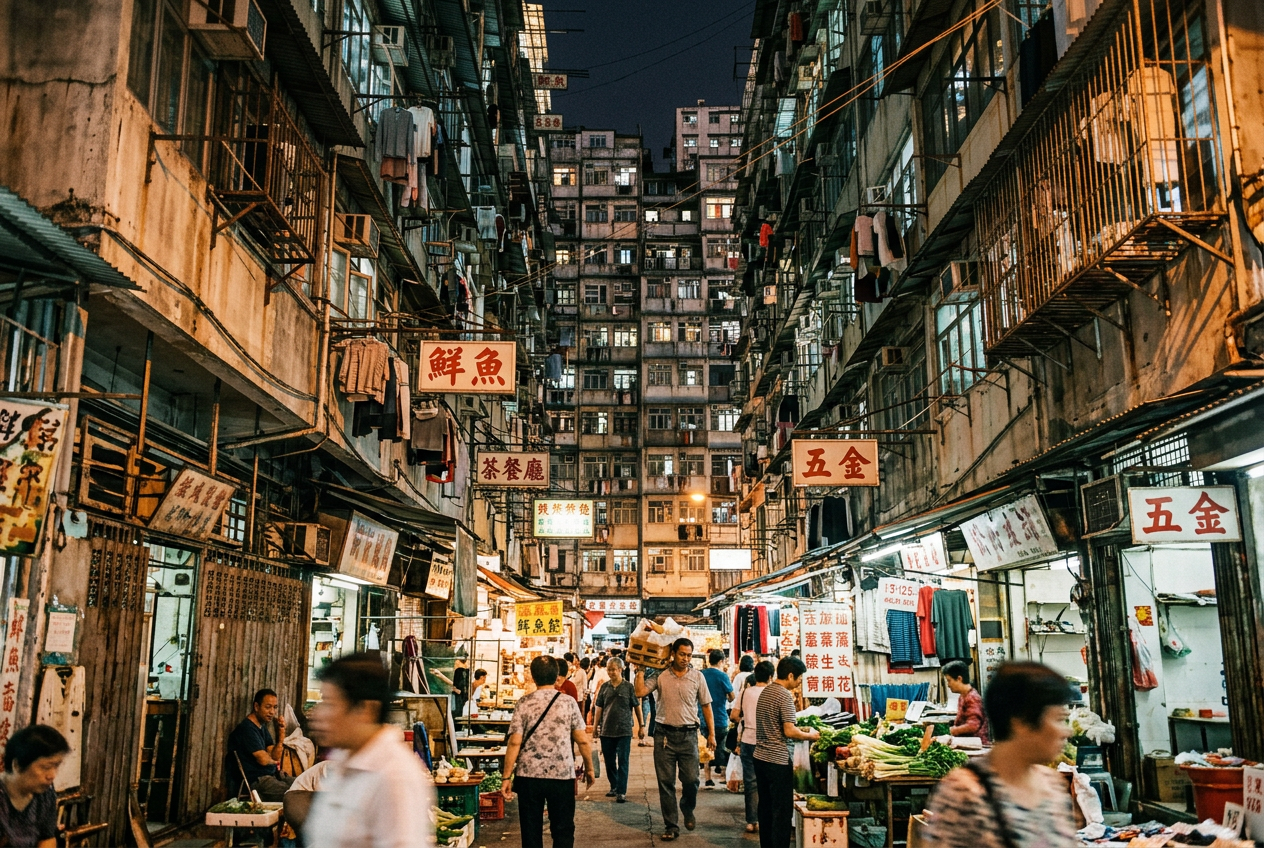
What was the most densely populated place on Earth before it was demolished in 1993?
- Kowloon Walled City
- Dharavi slum in Mumbai
- Tondo district in Manila
- Shibam in Yemen
Answer: Kowloon Walled City — Kowloon Walled City in Hong Kong reached a population density of 1,255,000 people per square kilometer at its peak—roughly 33,000 residents squeezed into a space barely the size of a city block. For comparison, Manhattan's density is only about 28,000 per square kilometer, and even the most crowded modern districts rarely exceed 100,000. The Walled City wasn't just the densest place in 1993; it remains the densest human settlement ever reliably documented in history, a record unlikely ever to be broken.
The Enclave That Fell Through the Cracks
Kowloon Walled City began as a Chinese military fort built in 1847 to enforce Qing authority in the New Territories, just outside British-controlled Hong Kong Island. When Britain leased the surrounding land in 1898, the treaty explicitly excluded the fort, leaving it under Chinese jurisdiction—a peculiar legal loophole that would shape the site's destiny. After the fort was abandoned in the 1940s, squatters moved in, and neither the British colonial government nor the Republic of China (later the People's Republic) exercised effective control. By the 1950s, the enclave had become a stateless zone, a 6.4-acre rectangle where neither government collected taxes, enforced building codes, or provided public services. Into this vacuum poured refugees from the Chinese Civil War, displaced families, and anyone seeking anonymity. With no zoning laws and no inspections, residents built vertically, each new floor balanced on the one below, until the entire block fused into a single colossal structure—walls shared, roofs interconnected, alleyways roofed over by the next tier of construction.
A City Built on Itself
By the 1980s, Kowloon Walled City comprised roughly 350 interconnected buildings rising 10 to 14 stories, all crammed into that original fort footprint. Sunlight reached only the perimeter; interior alleyways were lit by fluorescent tubes day and night, creating a perpetual twilight. Water came from rooftop tanks fed by a few wells and illegal taps into city mains; electricity was pirated from the grid through a spaghetti tangle of exposed wires that draped across every passage. Residents navigated by memory through the labyrinth—no maps existed, and no two floors aligned. Apartments measured as little as 100 square feet, often subdivided further by curtains or plywood partitions. Factories, dentists' offices, noodle shops, and unlicensed clinics operated side by side; one rooftop housed a kindergarten, another a makeshift temple. Fire was the omnipresent fear: the entire structure was wood, metal, and concrete pressed so tightly that firefighters could not enter, and residents formed their own brigades armed with buckets. Despite the chaos, a functioning community emerged—informal councils mediated disputes, merchants extended credit, and neighbors looked after one another's children.
The Lives Inside the Walls
Kowloon Walled City's reputation as a den of vice—opium dens, unlicensed gambling, dog-meat restaurants—was not invented, but it obscured the mundane reality that most residents were working families, small-business owners, and retirees who simply could not afford Hong Kong's soaring rents. Approximately 8,500 households called the Walled City home by 1987, the year a formal census was conducted. Doctors and dentists, unable to afford licenses or premises elsewhere, set up thriving practices; patients came from across Hong Kong for cheap fillings and surgeries. Factories produced fish balls, plastic flowers, and textiles around the clock, employing hundreds. The absence of regulation meant fourteen-hour shifts and child labor, but it also meant no red tape, no permits, no minimum lease terms—an economic ecosystem that functioned precisely because it was invisible to the state. Anthropologist Greg Girard and photographer Ian Lambot spent five years documenting the Walled City in the late 1980s, and their images reveal not squalor but adaptation: potted plants on balconies, laundry strung across air shafts, kids playing in stairwells, a grandmother rolling dumplings beside a makeshift shrine.
The Demolition and What Remains
In 1987, the British and Chinese governments—preparing for Hong Kong's 1997 handover—agreed to demolish Kowloon Walled City and relocate its residents. Compensation packages were negotiated, and by 1991 evictions began. Demolition commenced in March 1993 and took a full year; the interlocking construction meant the entire structure had to be dismantled floor by floor to prevent collapse into neighboring streets. By January 1994, the site was cleared, and in 1995 it reopened as Kowloon Walled City Park, a classical Chinese garden with pavilions, ponds, and the restored foundation stones of the original Qing fort. Nothing of the vertical city remains except photographs, a few salvaged doorframes displayed in the park's museum, and the memories of former residents. The Walled City's density record—1,255,000 people per square kilometer—stands unbroken, a spatial extreme unlikely to recur now that satellite surveillance and digital land registries make invisible cities impossible. Its legacy endures in cyberpunk fiction, video games, and architecture schools, where it is studied as both cautionary tale and proof of what communities can build when necessity overrides law.
What most people get wrong
Many assume Kowloon Walled City was controlled by organized crime. While triads did operate gambling dens and heroin labs in the 1950s and 1960s, a joint police crackdown in 1974 drove most criminal syndicates out, and by the 1980s the enclave was overwhelmingly populated by working families, small businesses, and retirees—chaotic and unregulated, but not lawless.
Word of the Day
anfractuous adjective · an-FRAK-choo-us
Full of twists and turns; winding and intricate, often maddeningly so. From the Latin anfractus, meaning 'a bending or turning,' the word originally described the coiled passages of the inner ear and the brain's convoluted surface—hence its medical echo—but by the 17th century it had migrated to geography, prose, and argument, always carrying the sense that the path ahead resists straightforward travel.
“The legal argument was so anfractuous that even the appeals court requested a summary. Hiking the anfractuous slot canyons of southern Utah, we lost the trail twice in an hour and relied entirely on cairns and luck.”
Joke of the Day
Why did the architect refuse to give tours of Kowloon Walled City?
Every floor plan was a work of fiction.
This Day in History
1770 — Captain James Cook's expedition aboard HMS Endeavour made first European contact with the eastern coast of Australia, landing at Botany Bay in what is now Sydney. Cook charted over 5,000 kilometers of previously unmapped coastline during the voyage, claiming the territory for Britain and naming it New South Wales. The encounter set in motion British colonization that began eighteen years later with the First Fleet, displacing the Aboriginal peoples who had inhabited the continent for more than 65,000 years and reshaping the political geography of the Pacific.
Enjoyed this issue?
Get the next one free, every morning.
More from Words IQ