Monday, October 5, 2026
Trivia of the Day
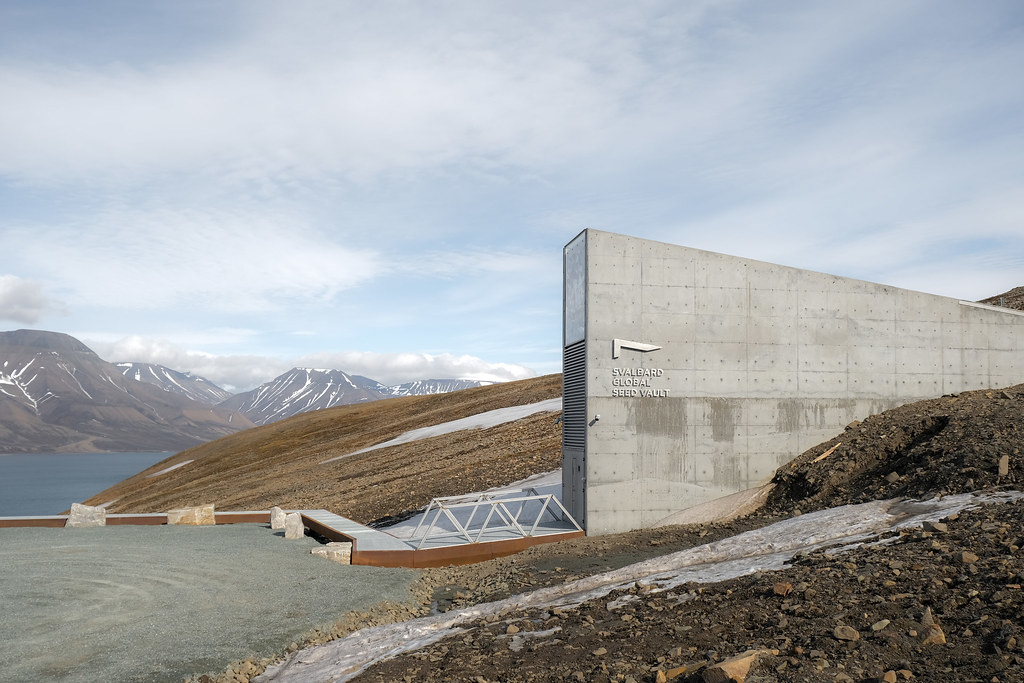
What Arctic facility was breached by melting permafrost in 2017, despite being designed to survive any disaster for thousands of years?
- Norway's Svalbard Global Seed Vault
- Canada's Doomsday Grain Reserve
- Iceland's Frozen Gene Archive
- Greenland's Perpetual Climate Bunker
Answer: Norway's Svalbard Global Seed Vault — In May 2017, the Svalbard Global Seed Vault—engineered to protect agriculture for millennia—experienced water intrusion when unseasonably warm temperatures melted permafrost and sent meltwater flooding into the entrance tunnel. No seeds were damaged, as the vault itself remained well below freezing, but the breach exposed a troubling irony: the very climate catastrophe the vault was built to withstand had arrived faster than anticipated, threatening the fortress meant to be humanity's insurance policy.
A Mountain Fortress for the Future
In February 2008, engineers carved a concrete-and-steel portal into the frozen mountainside of Spitsbergen, the largest island in Norway's Svalbard archipelago, roughly 800 miles from the North Pole. The Svalbard Global Seed Vault opened to safeguard duplicates of crop seeds from gene banks worldwide—a backup for agriculture in case of war, natural disaster, or the slow creep of climate change. The Norwegian government funded the construction, while the Global Crop Diversity Trust and the Nordic Genetic Resource Center manage operations. By 2017, the vault held more than 930,000 seed samples from nearly every nation, locked behind airlocks in a cavern kept at minus 18 degrees Celsius. Permafrost was supposed to act as a fail-safe: even if refrigeration failed, the Arctic cold would keep seeds viable for centuries. The location was chosen precisely because it was remote, geologically stable, and perpetually frozen.
The Day the Permafrost Betrayed Its Purpose
On May 19, 2017, maintenance workers discovered water pooling in the 100-meter entrance tunnel. Record-high winter temperatures—peaking near freezing when they should have been well below minus 10—had thawed the permafrost surrounding the tunnel and sent meltwater seeping through cracks in the rock. The water refroze into ice once it hit the tunnel's colder interior, creating a slick, irregular floor. No moisture reached the vault's three reinforced storage rooms, which remained at their target temperature, and no seeds were harmed. But the breach forced Norway's Statsbygg construction agency to install pumps, drainage ditches, and waterproof walls in the tunnel. Workers excavated trenches to divert runoff and added heat-monitoring sensors to track permafrost thaw in real time. The incident made global headlines precisely because it exposed the one assumption that underpinned the entire project: that Svalbard's permafrost would remain permanent.
The Irony of Climate Refuge
Svalbard is warming faster than almost any place on Earth—temperatures have risen by more than 3 degrees Celsius since 1971, and winter temperatures have jumped by 5 to 7 degrees. The archipelago's glaciers are retreating, snow cover is thinning, and permafrost is degrading at depths once considered stable. Scientists had predicted these changes, but not this quickly; climate models from the early 2000s did not foresee permafrost thaw reaching the vault's elevation within its first decade of operation. The 2017 breach was a wake-up call: the archive built to protect crops from a warming world was itself vulnerable to that same warming. Norwegian officials stressed that the seeds were never in danger, but the symbolism stung. If the planet's most secure seed vault could be compromised by climate change, what other fail-safes might fail?
The Vault's Mission Endures, with New Defenses
Today, the Svalbard Global Seed Vault continues to accept deposits—more than 1.2 million seed samples as of 2025, representing 13,000 years of agricultural history. After 2017, Norway invested millions in upgrades: a new concrete access tunnel with waterproof barriers, a dedicated emergency power building on higher ground, and round-the-clock monitoring of temperature and humidity. The vault has proven its worth in practice: Syria's gene bank withdrew and redeposited seeds during the civil war, Afghanistan retrieved samples after the Taliban's return, and researchers worldwide have used Svalbard duplicates to restore lost varieties. Yet the 2017 flood remains a reminder that no fortress is truly future-proof. The permafrost that once seemed eternal is now a variable, and the vault's engineers must adapt faster than the ice can melt.
What most people get wrong
Many believe the 2017 water intrusion damaged seeds or rendered the vault unusable. In fact, the floodwater never reached the seed chambers—everything remained frozen and viable—but the breach did force expensive tunnel upgrades and shattered the assumption that Svalbard's permafrost would stay solid indefinitely.
Word of the Day
pusillanimous adjective · pyoo-suh-LAN-uh-muhs
Lacking courage or resolution; timid, cowardly, or faint-hearted. Borrowed in the late 16th century from Late Latin pusillanimis ('having little spirit'), itself from pusillus ('very small') and animus ('spirit, courage'), the word originally described someone whose spirit was too small to meet the demands of honor or duty.
“The general's pusillanimous retreat abandoned thousands of civilians to the advancing army. In milder use, a pusillanimous apology—one that hedges and deflects—often does more damage than silence.”
Sponsored
A 60-second financial checkup
See what personal funding options you may qualify for.
Joke of the Day
Why did the seed vault refuse to hire a spokesperson after the 2017 flood?
It didn't want anyone spinning the permafrost meltdown.
This Day in History
1962 — On October 5, 1962, the first James Bond film—Dr. No—premiered in London, introducing Sean Connery as Agent 007 and launching a franchise that would span six decades. Ian Fleming's novels had sold modestly, but producers Albert Broccoli and Harry Saltzman gambled that a suave, violent spy could succeed on screen in the Cold War era. The film cost just over one million dollars, earned more than sixteen million at the box office, and established the template—exotic locations, gadgets, and a detached, lethal charm—that twenty-four sequels would follow. Dr. No's success turned Bond into a global icon and made Connery a star overnight.
Sponsored
Get paid for your opinion
You clearly like a good question — these pay you to answer them. Up to $8 a survey.
Enjoyed this issue?
Get the next one free, every morning.
More from Words IQ


