Sunday, November 15, 2026
Which sea animal transforms back into a child and starts over?
By Corey Lewis · Editorial standards
Trivia of the Day
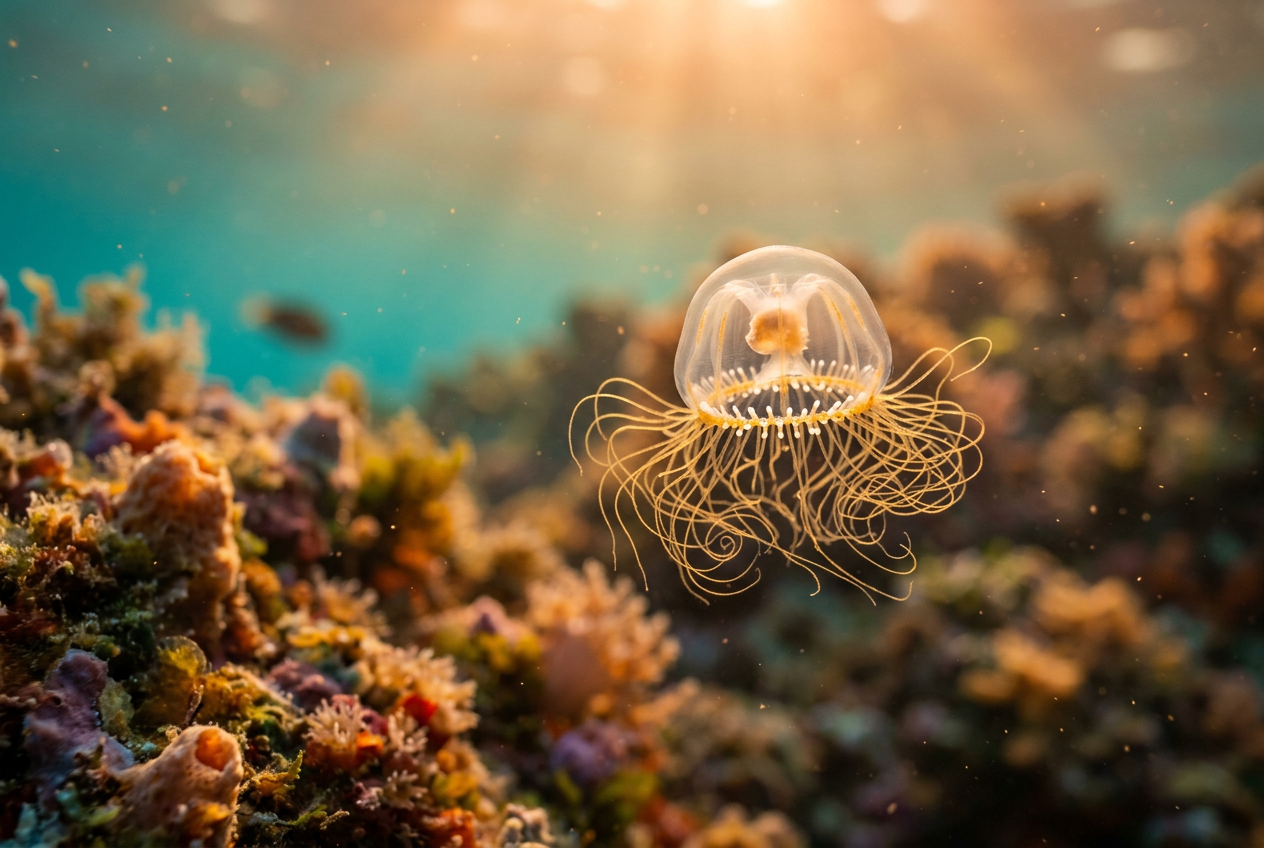
Which creature can reverse its aging process and return to its juvenile state, potentially living forever?
- the turritopsis dohrnii jellyfish
- the immortal lobster
- the regenerating hydra
- the ageless sea turtle
Answer: the turritopsis dohrnii jellyfish — When injured, starved, or simply old, turritopsis dohrnii sinks to the seafloor and rewrites its cellular identity—mature bell and tentacles reabsorb, and the animal reverts to a sessile polyp, the stage it occupied days after fertilization. From that polyp, genetically identical medusae bud off and resume adulthood, completing a loop no other animal is known to perform. The process can theoretically repeat forever, earning the species its 'biologically immortal' label, though in practice most are eaten by predators or succumb to disease long before testing the upper limit.
The Cellular Rewind
In 1996, German marine-biology student Christian Sommer was culturing hydrozoans in Rapallo, Italy, when he noticed something strange in a petri dish: adult Turritopsis dohrnii medusae—tiny, transparent bells barely five millimeters across—were not dying as expected but sinking to the bottom, reabsorbing their tentacles, and flattening into polyps, the juvenile life stage typically seen only after a fertilized egg settles on a rock. Sommer and his supervisor, Ferdinando Boero, published the observation in a 1996 paper that went largely unnoticed until Japanese researcher Shin Kubota spent years confirming the phenomenon in controlled lab conditions. Kubota documented the process frame by frame: within two days of stress—whether starvation, temperature shock, or physical injury—the bell deflates, the mesoglea thickens, and specialized cells called transdifferentiation factors reprogram mature tissue into stem-like pluripotent cells. Those cells then reorganize into a polyp, which buds off new medusae clones, each carrying the original genome. The reversion is not partial regeneration but a complete ontogenetic reversal, akin to a butterfly crawling back into a chrysalis and emerging as a caterpillar. No other metazoan—no vertebrate, arthropod, or mollusk—has demonstrated anything remotely similar, making turritopsis dohrnii the only animal known to escape the one-way arrow of development.
The Mechanics of Immortality
The cellular machinery behind the transformation centers on a process called transdifferentiation, in which one differentiated cell type converts directly into another without reverting to a stem-cell intermediate—a phenomenon once thought impossible in complex animals. When a turritopsis medusa experiences environmental stress, its muscle cells can become nerve cells, its digestive cells can become gonads, and its bell tissue can revert to the stolonic rootlike structure of a polyp. A 2022 study led by Maria Pia Miglietta at Texas A&M University sequenced the turritopsis genome and identified genes associated with DNA repair, telomere maintenance, and pluripotency—many of them duplicated or hyperactive compared to closely related jellyfish that age and die normally. The researchers found that turritopsis possesses twice the usual complement of genes for protecting chromosomes during replication and an unusually robust suite of tumor-suppressor genes, suggesting the animal has evolved fail-safes to prevent the cancerous chaos that normally derails wholesale cellular reprogramming. In lab trials, Kubota induced the cycle more than ten times in a single lineage, confirming the process is repeatable, though he noted that each reversion takes a metabolic toll—the polyp stage is smaller and produces fewer buds with every iteration, hinting that practical limits exist even if theoretical ones do not.
The Predator Problem and the Population Mystery
Biological immortality does not confer invincibility. Turritopsis dohrnii medusae drift in ocean currents with no armor, no speed, and no venom potent enough to deter predators—fish, sea slugs, and other jellyfish consume them by the thousands, and most never live long enough to experience old age, let alone trigger the reversal process. A 2011 survey off the coast of Japan found turritopsis polyps attached to ship hulls, harbor pilings, and floating debris, leading researchers to hypothesize that the species has hitchhiked across the globe in ballast water, establishing populations in the Mediterranean, the Caribbean, and the Pacific Northwest. Genetic analysis published in 2014 confirmed that Mediterranean and Japanese populations share near-identical haplotypes, suggesting a recent common ancestor and rapid anthropogenic dispersal within the past century. The ecological consequences remain unclear—turritopsis competes with native hydrozoans for substrate and planktonic prey, but its low caloric value and small size mean it exerts minimal predation pressure on fish larvae or copepods. What biologists find most puzzling is that despite its supposed immortality and global spread, turritopsis has not become a dominant species; ocean samples rarely turn up more than a handful of individuals, implying that environmental attrition—disease, osmotic stress, or simple bad luck—culls the population faster than iterative rebirth can compensate.
The Aging Research and the Philosophical Edge
The discovery of turritopsis dohrnii's life cycle arrived at a moment when gerontologists were beginning to view aging not as an inevitable decay but as a potentially modifiable process governed by gene expression, and the jellyfish became an unlikely mascot for longevity research. In 2020, a team at the University of Oviedo in Spain compared the methylation patterns of turritopsis DNA to those of the related—but mortal—Turritopsis rubra and found that the immortal species maintains youthful epigenetic marks even after repeated reversions, effectively resetting its biological clock with each cycle. The findings fed into broader investigations of senescence in humans, where researchers are exploring drugs that mimic the jellyfish's cellular reprogramming—compounds that strip away aging markers and restore pluripotency to damaged tissues. Yet the analogy has limits: humans are not modular colonies that can reabsorb limbs and regrow from a stump, and our neural architecture—our memories, personalities, identities—depends on stable cell lineages that a turritopsis-style reboot would erase. The jellyfish survives by forgetting, and the philosophical question it poses is whether immortality without continuity of self is immortality at all, or merely an elegant form of dying and being replaced by a genetic twin.
What most people get wrong
Many assume turritopsis dohrnii never dies and that the ocean must be swarming with ancient immortals; in reality, predation and disease kill most individuals long before they age, and the reversion process itself is a last-ditch stress response, not a routine event.
Word of the Day
iterative adjective · IT-er-uh-tiv
Relating to or involving repetition of a process or set of instructions, especially in which each cycle builds on or refines the previous one; from Latin iterare, 'to repeat,' itself from iterum, 'again.' In mathematics and computing, an iterative procedure generates successively closer approximations to a solution; in design and biology, iteration tests, learns, and adapts through repeated cycles.
“The sculptor worked in an iterative fashion, carving a rough form, stepping back to assess, then refining the contours in successive passes until the marble revealed the figure he envisioned. Software developers favor iterative releases—shipping a minimal product, gathering user feedback, and rolling out improvements in waves rather than waiting years for a single perfect launch.”
Joke of the Day
Why did the biologically immortal jellyfish refuse to buy a multi-year planner?
It kept reverting to polyp and losing track of which decade it was living in.','Because when your entire life strategy is 'start over from scratch,' long-term scheduling becomes an exercise in optimism.
This Day in History
1969 — The second manned Apollo mission, Apollo 12, landed on the Moon's Ocean of Storms on November 19, but four days earlier—on November 15, 1969—astronauts Charles Conrad and Alan Bean lifted off from Cape Kennedy in the middle of a rainstorm, and thirty-six seconds into the flight, lightning struck the Saturn V rocket, knocking out the spacecraft's fuel cells and sending every instrument into alarm mode. Conrad famously radioed, 'Okay, we just lost the platform, gang. I don't know what happened here,' while mission control scrambled to diagnose the electrical failure. Flight controller John Aaron recalled an obscure switch setting from a training simulation a year earlier and instructed the crew to flip the Signal Conditioning Equipment to auxiliary, which rerouted power and restored telemetry; the rocket's guidance computer had remained unaffected, and the mission continued. Apollo 12 went on to achieve a pinpoint landing within walking distance of the Surveyor 3 probe, demonstrating that NASA could target specific sites on the lunar surface—a capability essential for the later science-focused missions—and the lightning-strike recovery became a legendary example of quick thinking under pressure, though it also prompted stricter weather rules for future launches.
Enjoyed this issue?
Get the next one free, every morning.
More from Words IQ