Sunday, November 15, 2026
Trivia of the Day
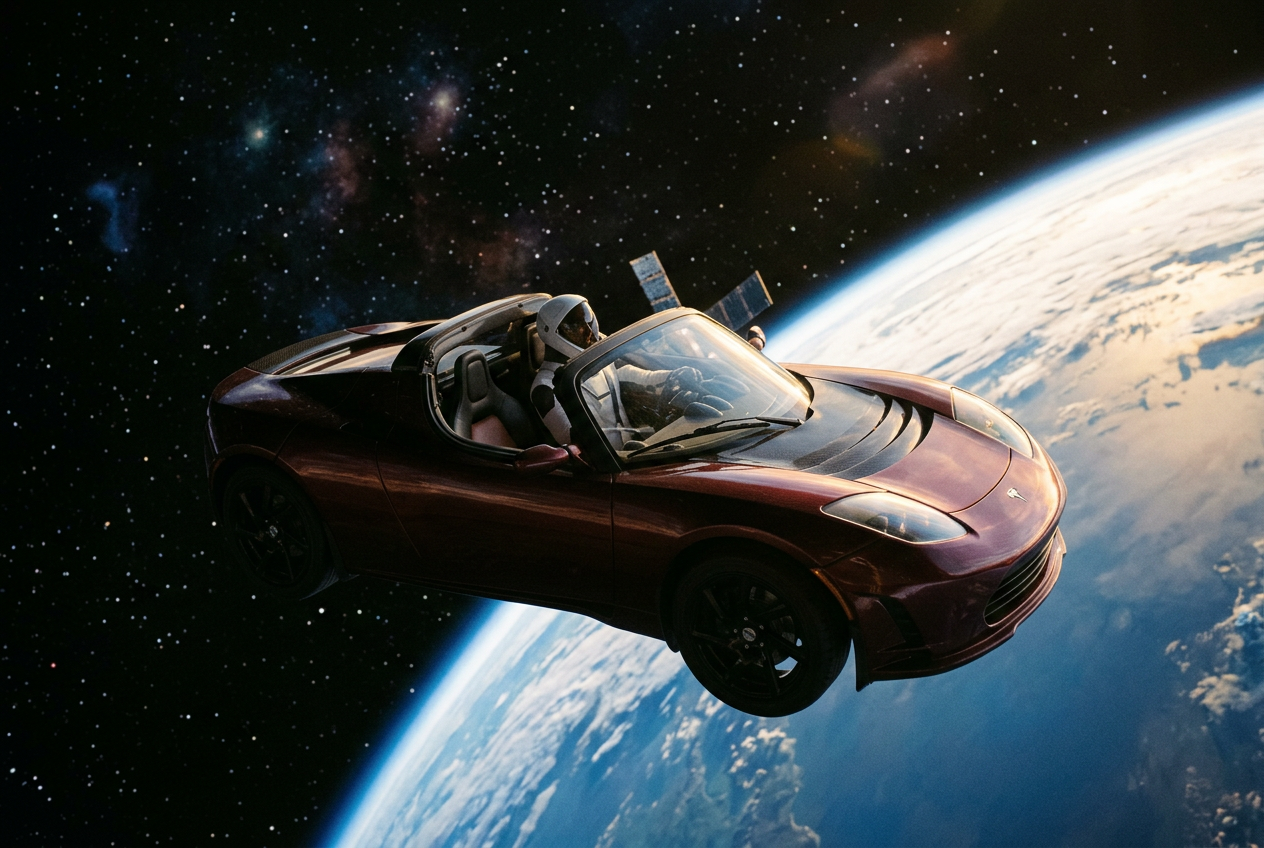
What vehicle became the first car launched into orbit around the Sun in 2018?
- Lunar Roving Vehicle replica
- Tesla Roadster in space
- SpaceX Dragon capsule mockup
- Chevrolet Corvette prototype
Answer: Tesla Roadster in space — Elon Musk's personal cherry-red Tesla Roadster has been orbiting the Sun since February 2018, launched aboard SpaceX's Falcon Heavy rocket as a dummy payload. The car carries a spacesuited mannequin named Starman in the driver's seat, a copy of Douglas Adams's *The Hitchhiker's Guide to the Galaxy* in the glovebox, and a circuit board etched with the names of 6,000 SpaceX employees. Astronomers predict the Roadster has a 6% chance of colliding with Earth within the next million years—and a 2.5% chance of hitting Venus first.
The Launch That Broke the Mold
On February 6, 2018, SpaceX's Falcon Heavy rocket lifted off from Kennedy Space Center's Launch Complex 39A—the same pad that launched Apollo 11 to the Moon. Strapped atop the world's most powerful operational rocket sat Elon Musk's personal 2008 Tesla Roadster, cherry red with white leather interior. The launch marked Falcon Heavy's maiden flight, and SpaceX needed a dummy payload to simulate the mass a real satellite would carry. Most companies use concrete blocks or steel slabs. Musk chose his car. The Roadster separated from the rocket's upper stage six hours after liftoff, already beyond the orbit of Mars, with David Bowie's "Space Oddity" playing on loop through the car's sound system. A spacesuited mannequin nicknamed Starman sat in the driver's seat, one arm resting on the open window frame, as cameras mounted on the car beamed back surreal images of a convertible drifting against the blackness of space with Earth shrinking in the background. The world watched, stunned, as a sports car became the most unconventional spacecraft ever launched. The Roadster's trunk carried a plaque reading "Made on Earth by humans," a nod to future archaeologists—or aliens—who might stumble upon it millions of years from now.
Where the Roadster Goes Now
The Tesla Roadster is not orbiting Mars, despite early headlines. It orbits the Sun in an elliptical path that crosses the orbits of Earth and Mars, swinging between 0.99 astronomical units from the Sun at its closest approach and 1.66 AU at its farthest—roughly 93 million to 155 million miles. The car completes one orbit every 557 Earth days. Astronomers at the University of Toronto tracked the Roadster's trajectory using radar and optical telescopes in the weeks after launch, refining its orbit to within a few kilometers. In March 2018, the car made its first close approach to Mars, passing within 5 million miles. It won't return to Earth's neighborhood until 2091, when it will pass within a few hundred thousand miles of our planet. Over millions of years, gravitational interactions with the planets will nudge the Roadster's orbit unpredictably. In 2018, a study published in *Astronomy & Astrophysics* calculated that the car has a 6% probability of colliding with Earth and a 2.5% chance of hitting Venus within the next million years. If it survives long enough, the Roadster could outlast human civilization, drifting as a monument to the absurdity and ambition of the 21st century.
What's Inside the Car Nobody Can See Anymore
The Roadster carries more than a mannequin. Tucked in the glovebox is a copy of Douglas Adams's science-fiction novel *The Hitchhiker's Guide to the Galaxy*, alongside a towel and a sign reading "DON'T PANIC"—references to the book's advice for interstellar travelers. A Hot Wheels toy Roadster sits on the dashboard with a tiny Starman figurine inside, a miniature version of the scene playing out in full scale. The car's circuit board is etched with the names of more than 6,000 SpaceX employees who worked on the Falcon Heavy project. Three cameras mounted on the car transmitted live video for roughly four hours after launch, until the batteries died and the feed went dark. Since then, no one has seen the Roadster except as a faint dot in telescopic images. The car is not transmitting data, and it has no propulsion or guidance system—it simply coasts, obeying Kepler's laws like any asteroid. The Sun's ultraviolet radiation is slowly degrading the car's paint, plastics and carbon-fiber body. Within a year, the red finish likely faded to pink, and the tires and seats are crumbling under bombardment by cosmic rays and micrometeorites. In a few million years, the Roadster may be reduced to a skeletal frame, a ghostly relic circling the Sun.
Why It Still Matters Today
The Roadster stunt was marketing genius wrapped in engineering spectacle. SpaceX needed to prove Falcon Heavy could work—three Falcon 9 boosters strapped together, generating more than 5 million pounds of thrust at liftoff, enough to send 64 tons to low Earth orbit or 17 tons to Mars. No company had flown a rocket this powerful since NASA retired the Saturn V in 1973. A failed test flight would have destroyed whatever payload sat on top, so using a real satellite made no financial sense. Musk's solution—launching his own car—turned a risky demo into a global media event, generating billions of dollars in free publicity and cementing SpaceX's reputation for audacity. The Roadster launch also marked a turning point in space accessibility. For the first time, a privately funded rocket rivaled the capabilities of government programs that once monopolized deep-space travel. Two of Falcon Heavy's three boosters landed back at Cape Canaveral in synchronized touchdowns minutes after launch, a feat that made reusable rockets look routine. The third booster missed its drone ship and crashed into the Atlantic, but the dual landing alone proved SpaceX could cut the cost of heavy-lift launches by reusing hardware. Today, Falcon Heavy has launched satellites, space station cargo, and Pentagon payloads, but none captured the world's imagination like the cherry-red Roadster sailing past Mars with Starman at the wheel.
What most people get wrong
Most people assume the Tesla Roadster is orbiting Mars or traveling toward Mars. In reality, it orbits the Sun in an elliptical path that crosses the orbits of both Earth and Mars, spending most of its time millions of miles from any planet.
Sources & further reading
Word of the Day
coruscate verb · KOR-uh-skayt
To give off flashes of light; to sparkle or glitter, often in a way that suggests brilliance or dazzling movement. Derived from the Latin *coruscare*, meaning "to vibrate or glitter," the word entered English in the 18th century and often describes light that flickers or dances rather than shining steadily—think of sunlight on water or the gleam of a freshly waxed car under spotlights.
“The Tesla Roadster's paint job coruscated under the camera lights during the prelaunch press conference, making the car look like a jewel before it became a space oddity. Her wit coruscated through the conversation, each remark sharper and brighter than the last.”
Joke of the Day
Why did the Tesla Roadster refuse to update its insurance policy after leaving Earth's orbit?
It figured collision coverage was pointless when the next fender-bender wouldn't happen for another 2.5 million years.
This Day in History
1315 — The Battle of Morgarten took place on November 15, 1315, when Swiss Confederate forces ambushed and routed a much larger army of Austrian knights in a narrow mountain pass near Lake Aegeri. The Austrians, clad in heavy armor and riding warhorses, expected an easy march through the pass to suppress the rebellious forest cantons of Uri, Schwyz, and Unterwalden. Instead, Swiss infantry rolled boulders and logs down the slopes, then attacked with halberds and pikes, slaughtering knights trapped in the confined terrain. The victory secured Swiss independence from Habsburg control and established the pike-and-halberd tactics that would make Swiss mercenaries the most feared infantry in Europe for the next two centuries. Morgarten became a founding legend of Swiss identity, celebrated as the moment when citizen-soldiers defeated feudal aristocracy through cunning and terrain advantage.
Enjoyed this issue?
Get the next one free, every morning.
More from Words IQ