Sunday, October 11, 2026
Romans believed their fire god's forge sat under an island—what word did we inherit?
By Corey Lewis · Editorial standards
Trivia of the Day
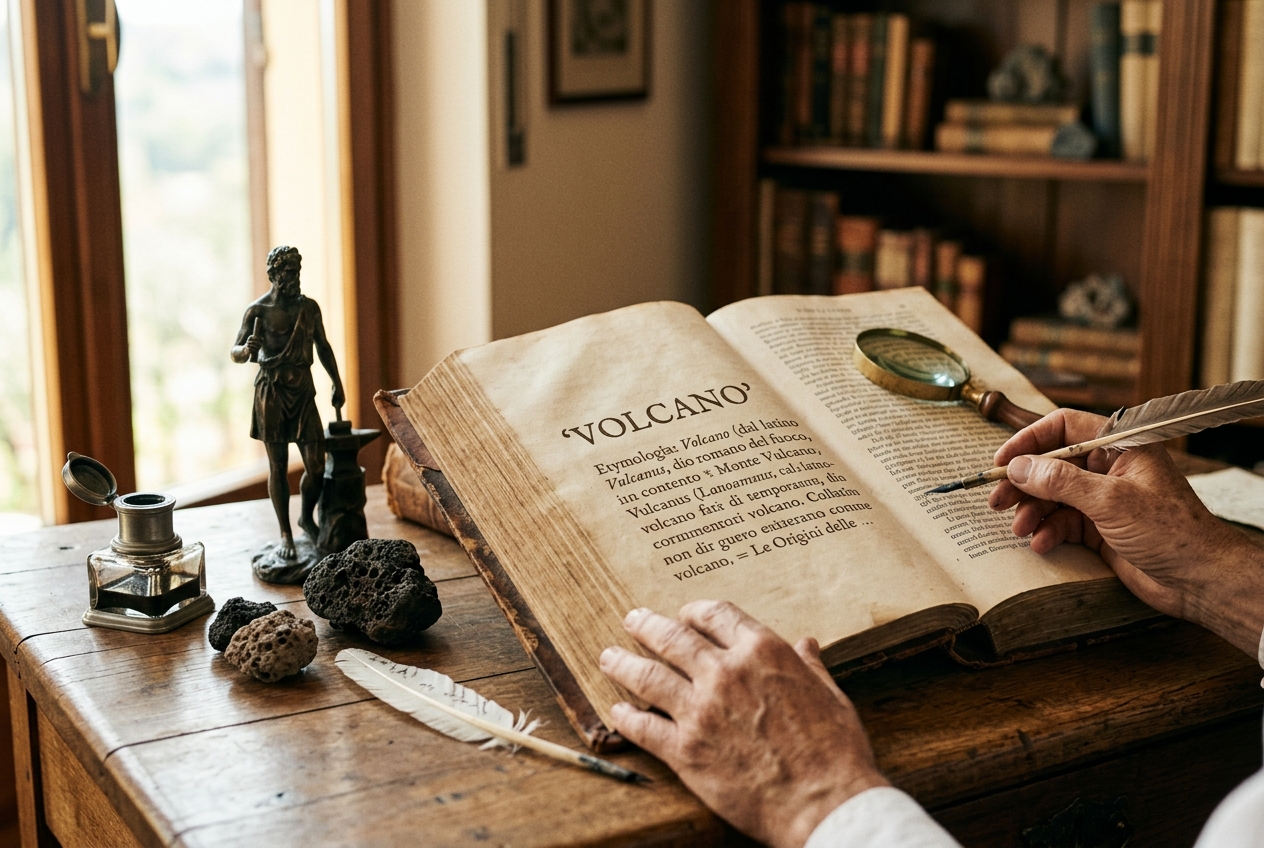
Which geological feature gets its name from the Roman god of fire, whose forge was believed to lie beneath a Mediterranean island?
- the word 'geyser'
- the word 'volcano'
- the word 'crater'
- the word 'magma'
Answer: the word 'volcano' — The word 'volcano' comes from Vulcan, the Roman god of fire and metalworking, whose underground workshop was thought to lie beneath Mount Vulcano in the Aeolian Islands off Sicily. Ancient Romans heard the mountain's rumblings and saw its smoke, and imagined the divine blacksmith hammering out thunderbolts for Jupiter and armor for the gods. That single island's name became the root for every fiery mountain on the planet—Vesuvius, Krakatoa, Mount St. Helens—all owe their English designation to one Roman deity's mythical forge, a reminder that our scientific vocabulary is built on layers of ancient storytelling.
The Divine Forge Beneath Vulcano
The Aeolian Islands rise from the Tyrrhenian Sea north of Sicily, a volcanic archipelago where the earth's crust is thin and restless. The island the Romans called Vulcano—modern Vulcano—smolders still, its fumaroles venting sulfurous steam, its crater a bowl of yellow and orange mineral deposits. To ancient Roman sailors and settlers, the mountain's constant smoke and periodic eruptions were unmistakable signs of industry below. They believed Vulcan, god of fire, metalworking, and the forge, kept his workshop in the mountain's heart, hammering out divine weapons and armor. The rhythmic rumblings were his anvil strikes; the glow at night, his furnace.
From Myth to Scientific Terminology
The term "volcano" entered scientific vocabulary through 16th-century Italian naturalists who observed Etna, Vesuvius, and the Aeolian peaks. By 1613, the word appeared in English texts describing mountains that expelled fire and molten rock. French scholar Pierre Gassendi used "volcans" systematically in his 1640s geological writings, establishing the term across European languages. The Royal Society formalized "volcano" in English scientific discourse by 1665, applying it to fire mountains worldwide—from Japan's Fuji to Mexico's Popocatépetl—based on their resemblance to Vulcano's behavior.
This linguistic evolution transformed a proper name into a common noun, much as "atlas" derived from the Titan or "cereal" from Ceres. The shift occurred as Renaissance scholars moved from mythological explanations toward empirical observation, yet they retained the Roman nomenclature as convenient shorthand for a geological phenomenon they were only beginning to understand through systematic measurement and comparison.
Vulcano's Modern Activity and Monitoring
Vulcano's most recent major eruption lasted from 1888 to 1890, producing violent Vulcanian-type explosions that ejected blocks of solidified lava and created the Fossa cone that dominates the island today. The volcano remains one of Europe's most closely watched geological features, with the Istituto Nazionale di Geofisica e Vulcanologia maintaining permanent monitoring stations since 1985. Seismometers detect micro-earthquakes; gas sensors measure sulfur dioxide and carbon dioxide emissions; thermal cameras track ground temperature fluctuations.
Crisis episodes in 1986, 1996, and 2021-2022 triggered evacuation plans when gas emissions spiked and seismic tremors intensified, though no full eruptions materialized. During the 2021 crisis, carbon dioxide concentrations reached 480 parts per million in residential areas, forcing authorities to close portions of the crater access. The island's 800 permanent residents live under Italy's civil protection protocols, with evacuation routes marked and regular emergency drills conducted quarterly.
The Broader Legacy in Earth Science
Vulcano's name extended beyond individual mountains to entire branches of geology. "Vulcanism" describes all processes involving magma movement and eruption; "vulcanology" became the scientific discipline's formal title by the 1820s. The term "Vulcanian eruption" now designates a specific eruption type characterized by short, violent explosions of viscous magma—defined precisely through observations at Vulcano itself during the 1888-1890 sequence. The German volcanologist Immanuel Friedlaender conducted groundbreaking gas chemistry studies on Vulcano in 1910, establishing protocols still used worldwide.
The Roman forge metaphor proved remarkably durable in scientific thought. Nineteenth-century geologists debated whether Earth's interior was molten or solid, describing the planet's heat as resembling a cosmic forge. Modern plate tectonics reveals the Aeolian arc forms where the African plate subducts beneath Eurasia—a geological process generating magma through friction and pressure, an actual forge of sorts, where rock melts and reforms. Today, over 1,500 active volcanoes worldwide bear a name derived from that single Mediterranean island where Romans imagined Vulcan's hammer striking divine metal, the ancient myth becoming the foundation of modern geological vocabulary.
What most people get wrong
Most pe op le assume 'vol cano' is a purely Greek word or that it comes from Vesuvius, the famous mountain that buried Pompeii in 79 AD. In fact, Vesuvius took its name from an older Oscan or Latin root, and 'volcano' specifically derives from the Roman fire god Vulcan and the island named for him. The Greeks had their own terms—'pyriphlegethon' for fiery regions—but it was the Latin 'Vulcanus' and the island 'Vulcano' that gave modern European languages their common word for eruptive mountains.
Sources & further reading
Word of the Day
scurrilous adjective · SKUR-uh-lus
Making or spreading scandalous claims about someone with the intent to damage their reputation; abusively insulting and coarse. From Latin 'scurrilis,' meaning buffoonish or vulgar, itself from 'scurra,' a jester or clown—originally someone whose humor was low and crude rather than clever.
“The tabloid published scurrilous allegations about the senator's personal life, none of which were backed by evidence. In the 18th century, pamphleteers traded scurrilous verses, each trying to outdo the other in colorful insults and scandalous insinuation.”
Joke of the Day
Why did the etymologist refuse to climb Mount Vulcano during the conference?
She didn't want to get fired from her job.
This Day in History
1982 — On October 11, 1982, the Spanish galleon Nuestra Señora de Atocha's main treasure pile was finally located off the Florida Keys by treasure hunter Mel Fisher, who had searched for sixteen years. The ship sank in a 1622 hurricane carrying forty tons of gold and silver, emeralds from Colombia, and coin minted in Spain and the New World. Fisher's crew brought up over $450 million worth of artifacts, coins, and bullion—one of the richest maritime finds in history. The discovery vindicated Fisher's stubborn refusal to give up, and the legal battle over ownership eventually established that finders have rights to treasure in international waters, reshaping salvage law.
Enjoyed this issue?
Get the next one free, every morning.
More from Words IQ


